
Overclocking ASUS PRIME GeForce RTX 5070 Ti
To overclock the ASUS PRIME GeForce RTX 5070 Ti video card, we utilized the latest version of ASUS GPU Tweak III. This is version 1.8.7.3 which supports GeForce RTX 50 series GPUs. This software allowed us to increase the Power Limit, the GPU Voltage, GPU frequency, and memory frequency. In addition, we could enable manual fan control, and even individualize fan speeds, but we kept them synced for our testing. ASUS GPU Tweak III allows hardware monitoring, as well as an OSD and fan profile configurations.
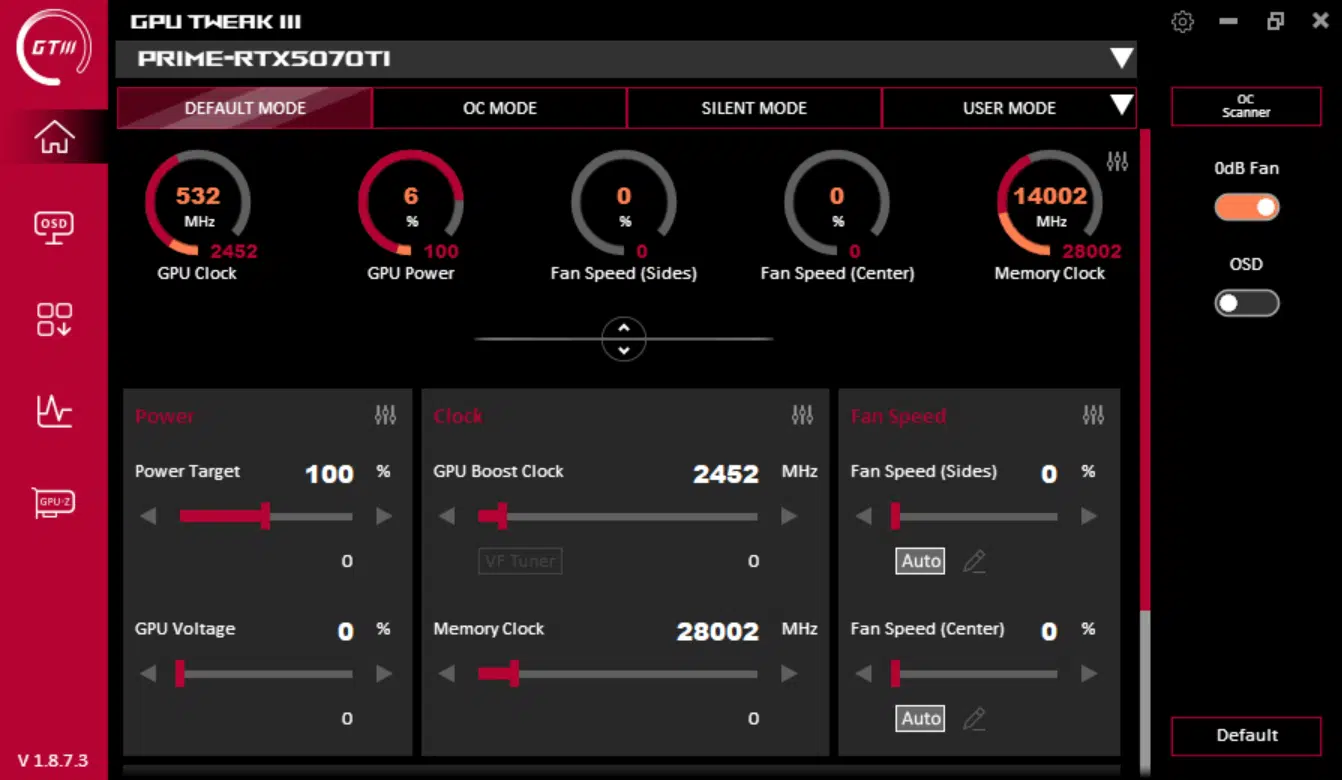
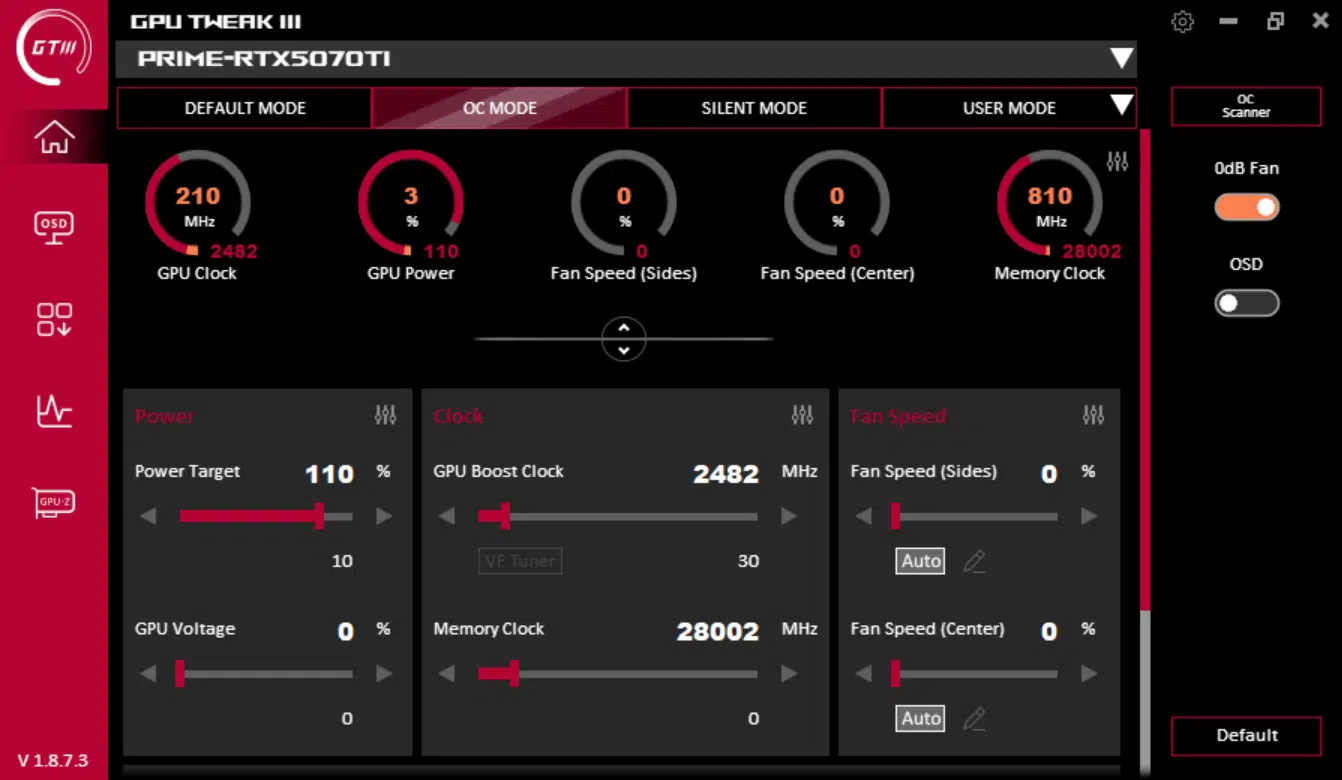
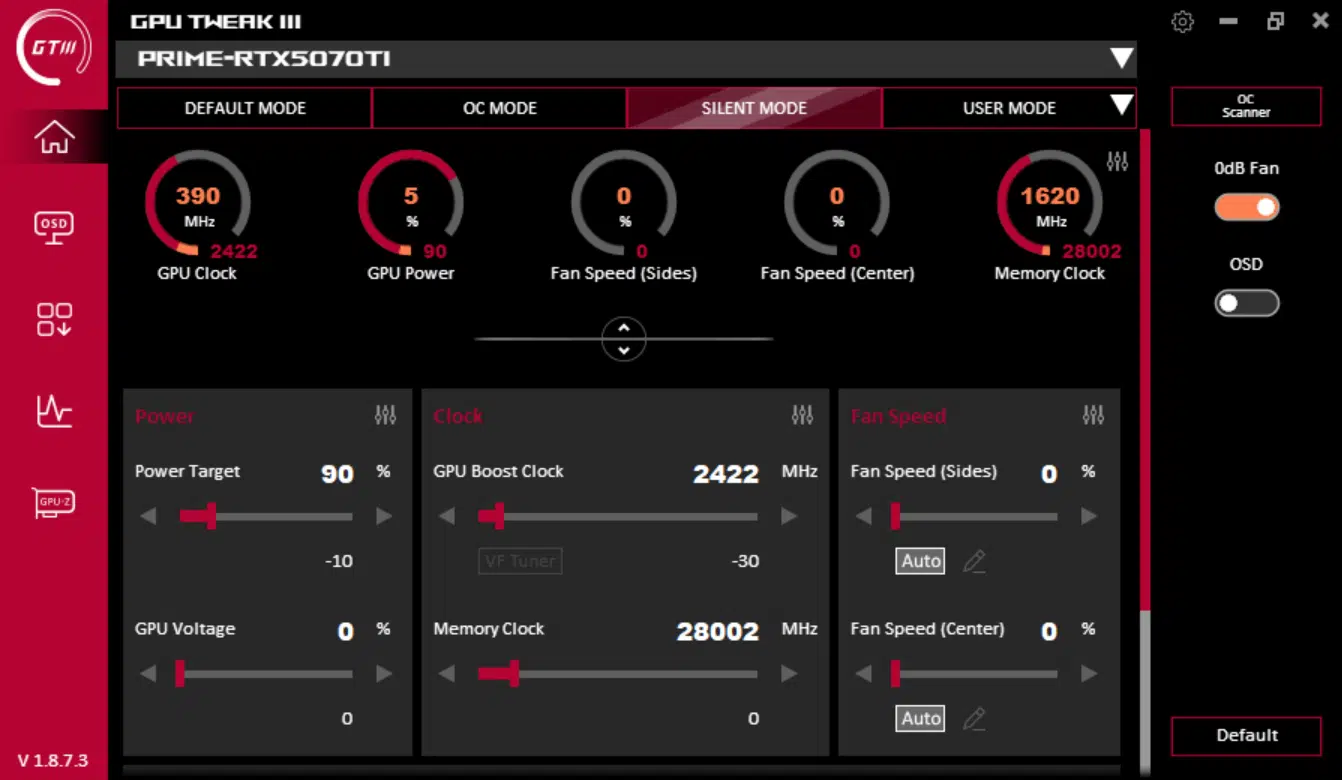
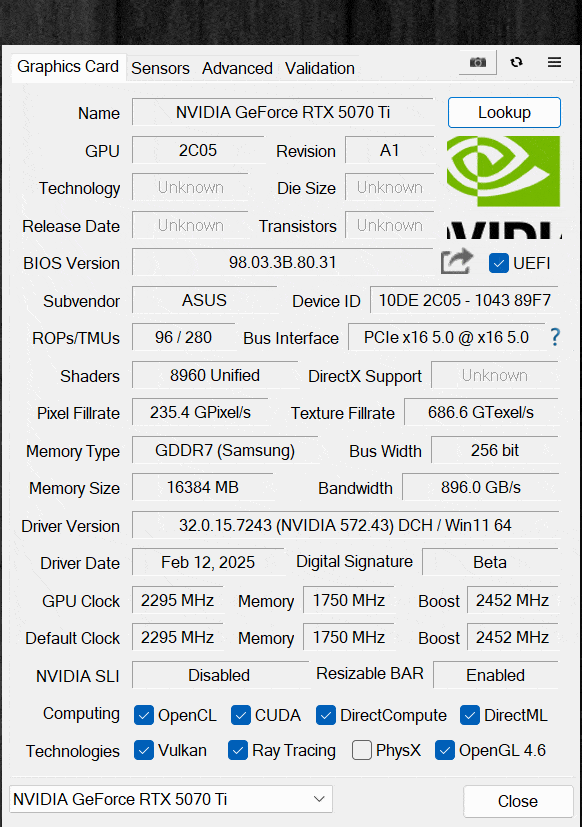
We mentioned that ASUS GPU Tweak III allows an OC Mode, it also has a Silent Mode in the software that you can enable on the ASUS PRIME GeForce RTX 5070 Ti. In OC Mode it bumps the Power Target up by 10% as well as the GPU Boost Clock up to 2482MHz. In Silent Mode, it downclocks the Power Target to 90% and the GPU Boost Clock to 2422MHz.
Highest Stable Overclock
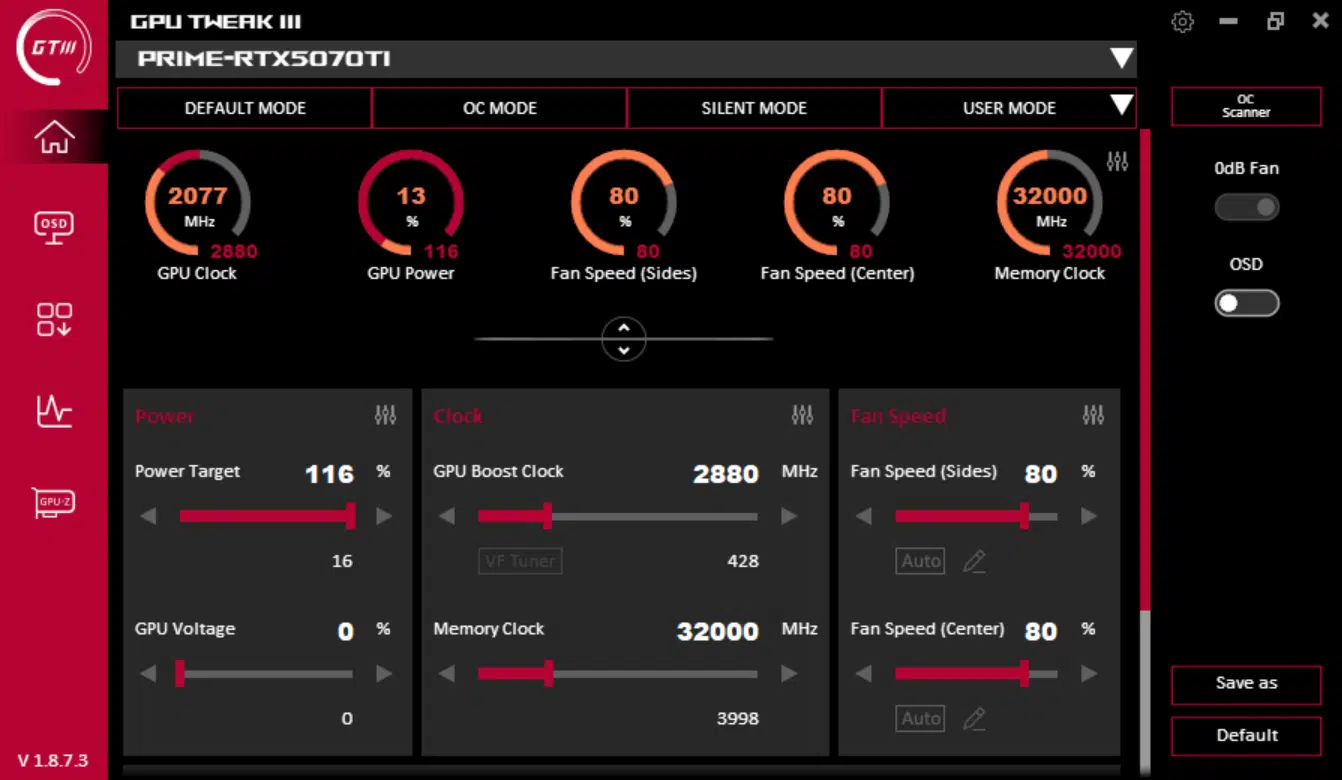
On the ASUS PRIME GeForce RTX 5070 Ti, we were able to increase the Power Target up to a high 16% increase, from 100 to 116%. This is the highest amount of power headroom we’ve had yet on any GeForce RTX 50 series video card. Previously, on the GeForce RTX 5090 or RTX 5080 the highest we saw on a partner card was 11% on an RTX 5080. Therefore, a 16% power target increase is a very positive enthusiast experience for overclocking. We were also able to set the fan speed, just to be sure of the highest overclock we set the fans to 80%.
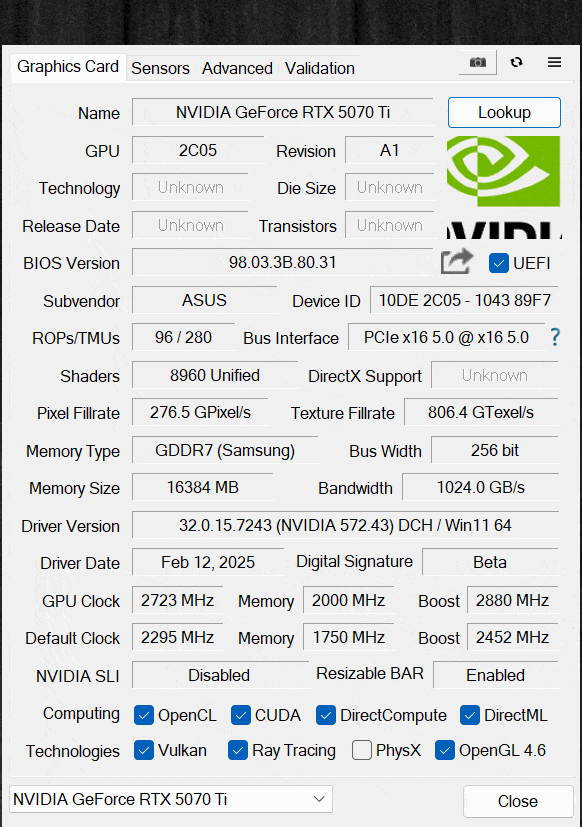
Above, you can see that the GPU Boost Clock we were able to set it to was 2880MHz. To see what this translates to into real-world GPU frequency see the graph below. You see, this video card, like all, supports NVIDIA GPU Boost, and the actual in-game clock frequency will be higher based on power and thermals, you’ll really be impressed by what frequency we hit when you look below.
Just a little context, we were able to push it up to 2900MHz in some situations, but after about 45 minutes of gaming, we did get one lock up with Ray Tracing enabled, so we backed it back down to 2880MHz to keep it stable. What about more Voltage you ask? Well yes, it did work, increasing the Voltage slider did work. However, we did encounter a weird thing that has also happened on some other RTX 50 series cards.
That is, when you increase Voltage, and also do that at a high GPU Boost Clock, or further adjust Boost Clock, some kind of protection mechanism kicks in and downclocks the GPU. The only way to overcome this is a complete system shutdown, turn it off completely, let power draw, and re-start, to clear it. We did manage to get more Voltage working with a lot of trial-and-error, but in the end, it only added about 20-30MHz more of frequency, and so we just didn’t find it that beneficial in this scenario. We opted to keep it off, which helped with the temperatures and meant we didn’t have to crank the fans up as high.
On the memory side of things, the default memory frequency is 28Gbps. We managed to easily, and I mean easily, just crank that up to 32Gbps and it worked without a hitch! That pushed the memory bandwidth up from 896 GB/s up to 1024 GB/s of memory bandwidth, breaking the 1TB/s barrier on a 5070 Ti!
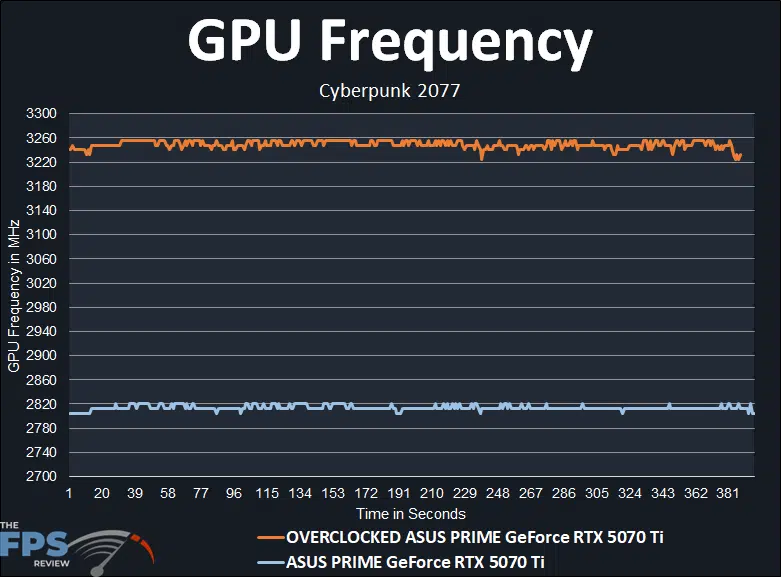
The default clock speed of the ASUS PRIME GeForce RTX 5070 Ti is 2452MHz. As you can see, at default, it actually operates higher in games, up to 2820MHz. The exact average is 2813MHz while gaming. That boosts it quite high over the reference clock, just because it cools so well and is built well for power delivery.
When we set the overclock to 2880MHz, well that boosts it way up to (no joke), 3.2GHz-3.3GHz while gaming! You can see in our graph it is hitting 3260MHz at the high end. When we set it to 2900MHz, it peaked just under 3.3GHz, and we also tried even higher and got it to show 3.3GHz at times, just not exactly stable. At any rate, at the 2880MHz setting in GPU Tweak III, the exact average we are getting above is 3248MHz!
The final overclock was 3248MHz/32Gbps (GPU/Mem).
Discussion (19 replies)
Join Discussion →Hey, I see that MSRP of 749... got a link where I can see it for that price. Not buy it because we ALL know that's impossible.
I have to take it back. Looking at Microcenters site it's been marked DOWN to 749.99 from the 899.99 price it was initially published at!
I wonder of J2C's video had an impact on that.
While I expected it to be much closer to the RTX 4080 vs the RTX 4070Ti, it's a nice card none the less.
From what I've gathered from other reviews, the 5070Ti likes 4k better than 1440p, where it seems to call for some driver optimizations, could be the best 4kDLSS card for the price.
No reason to get a 4070Ti and might wanna hold off getting a 4080Super until they come down in price.
There's also futureproofing with neural shaders and the other new fancy features Blackwell brings to the table.
I was betting it would be a great overclocker, very pleasant surprise.
Now let's see what AMD brings to the table. I'm expecting the 9700XT to be faster than the 5070Ti in raster with RTX4080Super level of performance.
There's no reason getting a 4070TiS or 4080S because they are completely OOS everywhere other than China.
Why no 4k benchmarks?
what would it change
Some folks are under the impression it provides a better 4k experience. *shrugs*
compared to the 4070Ti super, it does.
I would not be too thrilled about the 5070 Ti's 4K gaming performance, to be honest. It would most definitely require DLSS to be enabled, and RT would be a pipedream.
From what I've seen, 4k gaming is within reach in several games even without DLSS, but RT is pretty much out of the question even with DLSS. well... actually there's multiframe generation, but, really?
I'd run it at 4k if that's what I had to work with, DLSS and MFG if I had to. Remember older games / slower games are still fine, but make for less interesting benchmarks ;).
Plenty 4080 super in stock here, for only 1.599€ and up, still cheaper then the 5080's
We have basically zero rolling stock in the US. It's sold out as soon as it's listed.
Yeah, but if you want to play newer games... Also consider people keep their cards maybe 2+ years, so you are talking about new game releases in 2025, 2026, and maybe 2027 that you'll be playing on it.
Restocking is done in the U.S. since production has ceased. There are no more new units to be had. 4000 series is deadski.
on a side note, apparently this "MSRP" card is being listed for $1,000 and up