
FSR 3 vs FSR Redstone (ML/FSR 4) – Black Myth: Wukong
Black Myth: Wukong exists on both the AMD FSR Redstone ML-Upscaling supported game list and AMD FSR Redstone ML-Frame Gen supported game list from AMD. This allows us to toggle between FSR 3.1 and FSR 4 (ML-Powered modes) by using the AMD Adrenalin software control panel.
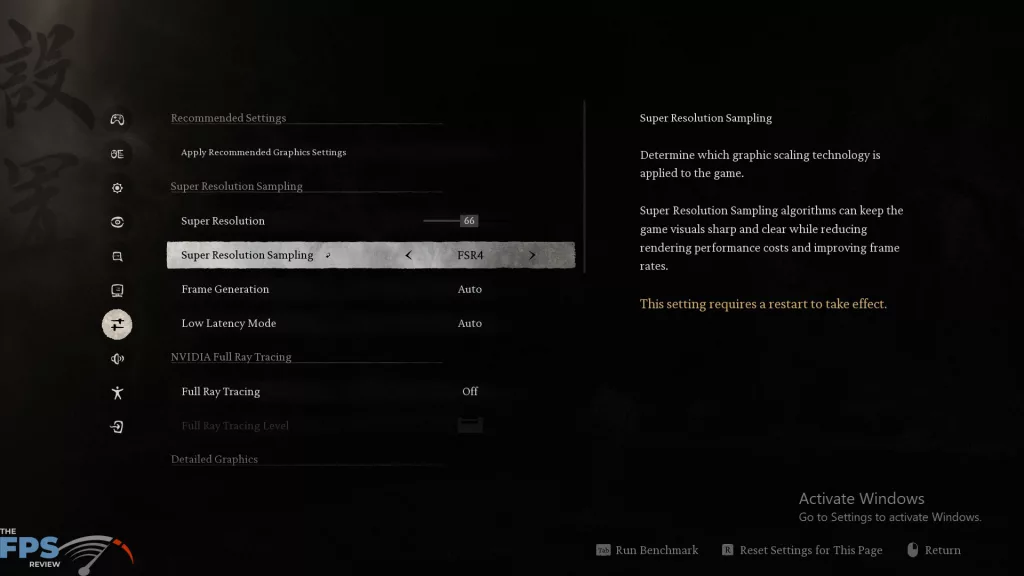
When we have ML-Upscaling and ML-Frame Gen disabled in the control panel, the game defaults to the anaytlical model of FSR 3 Upscaling and FSR 3 Frame Gen. When we toggle the options back to Enabled in the driver control panel, we now have the “FSR4” option under “Super Resolution Sampling” in the game, and then we can set the Super Resolution scale. When ML-Frame Gen is enabled in the driver, it will override the Frame Generation version in the game and run ML-Frame Gen. We can verify this in the image quality difference experienced, as well as the performance, and by hitting ALT+R to verify the features are enabled.
For this game, we utilized the built-in benchmark to get our results, and we used the 5% Lows result for this one. We also found that due to this game being very demanding, we had to lower the in-game graphics quality setting to “Very High”, else it would bottleneck the GPUs at Native Resolution at each respective resolution, due to the demanding nature of the graphics demand in this game.
AMD Radeon RX 9070 XT
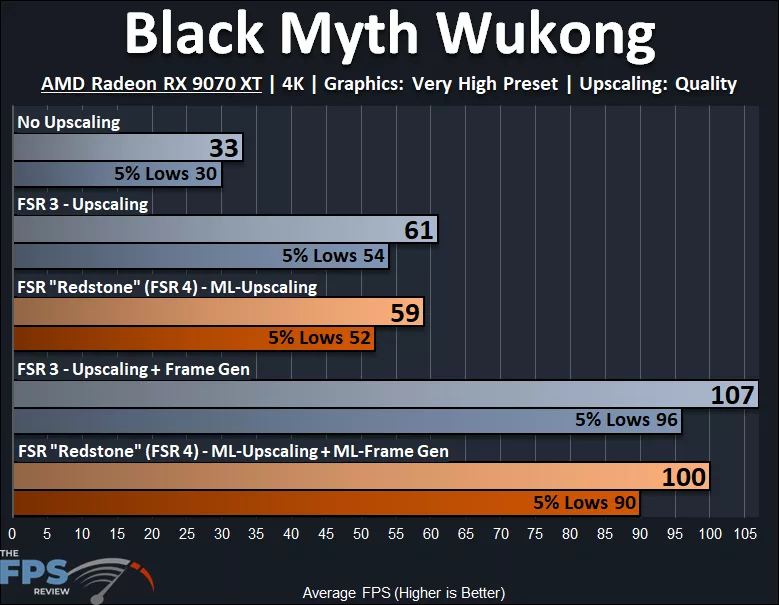
In Black Myth: Wukong, we are running the game at 4K resolution on the “Very High” graphics preset on the Radeon RX 9070 XT. Using the benchmark, at native resolution, performance averages only 33FPS, so very unplayable, even at this lowered graphics setting preset at 4K. When we enable analytical FSR 3 Upscaling, the average is now at a playable level of 61FPS, an increase of 85% to performance, and the 5% Lows also increase. When we enable FSR 3 Frame Generation on top of that, the AVG FPS number increases to 107FPS, a 75% increase, but remember this is not more performance, but rather more smoothing. The 5% Lows do increase in this game with FSR 3 Frame Gen, and the spread between the 5% Lows and AVG is still close together.
When we specifically enable the new ML-Upscaling (FSR Redstone/FSR 4) upscaling component, we see that it increases performance from native resolution by 79%, a bit less than FSR 3 Upscaling. The 5% Lows also increase from native resolution. Therefore, we do find that ML-Upscaling is about 3% slower on AVG compared to FSR 3 Upscaling, with a 4% slower 5% Low. When we enable ML-Frame Generation the increase in framerate from just ML-Upscaling is 69% more smoothing, and we do see the 5% Lows increase from Upscaling. Therefore, this means ML-Frame Gen is also slower than FSR 3 Frame Gen, by 7% AVG FPS slower, and 6% slower 5% Lows.
AMD Radeon RX 9070
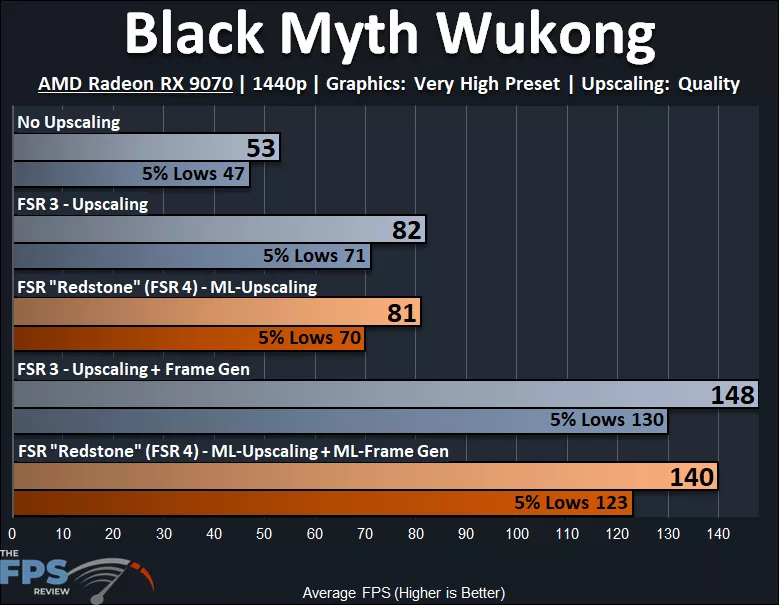
In Black Myth: Wukong, we are running the game at 1440p resolution on the “Very High” graphics preset on the Radeon RX 9070. Using the benchmark, at native resolution, performance averages 53FPS, which is not exactly playable, with 5% Lows at 47. Enabling FSR 3 Upscaling improves performance to playable levels, with a 55% performance increase, and 5% Lows increase 51%. Enabling FSR 3 Frame Generation further increases AVG FPS by 80%, and 5% Lows also increase, with a close nature between 5% Lows and the AVG FPS.
When we enable the new AMD FSR Redstone/FSR 4 ML-Upscaling, performance increases over native resolution by 53%, and 5% Lows increase by 51%. We can see that ML-Upscaling is 1FPS behind FSR 3 Upscaling, or 1% slower. When we enable ML-Frame Generation AVG FPS increases over Upscaling by 73%, and 5% Lows also increase. We can see that ML-Frame Generation is slower than FSR 3 Frame Generation by 5% on AVG and on 5% Lows.
AMD Radeon RX 9060 XT
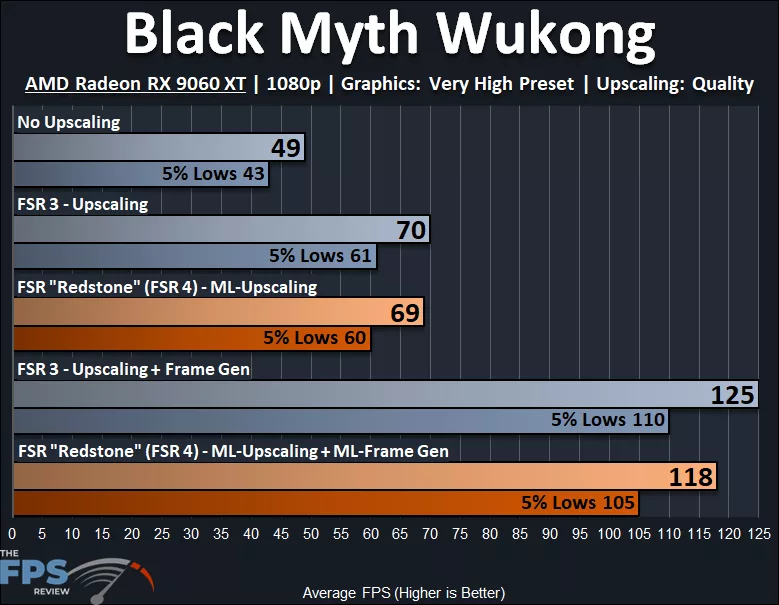
In Black Myth: Wukong, we are running the game at 1080p resolution on the “Very High” graphics preset on the Radeon RX 9060 XT. At native resolution, the Radeon RX 9060 XT provides 49FPS AVG, and 43FPS 5% Lows. The game is not playable at this quality setting at 1080p. When we enable FSR 3 Upscaling, the game does become playable with a 43% performance increase, and 5% Lows are also at 60FPS with a 42% performance increase. When we enable FSR 3 Frame Generation, the AVG FPS goes up 81%, and the 5% Lows also increase, and the Lows and AVG are close.
When we enable AMD Redstone/FSR 4 ML-Upscaling, performance increases over native resolution by 41%, and 5% Lows also increase. Similar to the Radeon RX 9070, ML-Upscaling is 1-FPS behind FSR 3 Upscaling, with only a 1% difference. When we enable ML-Frame Generation the AVG FPS increase is 71% from Upscaling, and 5% Lows are improved with a close distance between Lows and AVG. However, we can see that ML-Frame Gen is slower than FSR 3 Frame Gen by 6% on the Radeon RX 9060 XT. The 5% Lows are also 5% slower.
Overall, the Radeon RX 9060 XT takes the biggest hit on performance for ML-Frame Generation. In ML-Upscaling, the Radeon RX 9070 XT does at 4K resolution, with that being more demanding. This game only shows 5% Lows, but in the other games on the next several pages, we will show the 1% Lows, and after Call of Duty, they will all be manual run-throughs.