
FSR 3 vs FSR Redstone (ML/FSR 4) – Cyberpunk 2077
Cyberpunk 2077 exists on both the AMD FSR Redstone ML-Upscaling supported game list and AMD FSR Redstone ML-Frame Gen supported game list from AMD. This allows us to toggle between FSR 3 and FSR 4 (ML-Powered modes). In this game, there is a dedicated “FSR 4” option in the game menu to enable FSR 4 as long as it is turned on in the AMD Adrenalin software control panel.
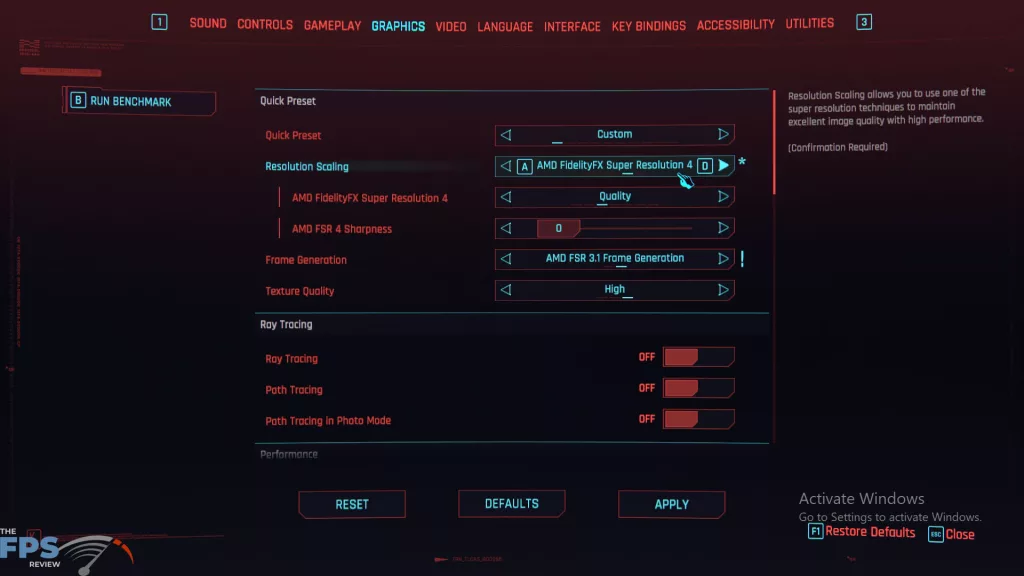
When we have ML-Upscaling and ML-Frame Gen disabled in the control panel, the game only displays FSR 3 and defaults to the anaytlical model of FSR 3 Upscaling and FSR 3 Frame Gen. When we toggle the options back to Enabled in the driver control panel, we can go back into the game and now select the FSR 4 mode, and with ML-Frame Gen turned on in the control panel it will override Frame Gen and make it the ML-Frame Gen version. We can verify this in the image quality difference experienced, as well as the performance, and by hitting ALT+R to verify the features are enabled. For this game, we ran a manual run-through and we are showing the 1% Lows.
AMD Radeon RX 9070 XT
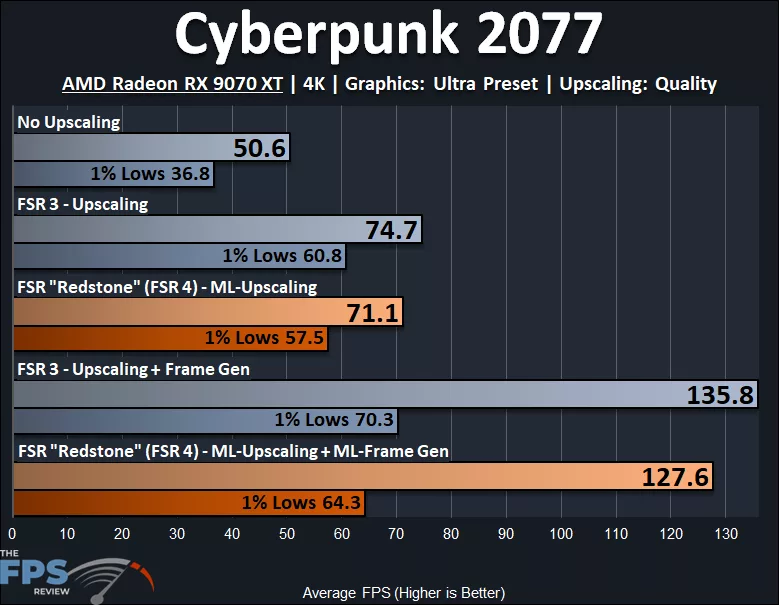
In Cyberpunk 2077, we are running the game on the “Ultra” preset at 4K on the AMD Radeon RX 9070 XT. We are using a long manual in-game run-through in this game for these results. The AMD Radeon RX 9070 XT averages 50.6FPS at native resolution with 1% Lows at unplayable levels of 36.8FPS. When we enable FSR 3, Upscaling performance increases by 48%, and 1% Lows increase by 65%. With the 1% Lows at 60FPS this game is now responsive and playable. When we enable FSR 3 Frame Generation, smoothness increases by 82%, and 1% Lows only increase by 16%.
What you will see that happens is that the difference or distance between the 1% Lows and the AVG FPS is much wider/greater with Frame Generation enabled vs with just Upscaling. In other words, the distance between the 1% Lows and AVG FPS with just Upscaling is 13.9, while the distance between the 1% Lows and AVG FPS with Frame Generation is 65.5. It is this greater distance that makes Frame Gen “feel” the way it does; greater distance means wider swings in FPS, means more lag, means worse latency, etc…
When we enable AMD FSR Redstone/FSR 4 we see performance increases 41% over native resolution, with 1% Lows increasing by 56%. The 1% Lows don’t quite make it to 60FPS as they did with FSR 3. With FSR 4 ML-Upscaling, the Radeon RX 9070 XT is 4% slower than with FSR 3, and 1% Lows are 5% slower. When we enable ML-Frame Gen, the smoothness increase is 79%, and 1% Lows only increase 10%. When we compare this to FSR 3 Frame Gen, we find ML-Frame Gen to be 6% slower and 1% Lows to be 9% slower, which is a more significant of a difference, bringing it almost back to that 60FPS level. The spread between 1% Lows and AVG is also wider than with just Upscaling.
AMD Radeon RX 9070
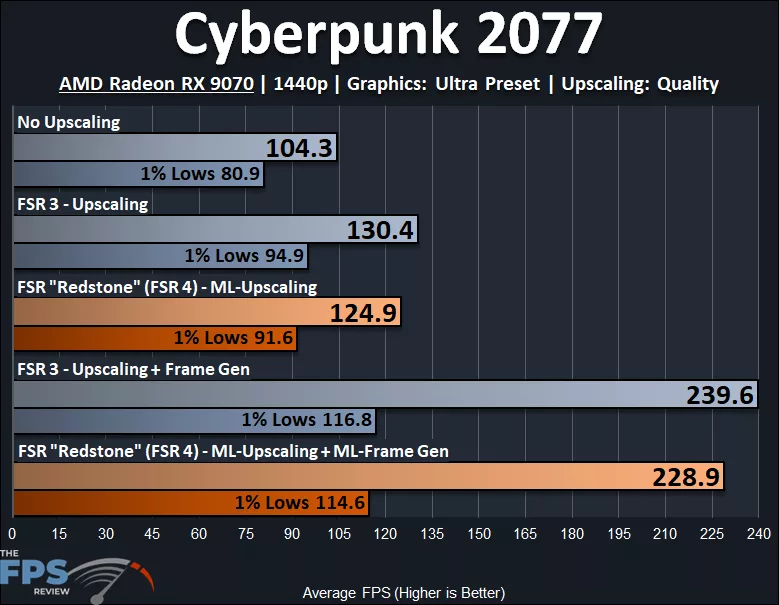
In Cyberpunk 2077, we are running the game on the “Ultra” preset at 1440p on the AMD Radeon RX 9070. We are using a long manual in-game run-through in this game for these results. The AMD Radeon RX 9070 is able to provide 104.3FPS AVG and 80.9FPS 1% Lows for a playable experience at 1440p native resolution. When we enable FSR 3 Upscaling, the game’s performance is improved by 25%, and the 1% Lows are improved by 17%. When we enable FSR 3 Frame Generation, smoothness is improved by 84%, and the 1% Lows improve by 23%, but the spread is wider.
When we enable AMD FSR Redstone/FSR 4 ML-Upscaling, performance over native resolution is a small and much less 20% advantage in Quality mode. The 1% Lows increase by only 13%. This is therefore slower than FSR 3 by 4% on AVG and 3% on 1% Lows. When we enable ML-Frame Generation, the smoothness over ML-Upscaling is 83%, and the 1% Lows improve by 25%. However, this is slower than FSR 3 by 4% on AVG and 2% on 1% Lows.
AMD Radeon RX 9060 XT
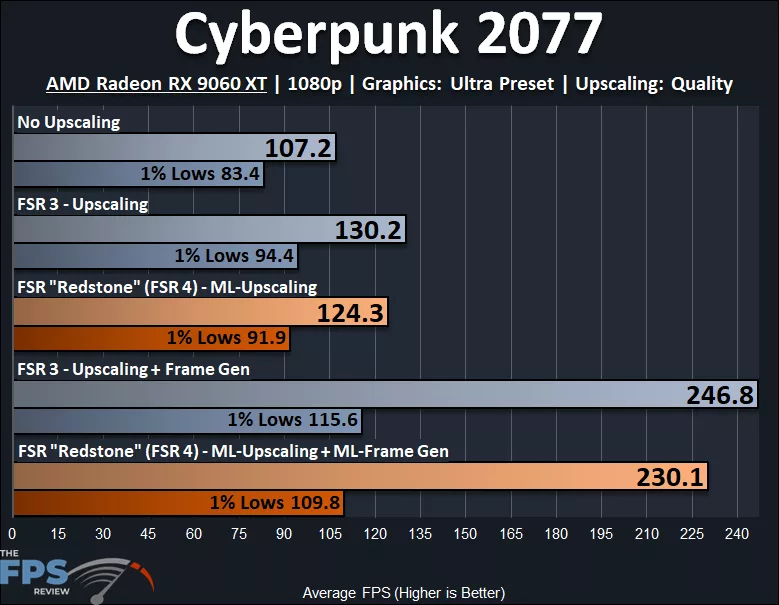
In Cyberpunk 2077, we are running the game on the “Ultra” preset at 1080p on the AMD Radeon RX 9060 XT. We are using a long manual in-game run-through in this game for these results. The AMD Radeon RX 9060 XT is able to provide a playable experience at native resolution 1080p at 107.2FPS AVG and 83.4FPS 1% Lows. When we enable FSR 3, Upscaling performance increases by 21% on AVG and 13% on 1% Lows. When we enable FSR 3 Frame Generation, the smoothness improves by 90%, and 1% Lows improve by 22%.
When we enable AMD FSR Redstone/FSR 4 ML-Upscaling, performance over native resolution is a lower 16% AVG FPS, higher, and 10% higher 1% Lows. This is therefore slower than FSR 3 by 5% on AVG and 3% 1% Lows. When we enable ML-Frame Gen, we see a smoothness improvement of 85% and a 1% Low improvement of 19%. However, we do find it takes a toll compared to FSR 3 Frame gen, with ML-Frame Gen being 7% lower on AVG and 5% lower on 1% Lows.