
Introduction
AMD is leading CES once again with a Keynote at CES 2026, with new product announcements here at the beginning of the year. Most of these are a continuation of the product lines already existing, with some new products in those stacks now being added. We aren’t seeing any new architectural launches or radical changes, but rather building on an existing ecosystem that AMD has in place for 2026.
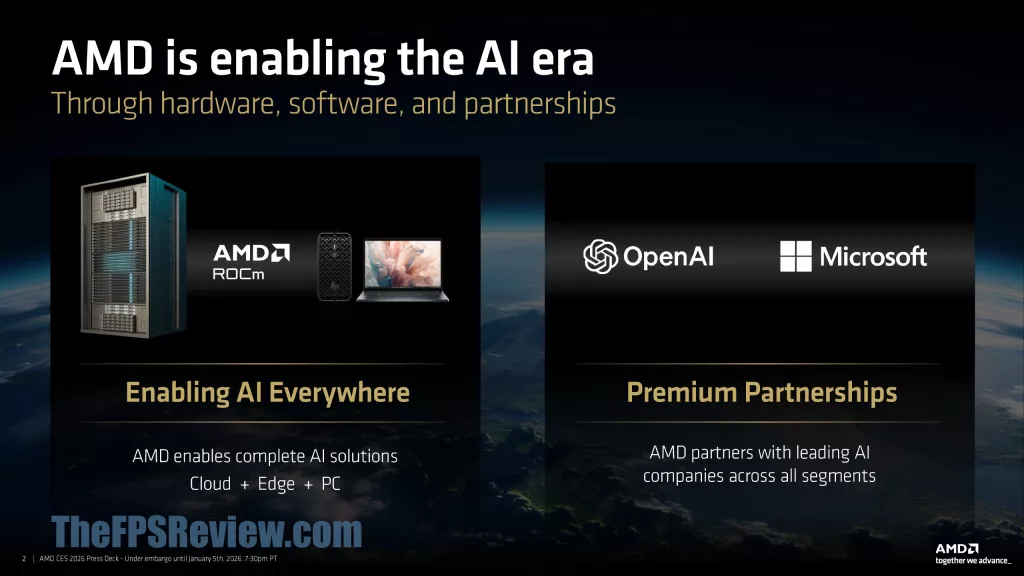
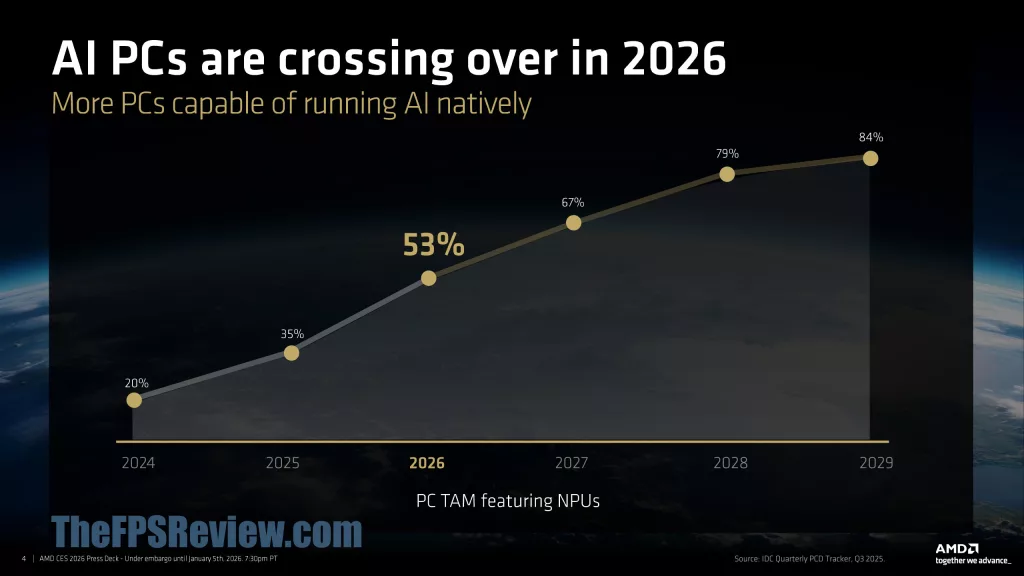
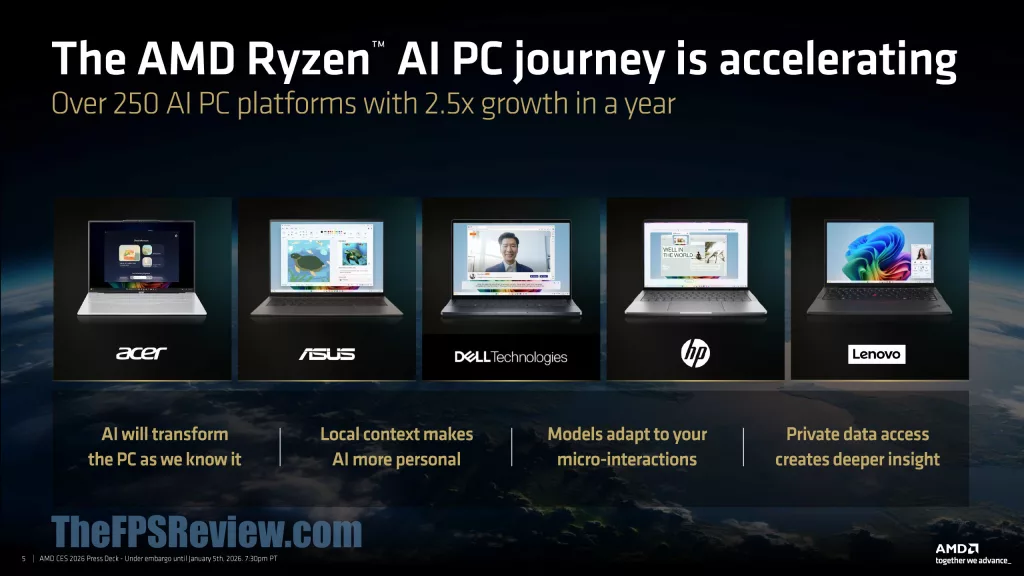
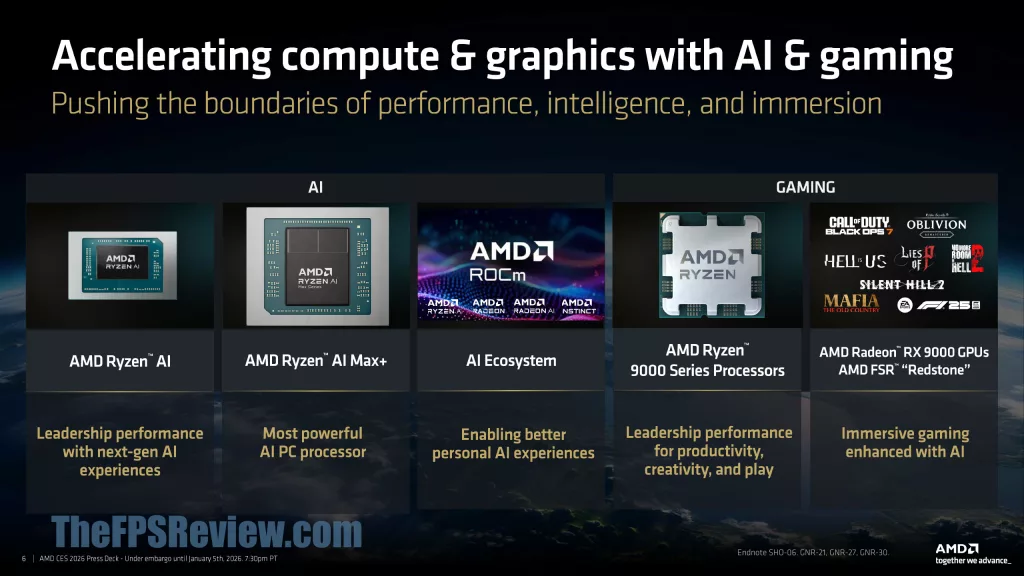
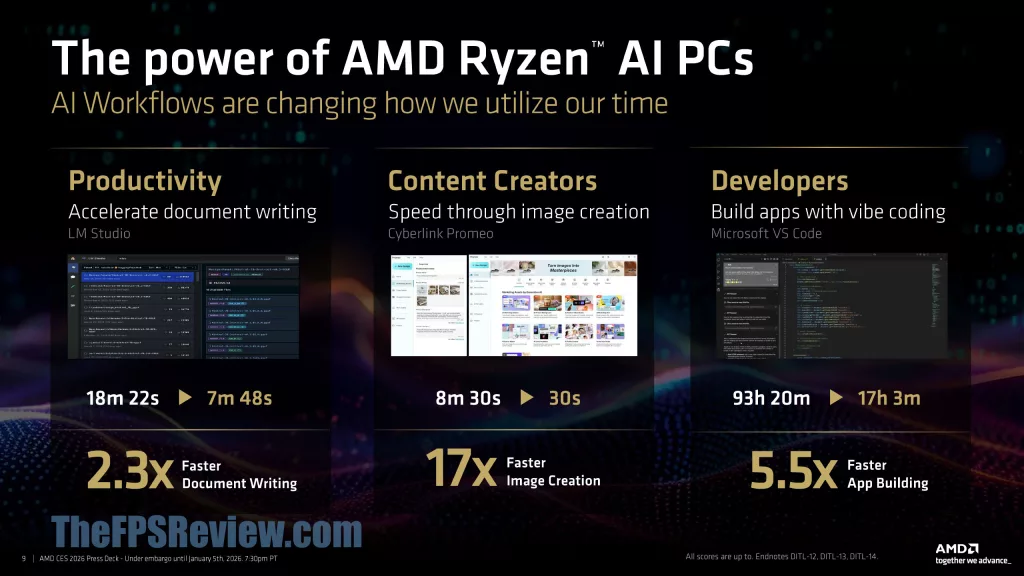
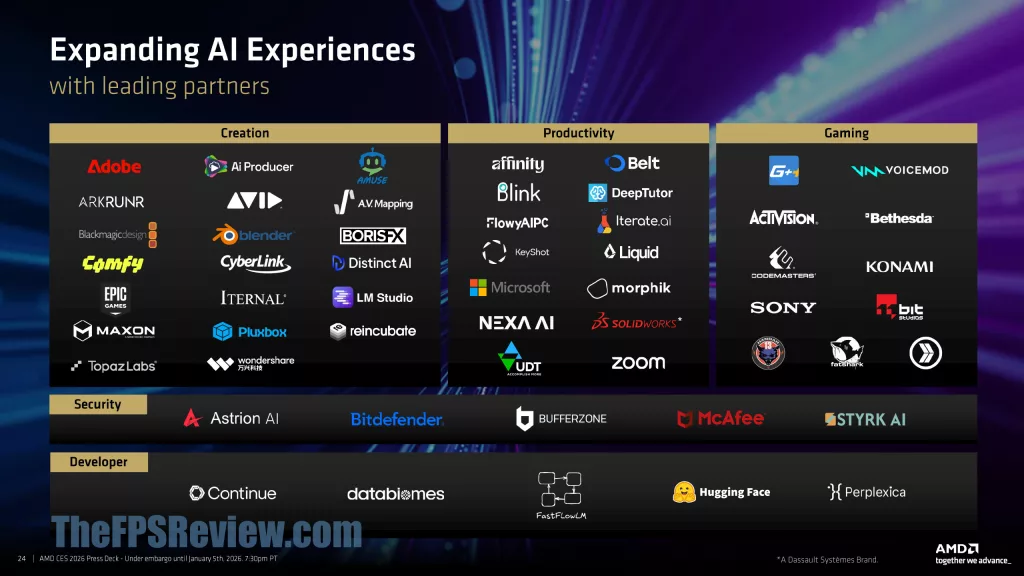
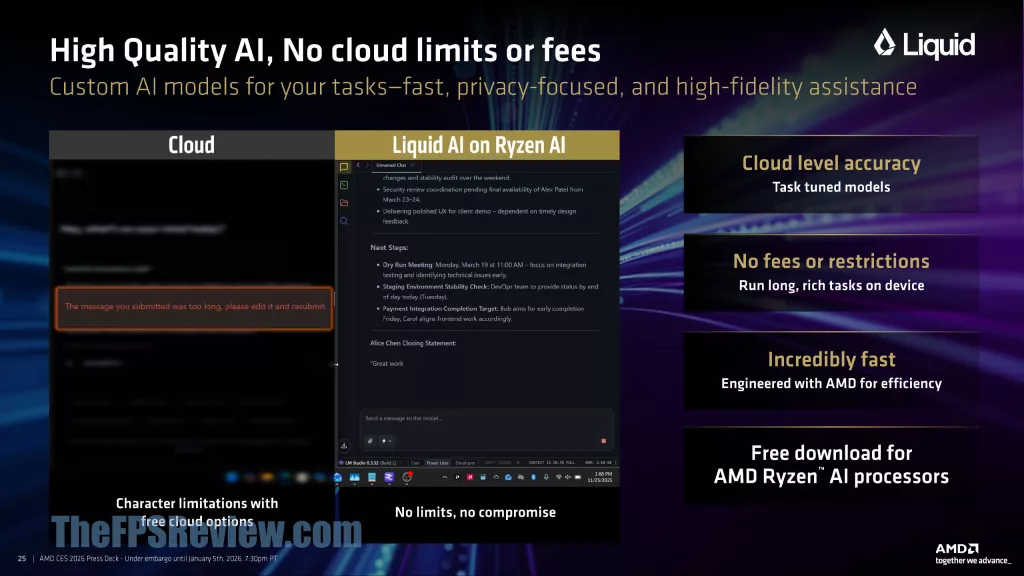
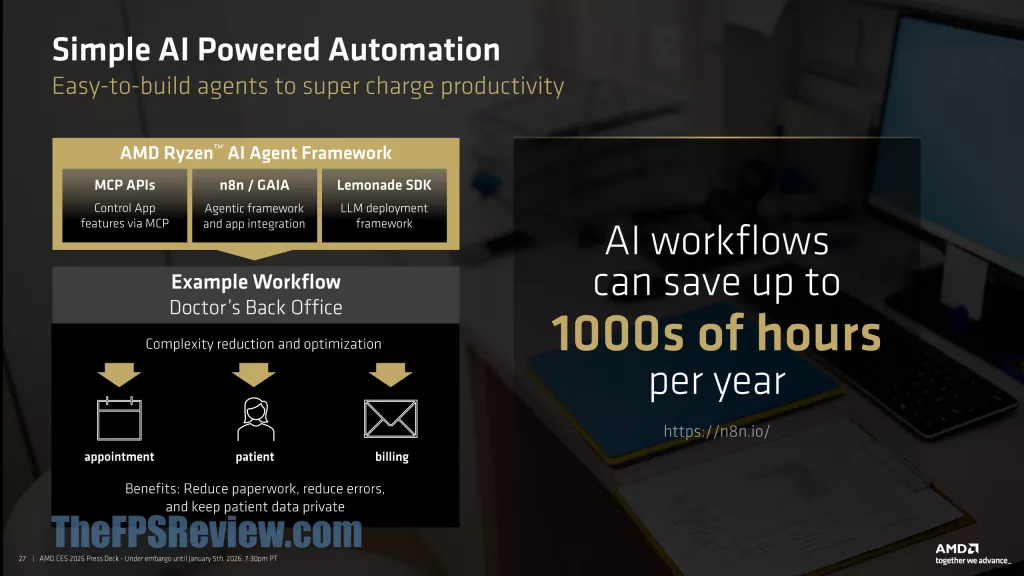
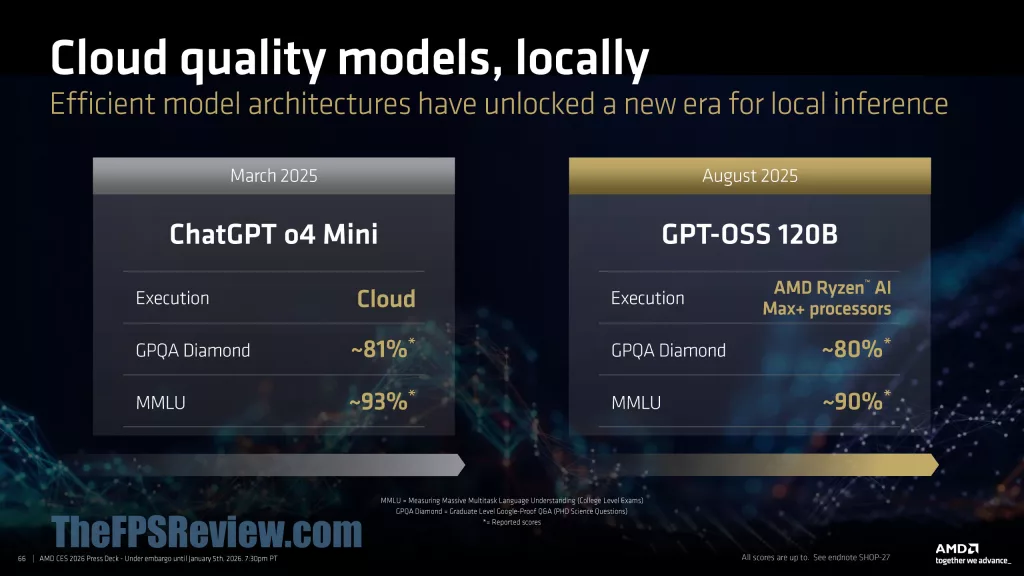
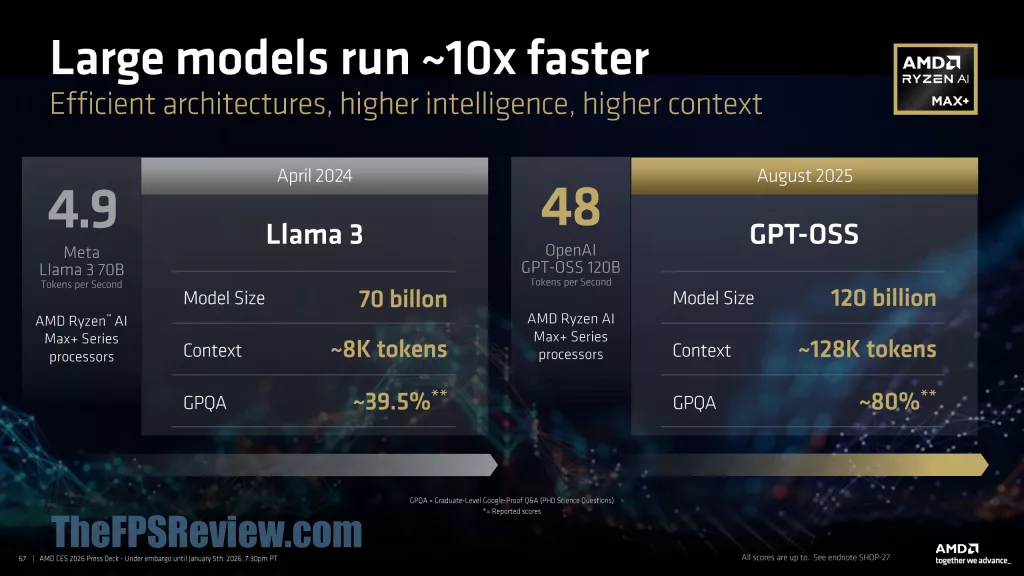
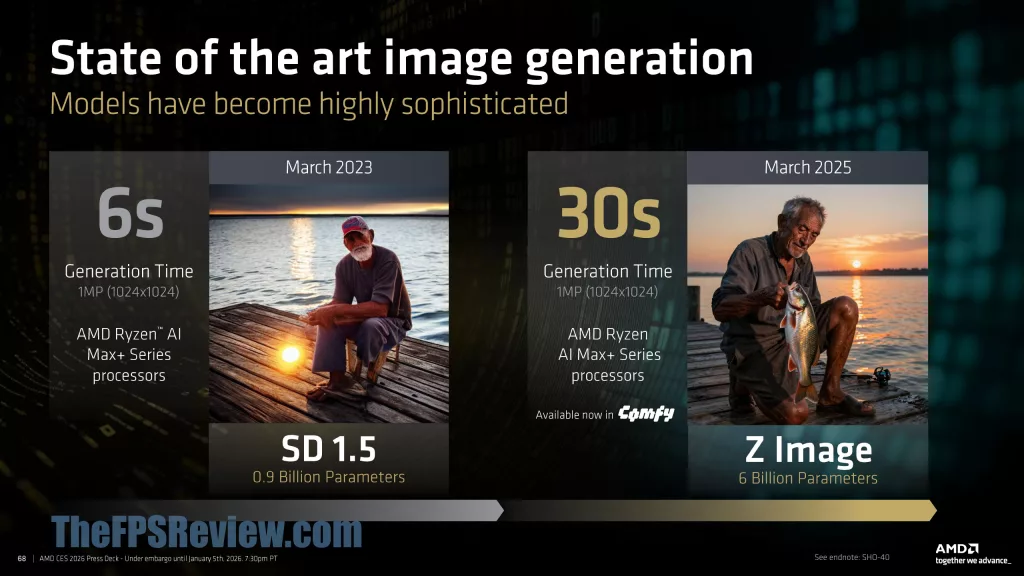
There is going to be a lot of talk about AI, and you will find it plastered everywhere in discussions, as that is where the dollar signs are these days. We will post the general slides for your information, and you may browse through them for your own information, but we really don’t have anything to discuss within that. For our crowd, the most interesting thing will be the AMD Ryzen 7 9850X3D CPU launch we will discuss. First, let’s get all the AI slides posted for your information.




AMD Ryzen 7 9850X3D
The most interesting thing for our readers and us is going to be the AMD Ryzen 7 9850X3D CPU announcement and launch. However, we do stress this is only just barely interesting, because there isn’t anything new architecturally interesting about it. At any rate, let’s post the slides, and then we’ll discuss it.
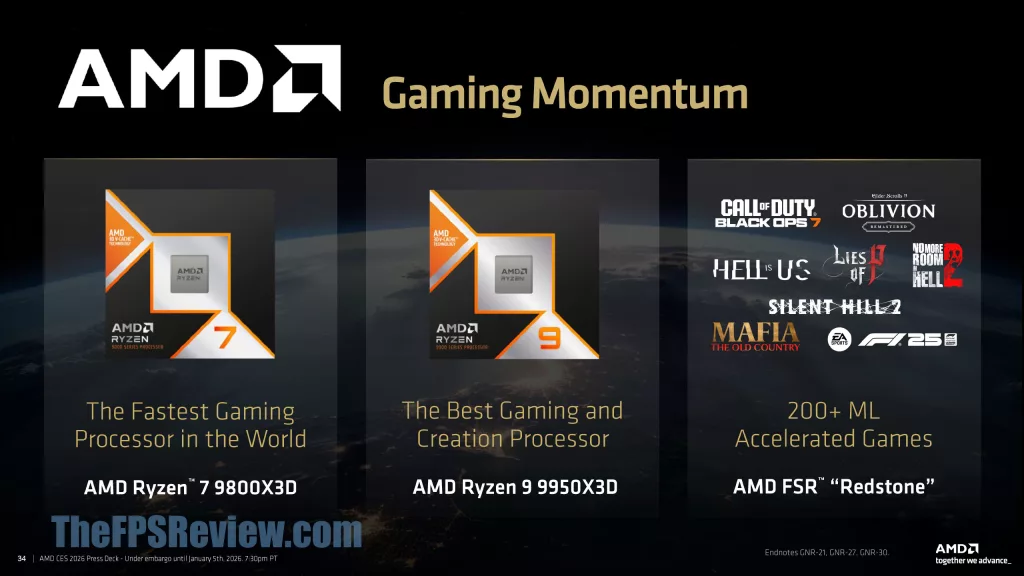
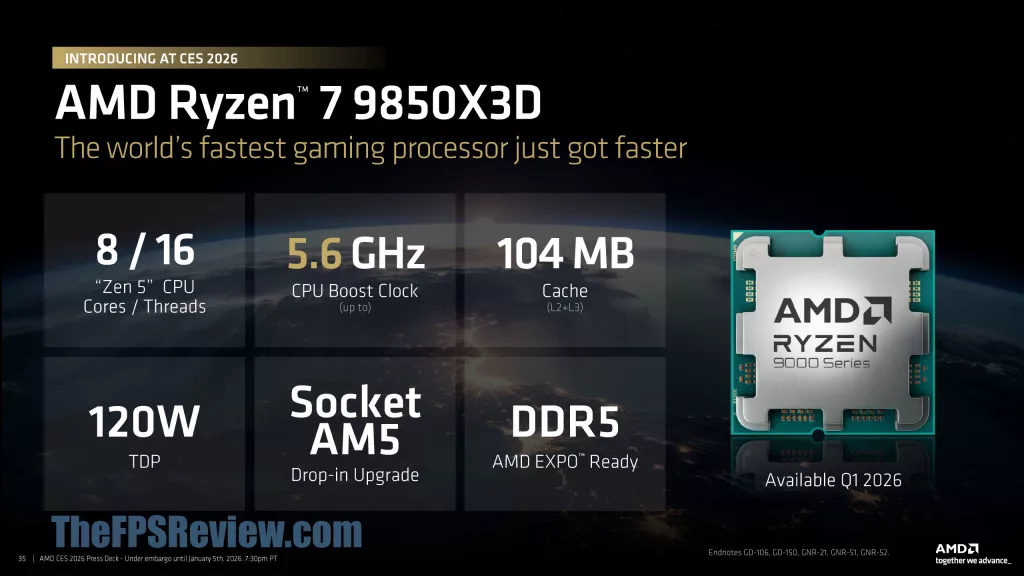
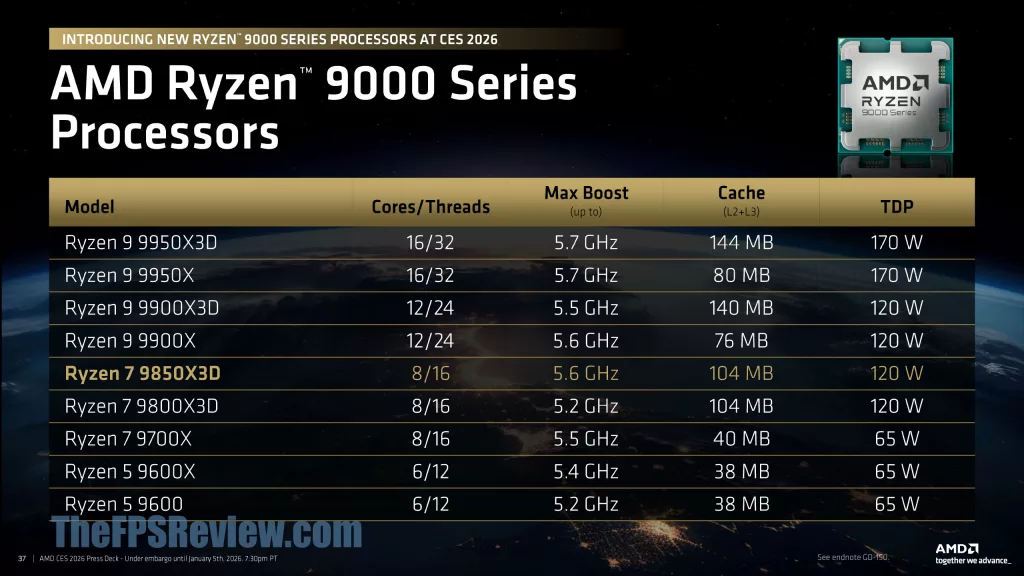
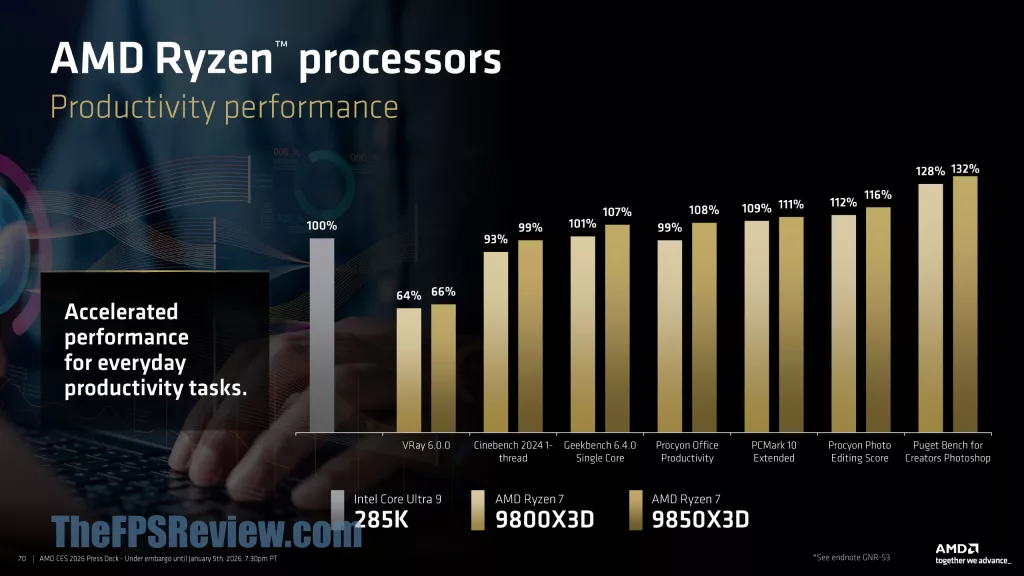
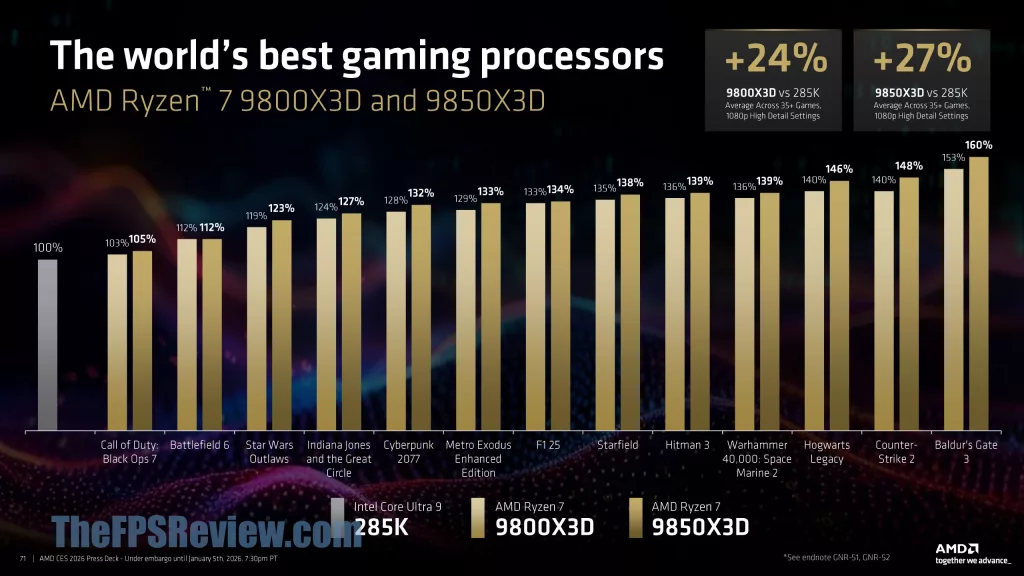
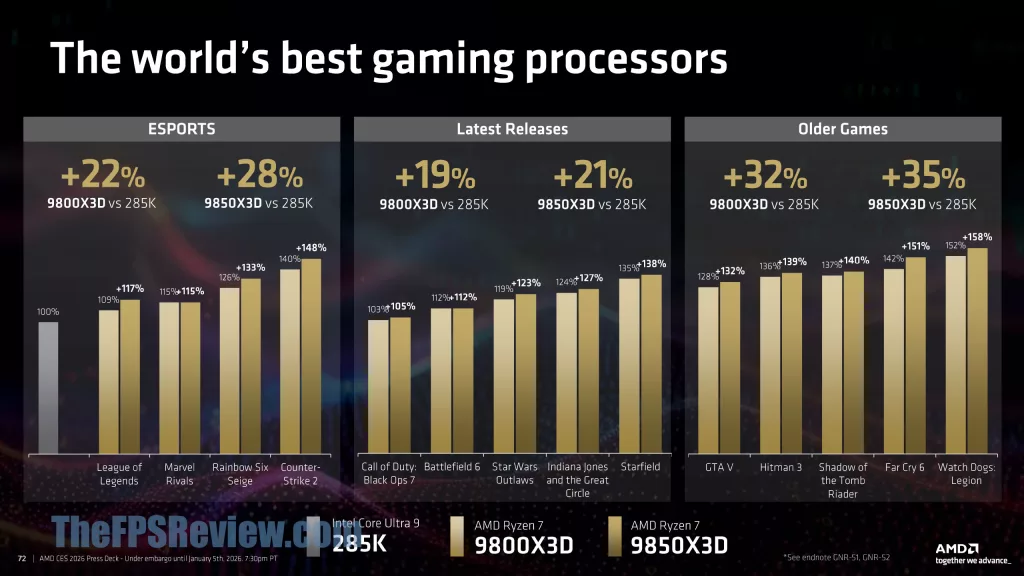
The AMD Ryzen 7 9850X3D supercedes the AMD Ryzen 7 9800X3D, it is an AM5 CPU and gets added the “50” in the product name. This indicates it is a slight increment or evolution of the Ryzen 7 9800X3D. It will have the same 8-core/16-thread configuration, the same 120W TDP, and the same 2nd Gen X3D V-Cache with a capacity of 104MB. Where it differs is solely in the clock speed. The Ryzen 7 9800X3D has a GPU Boost Clock frequency up to 5.2GHz, and the new Ryzen 7 9850X3D now has a higher GPU Boost Clock frequency of 5.6GHz. That is an increase of up to 400MHz or almost 8% higher clock speed.
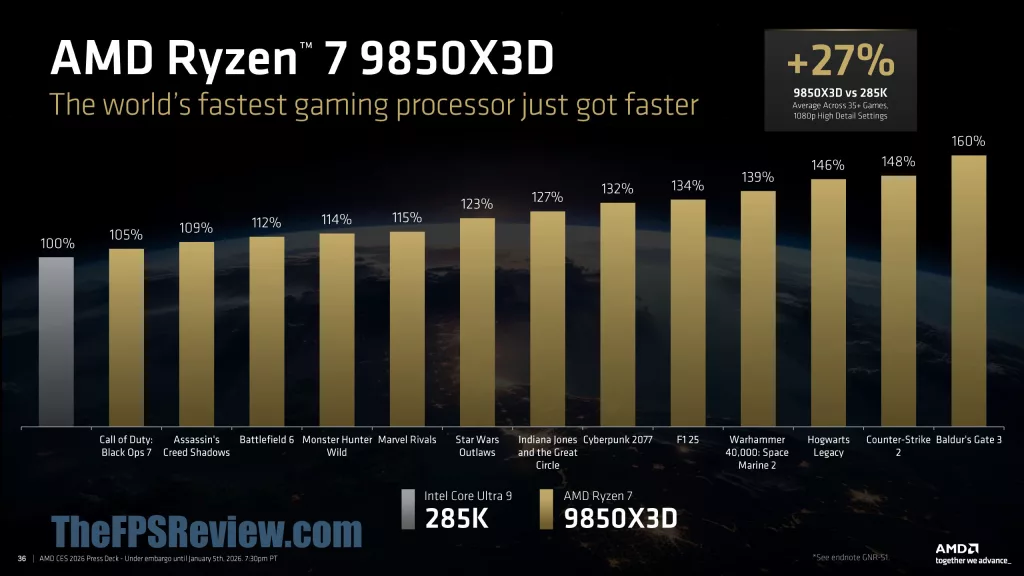
In AMD’s first-party benchmark graphs, AMD compares the Ryzen 7 9850X3D with the competition’s Intel Core Ultra 9 285K. AMD claims between a 5%-up to 60% performance advantage based on the game, with the average being 27% uplift. This is thanks to the onboard X3D V-Cache, which the “X3D” CPUs are known for. When asked about performance compared to the Ryzen 7 9800X3D, AMD has stated to press that it is seeing around a 7% performance difference between the Ryzen 7 9850X3D and Ryzen 7 9800X3D. AMD has also gone on to clarify for us that the Ryzen 9 9850X3D will co-exist with the Ryzen 7 9800X3D in production; it will not replace it. Availability is expected in Q1 2026, and pricing is to be announced.
AMD FSR Redstone
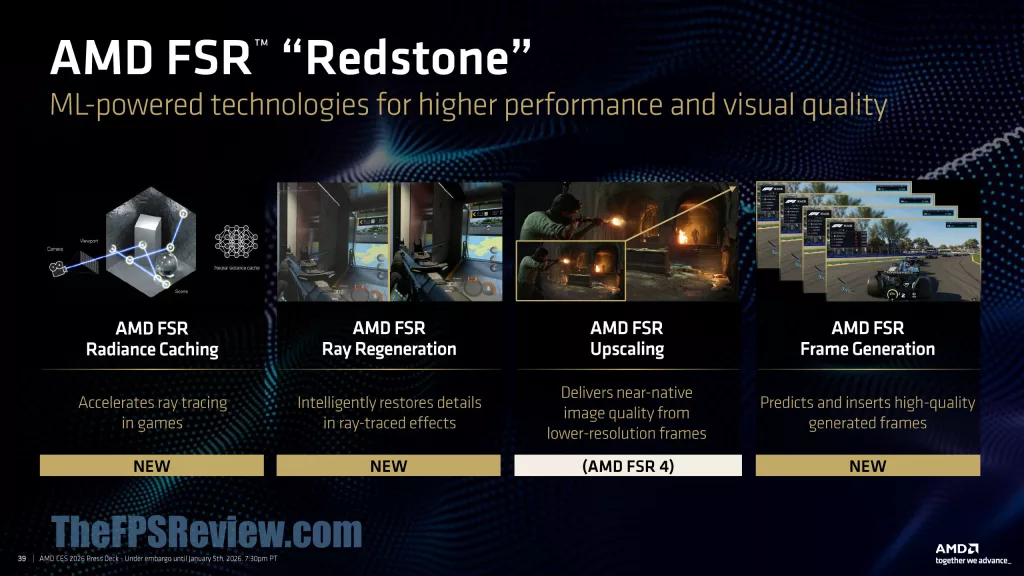
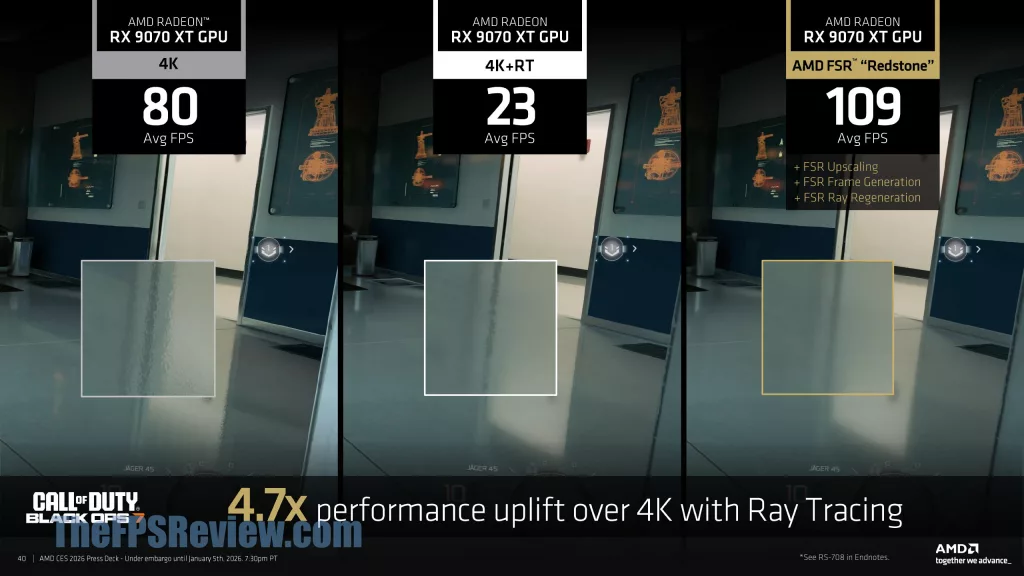
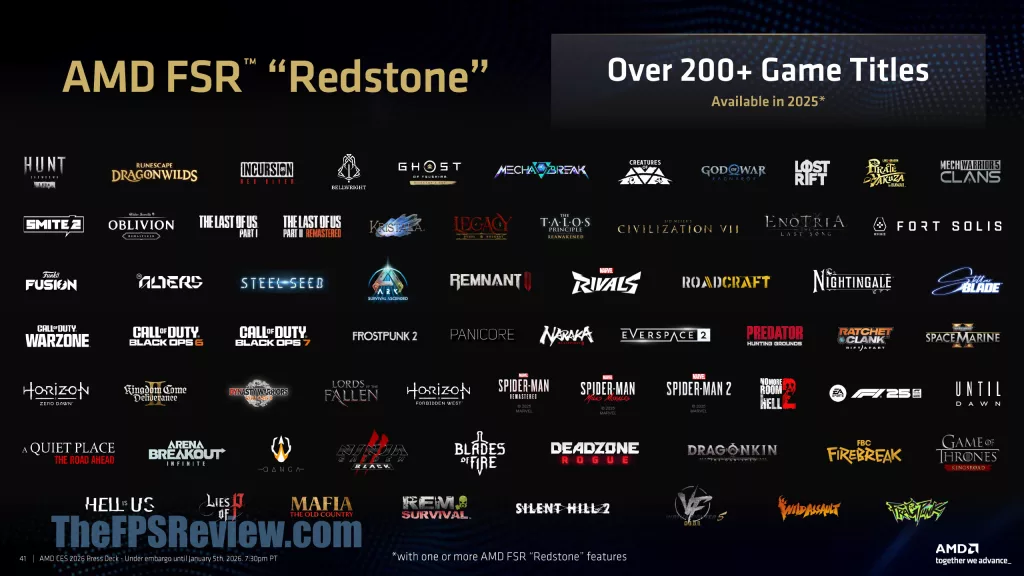
The AMD FSR Redstone being discussed at CES 2026 is not new information; this is, in fact, a recap of what was launched in 2025. Toward the beginning of 2025, when Radeon RX 9000 Series (RDNA 4) GPUs launched, we saw the introduction of AMD FSR Redstone FSR 4 ML-Upscaling launched. Then, in December of 2025, we saw AMD FSR Redstone get its final form with the introduction of ML-Frame Gen, Ray Regeneration, and Radiance Caching announced.
Therefore, AMD FSR Redstone will continue to evolve and gain adoption in 2026. Indeed, this is the main thing holding back FSR Redstone is the adoption rate and integration. As more games support in-game FSR 4 ML-Upscaling options, and eventually ML-Frame Gen, the technology can widen its influence if decoupled from needing to enable AMD Adrenalin Software driver control panel features.
In addition, Ray Regeneration will need to be adopted by more games, as currently it is only supported in one single game. As well, AMD FSR Radiance Caching will need to be supported, in well, any game period, as right now we haven’t seen what that will do for performance in production. AMD FSR Redstone technologies are promising, but we really do need to see them adopted and used in games to make an impact. However, the most successful and useful part of it, FSR 4 ML-Upscaling is gaining more support faster, and it is very competitive with the competition in image quality.
AMD Ryzen AI 400 Series
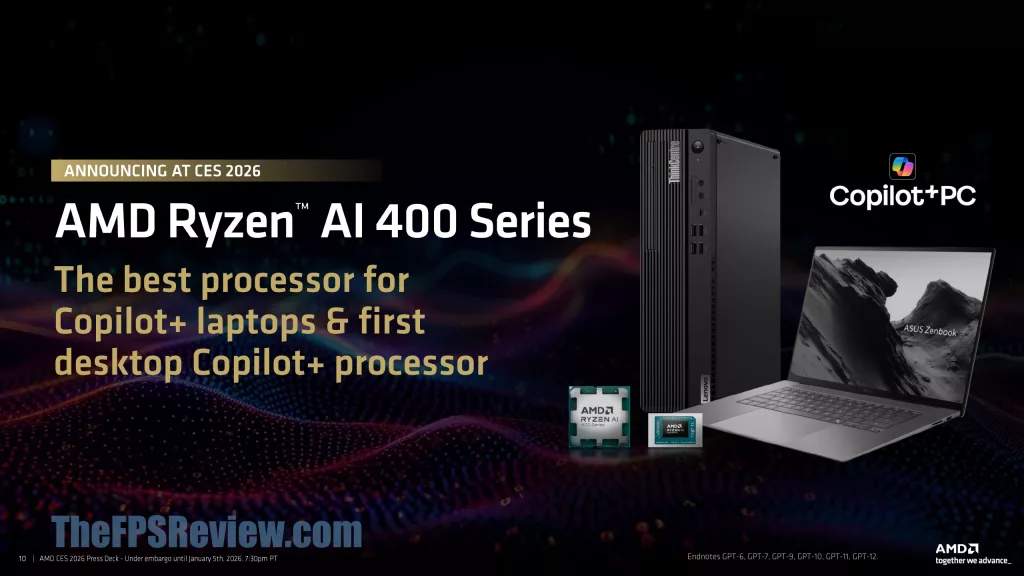
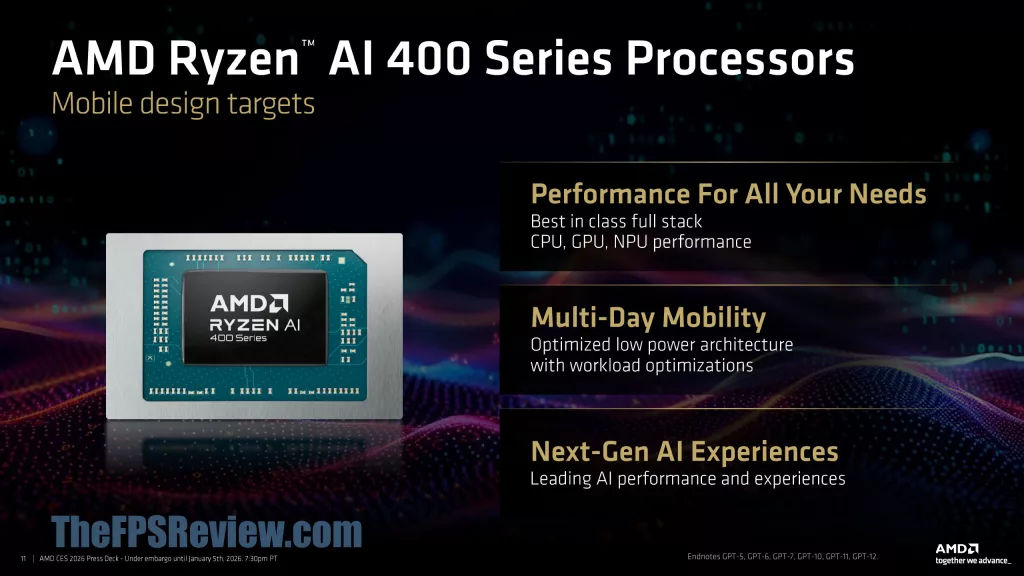
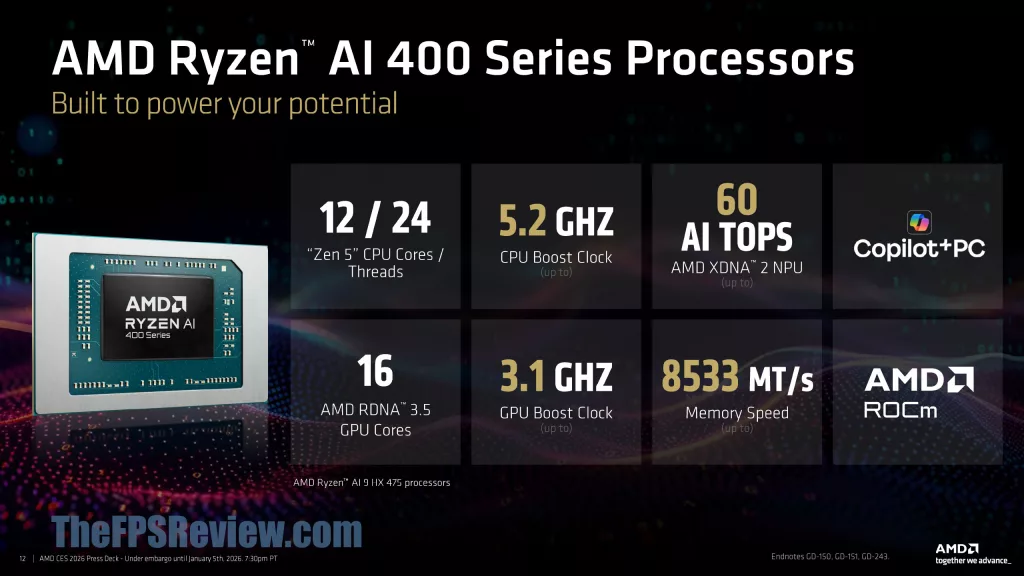
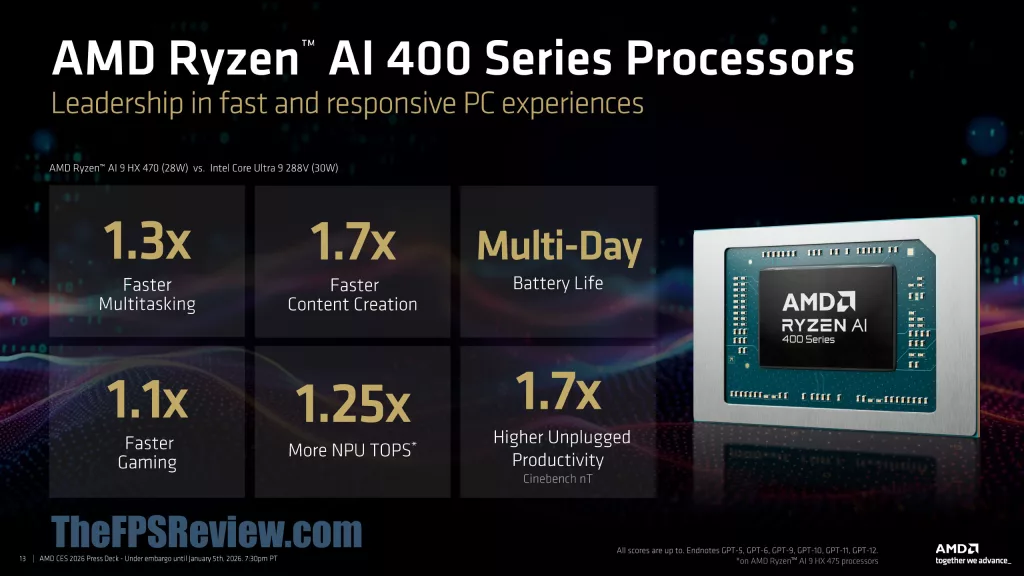
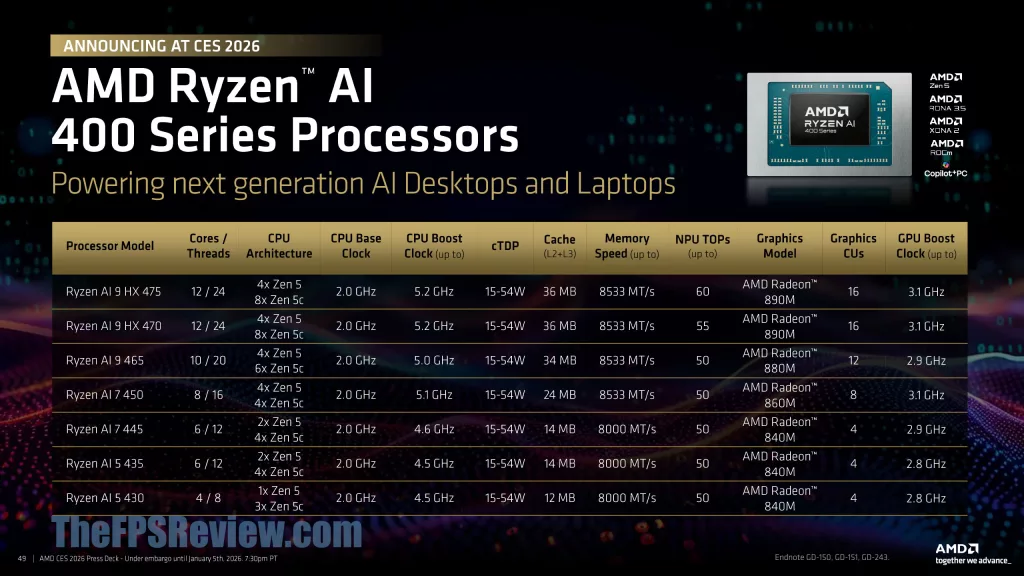
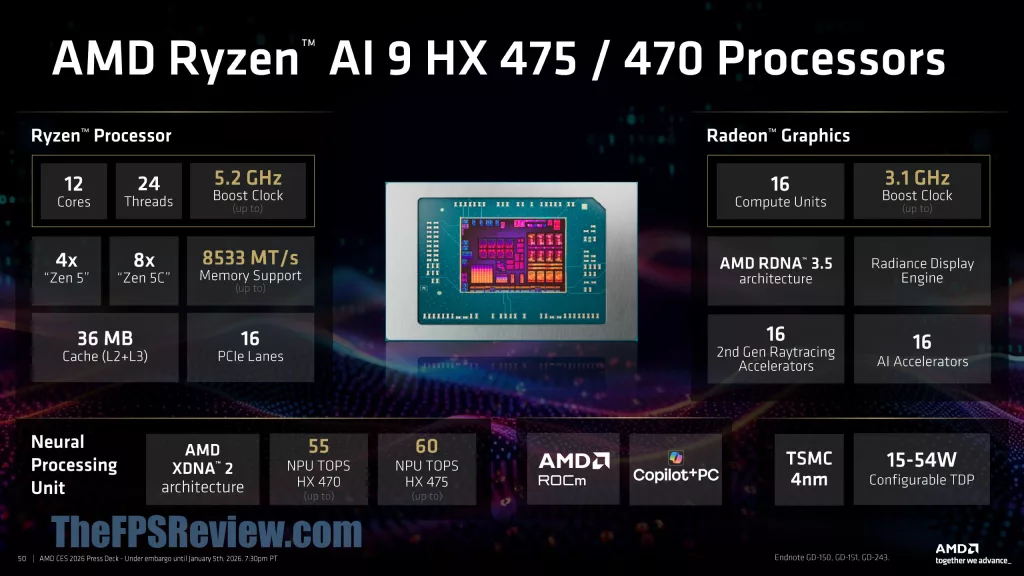
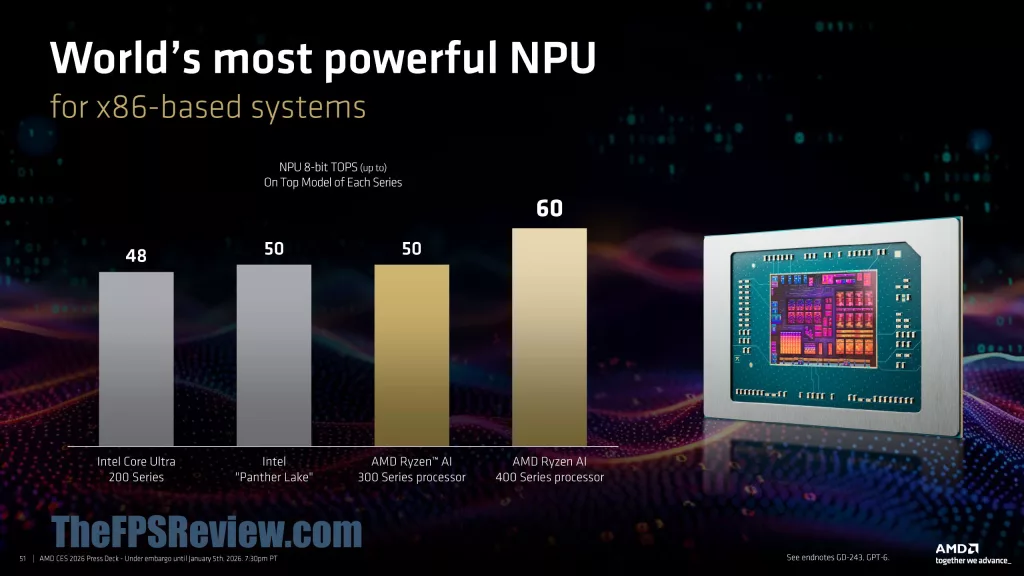
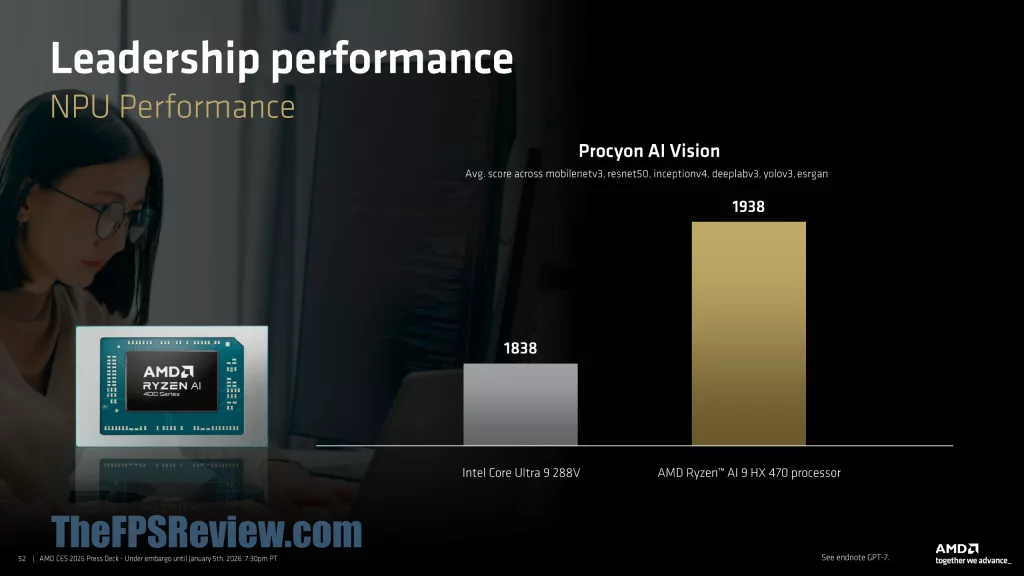
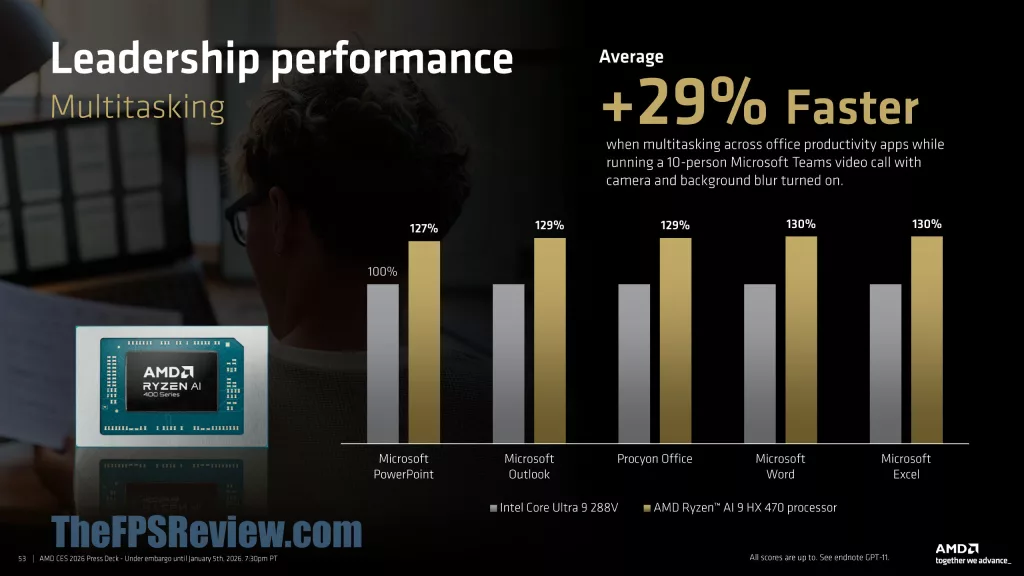
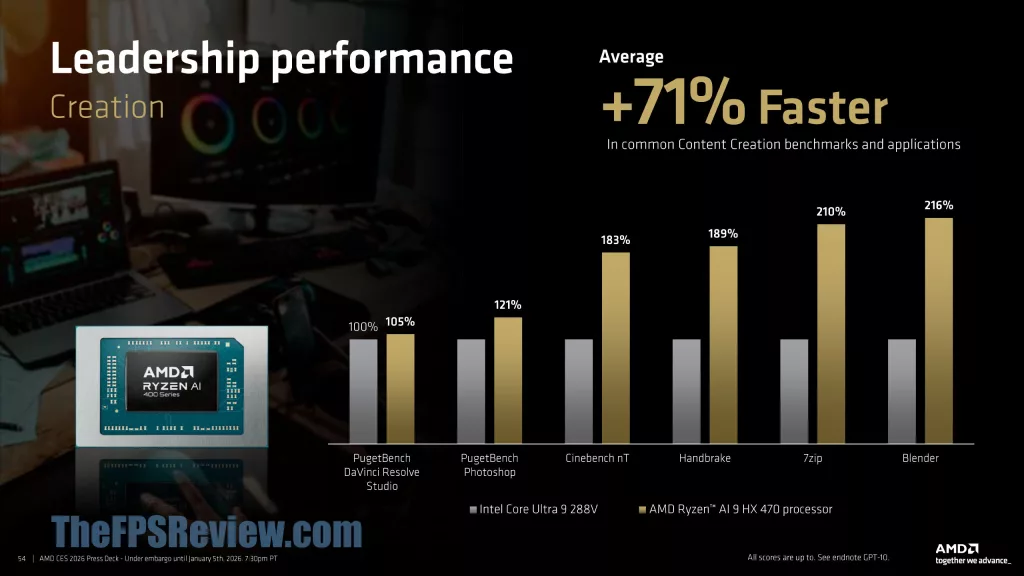
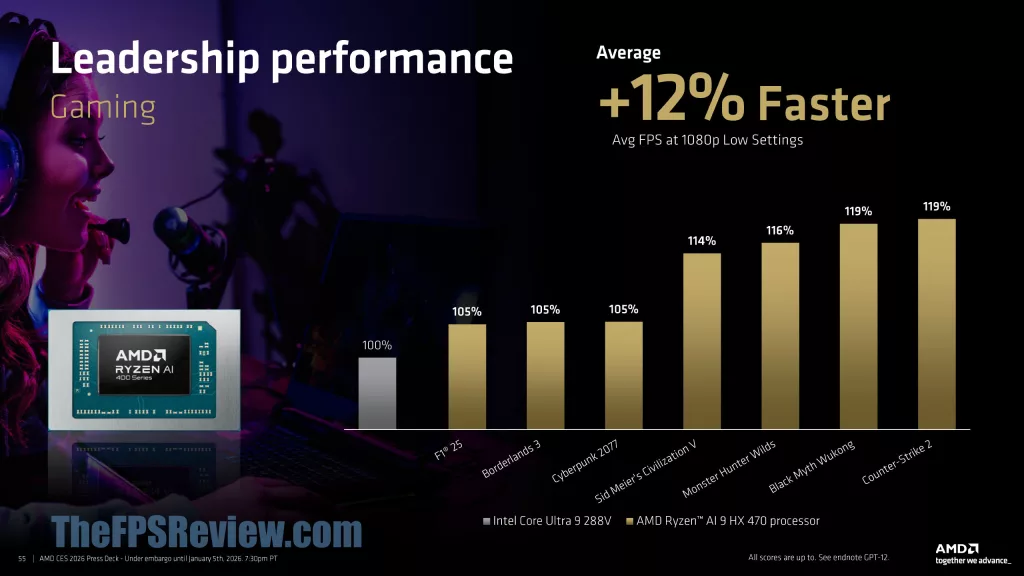
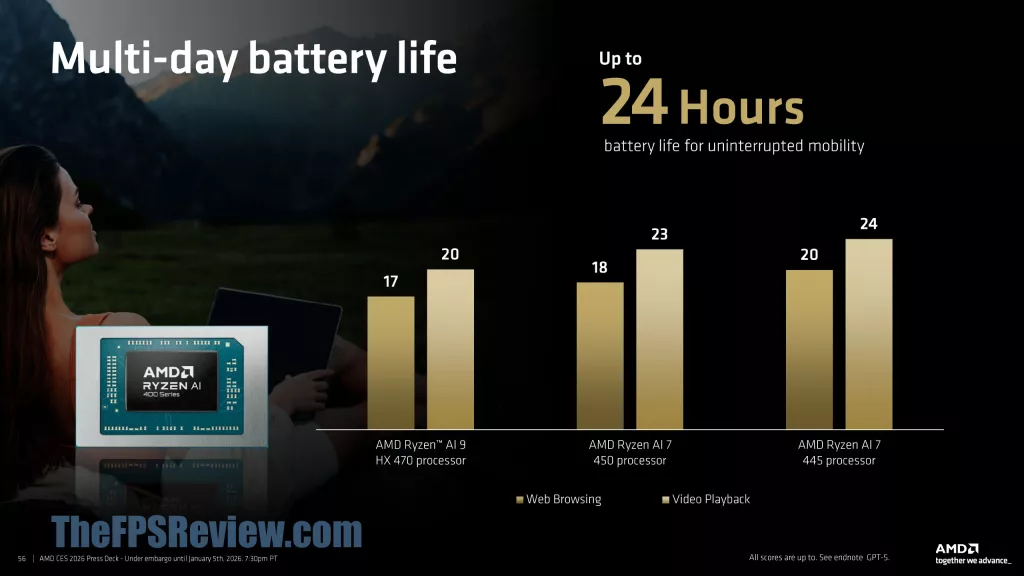
AMD is announcing the AMD Ryzen AI 400 Series mobile processors, based on “Gorgon Point.” These are a refresh of the current-gen Ryzen AI 300 Series “Strix Point” mobile processors. Key features are a continuation of using Zen 5 CPUs and RDNA 3.5 integrated APUs, and XDNA 2 NPUs, with a slight spec bump. These mobile processors are built for Copilot+ laptops and desktop Copilot+ processors. At max spec, you will find Zen 5 12 Cores and 24 threads, up to 5.2GHz with 16 RDNA 3.5 GPU cores at 3.1GHz and memory at 8533MT/s with 60 AI TOPs. Key features are 1.3x faster multitasking, 1.7x faster content creation, better battery life, 1.1x faster gaming, and 1.25x more NPU TOPs.
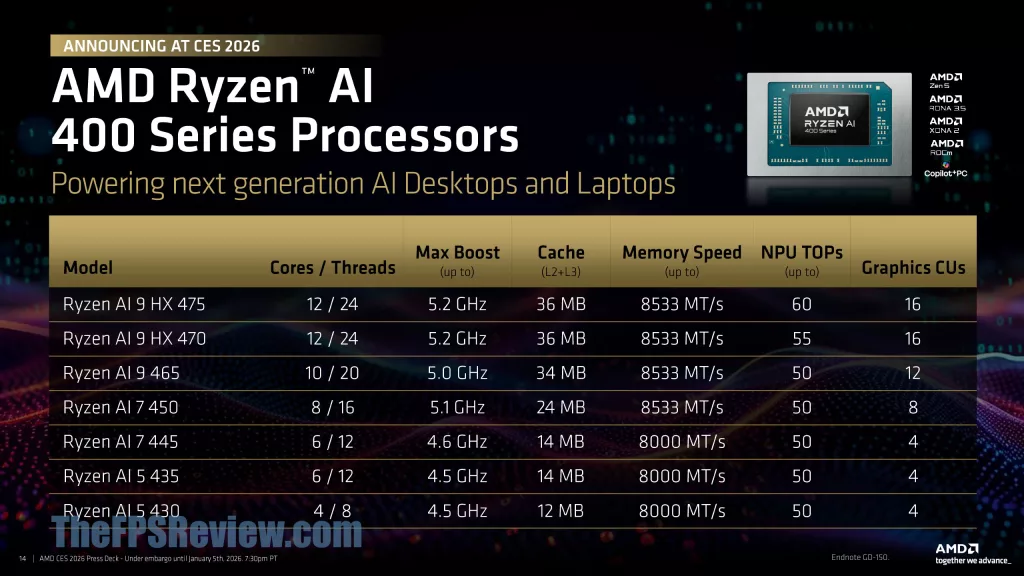
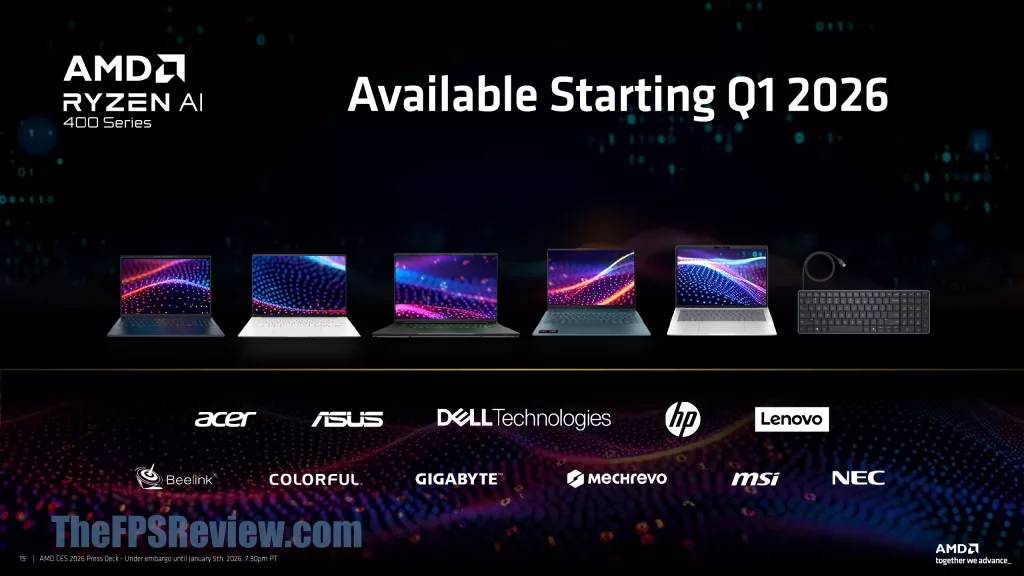
At the top-end is the Ryzen AI 9 HX 475 in this full 12/24 configuration with 16 GPU cores. Next down is the Ryzen AI 9 HX 470 with a 12/24 configuration at up to 5.2GHz, as well as 16 GPU cores and the same memory speed, but a slight downgrade in NPUs. Next is the Ryzen AI 9 465 with a 10/20 core configuration at up to 5GHz, and 12 GPU cores and downgraded NPUs but the same memory speed. Next is the Ryzen AI 7 450 with an 8/16 configuration at 5.1GHz, 8 GPU cores, 50 TOPs and 8533MT/s memory. Then the Ryzen AI 7 445 has 6/12 configuration, 4 GPU cores, 50 TOPS, and memory goes to 8000MT/s. The Ryzen AI 5 435 has a 6/12 config and a slightly lower clock speed, and 8000MT/s memory. Finally, the Ryzen AI 5 430 us a 4/8 config at 4.5GHz, 4 GPU cores, 8000MT/s RAM and still 50 TOPs. Availiablity is starting Q1 2026.
AMD Ryzen AI Max+ Series
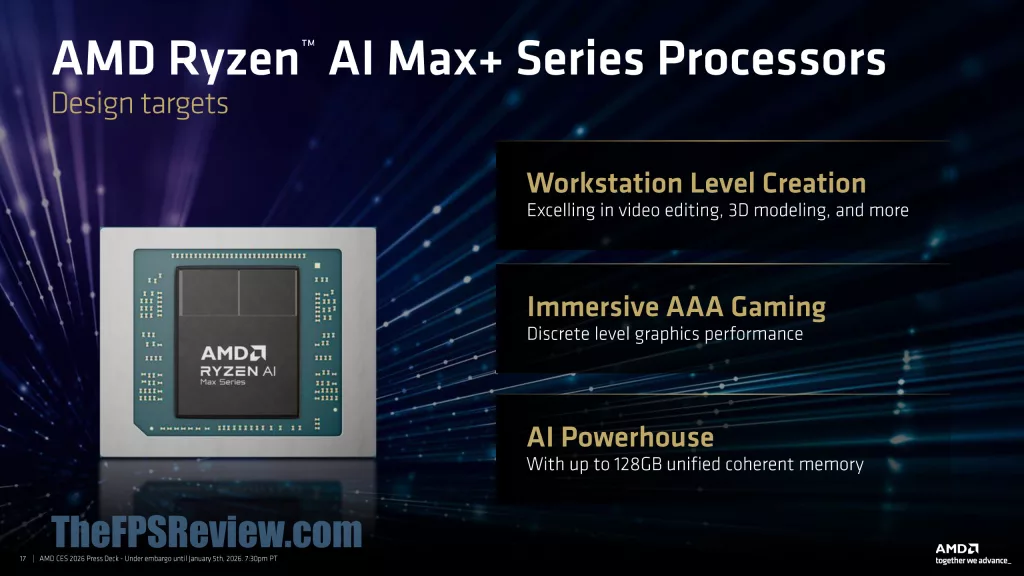
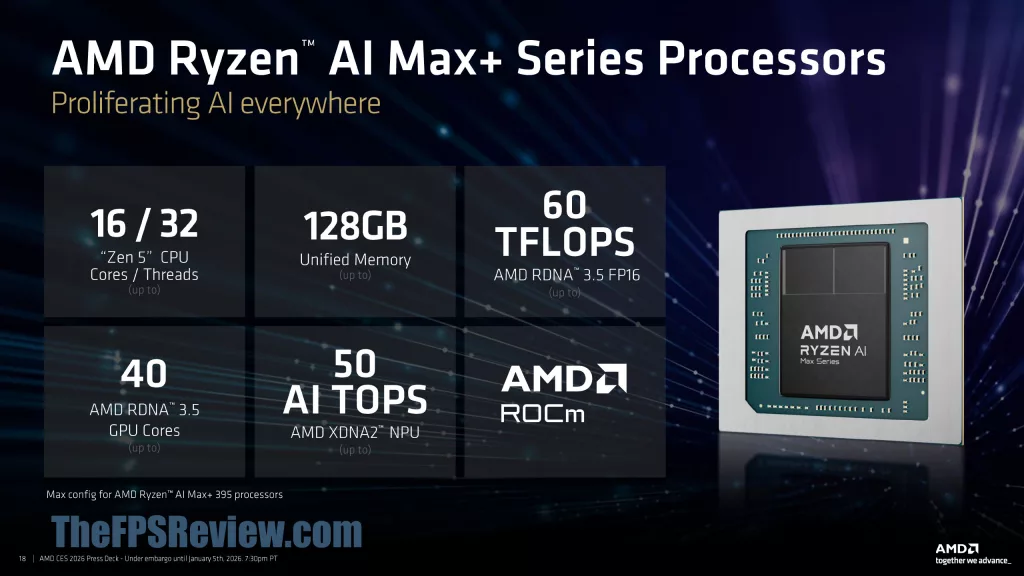
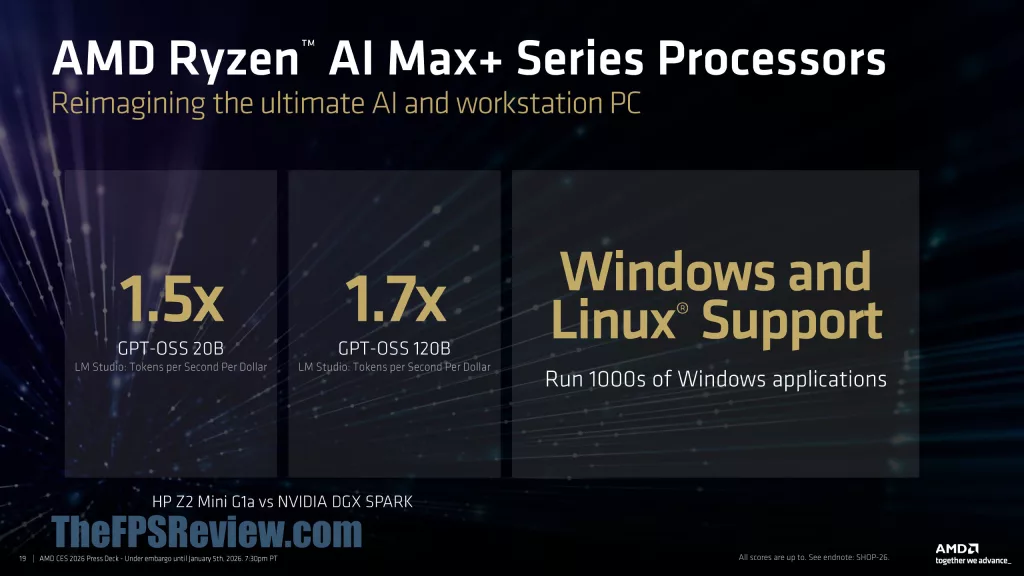
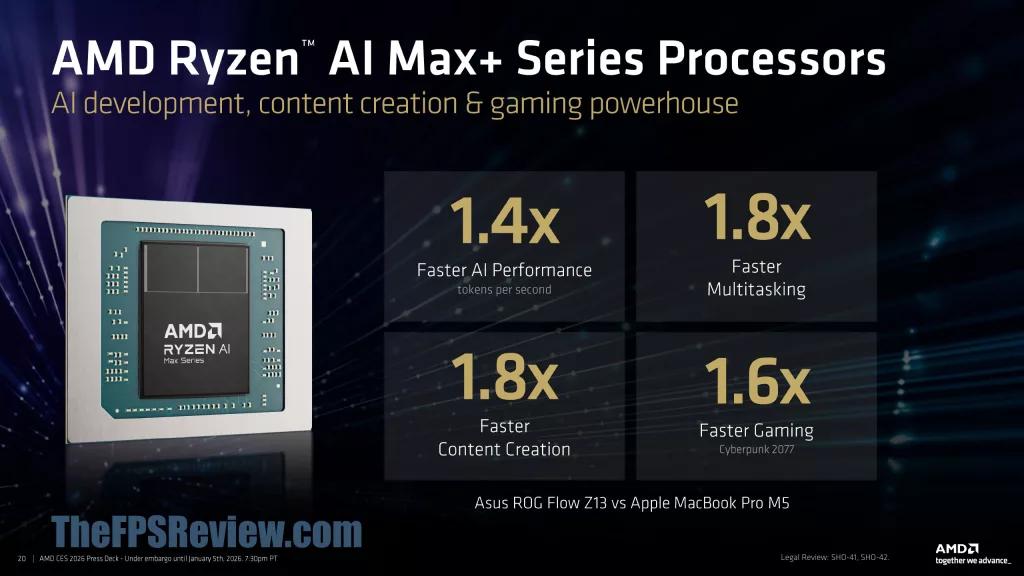
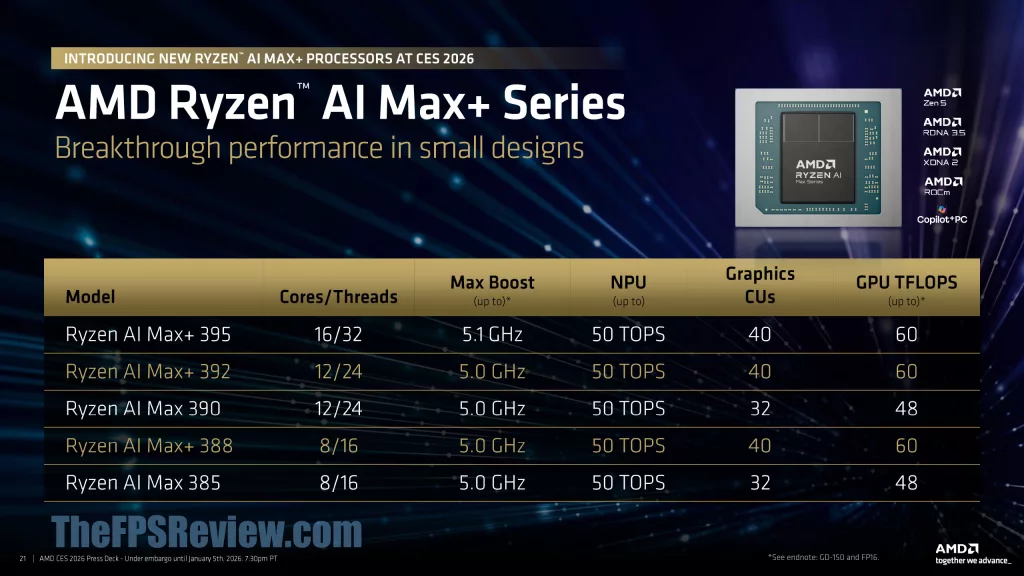
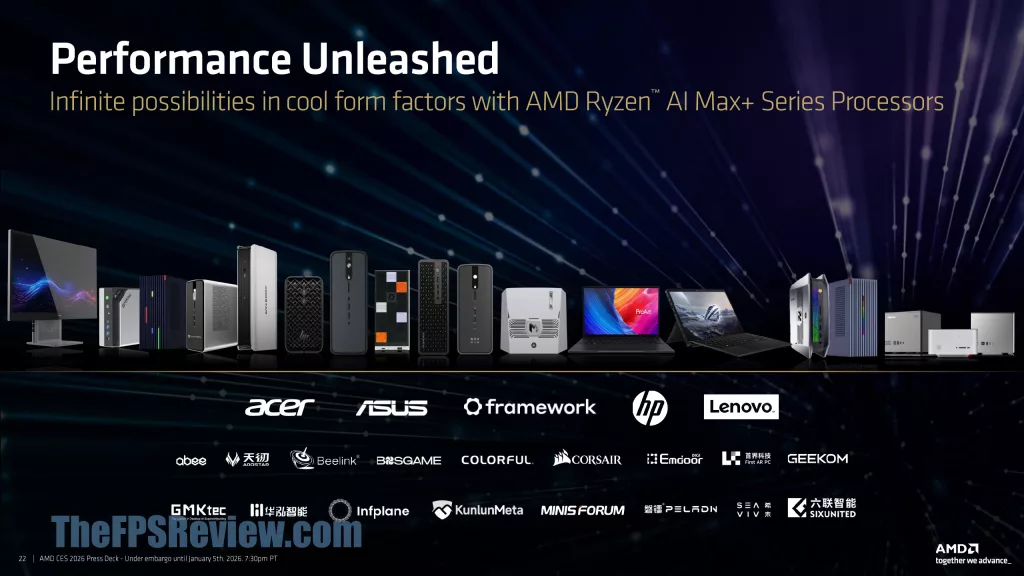
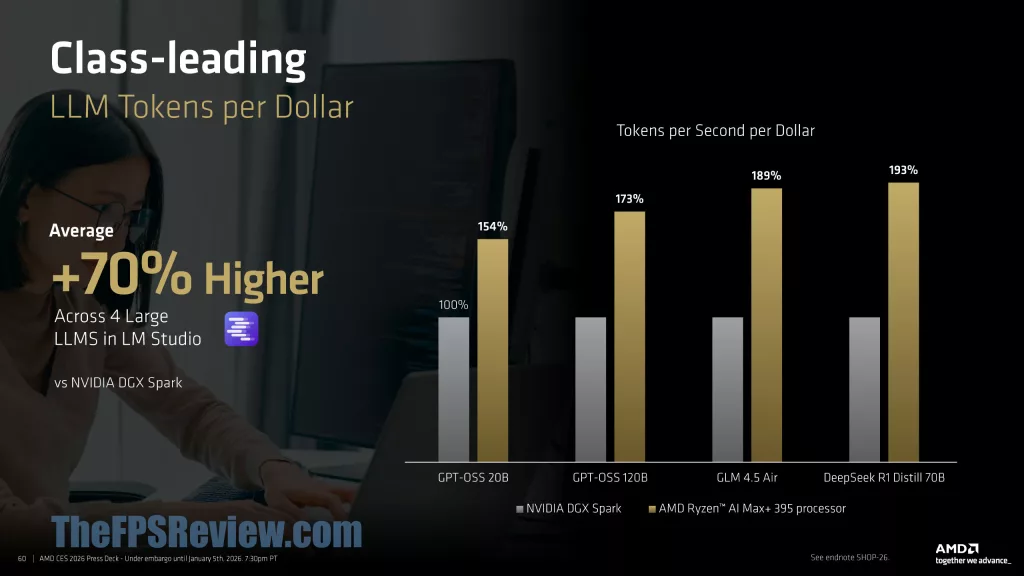
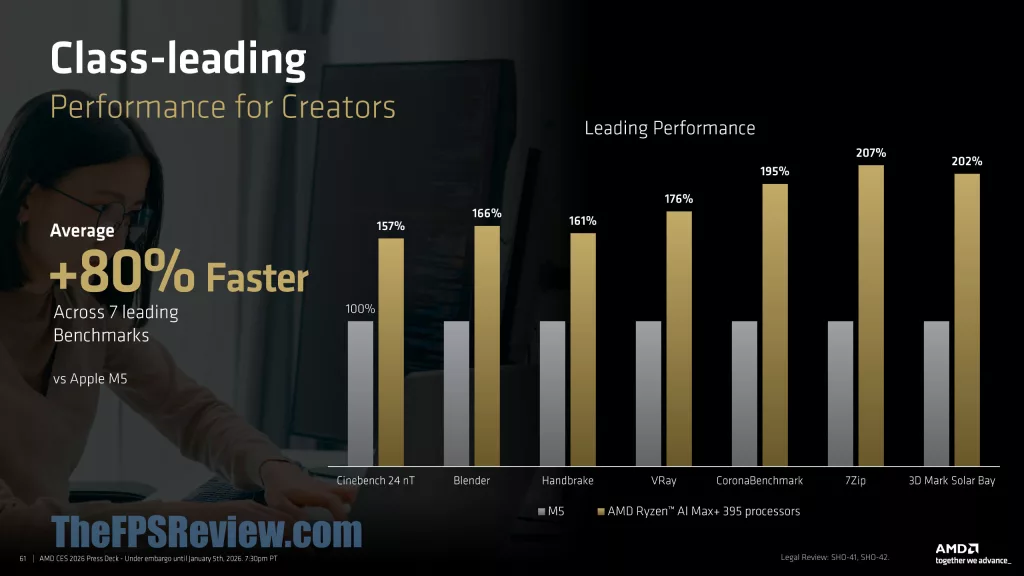
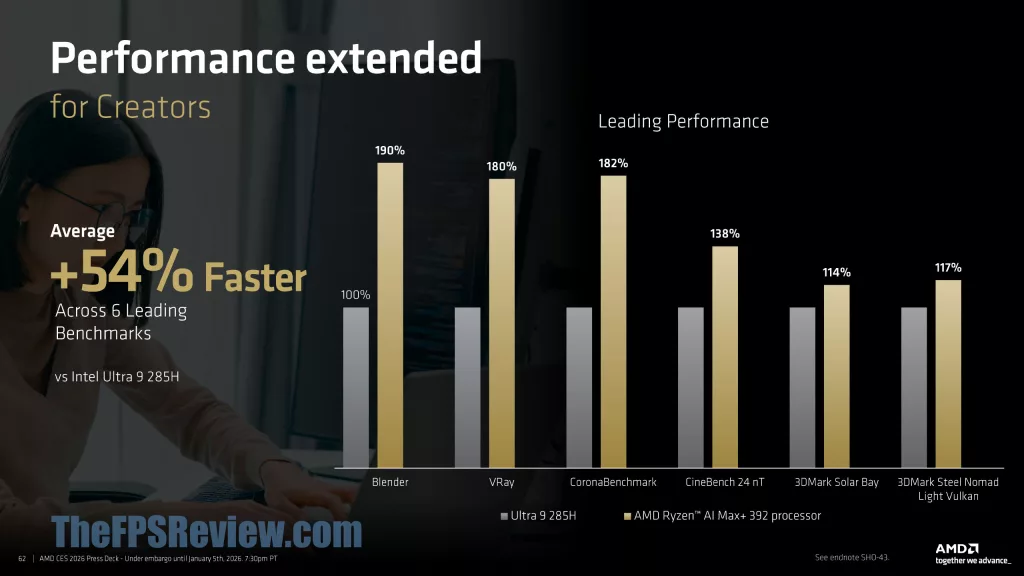
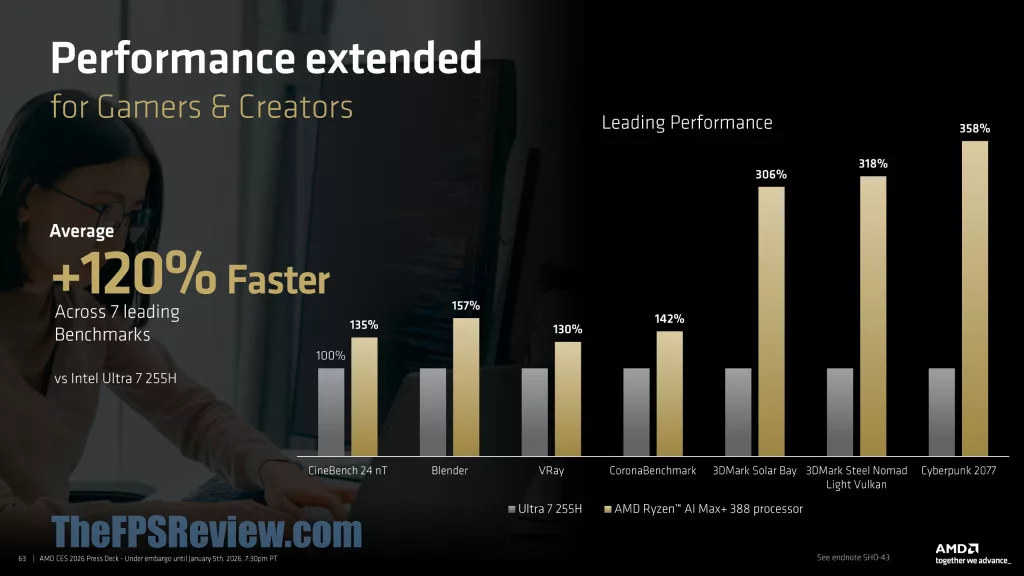
The Ryzen AI Max+ Series is an already existing range of processors for AI developers. In the announcement today, AMD is talking about this series of processors that exist, and announcing two new product SKUs in the lineup. AMD reminds us that these are for workstation-level content creation, video editing, 3D modeling, and are an AI powerhouse with up to 128GB unified coherent memory. The top-end configuration is 16/32 Zen 5 Cores, and 40 RDNA 3.5 GPU cores, with up to 128GB of memory, and XDNA 2 at 50 GOPs, with RDNA 3.5 FP16 at up to 60 TFLOPS and AMD ROCm support.
The two new SKUs being added are the Ryzen AI Max+ 392 and the Ryzen AI Max+ 388. The Ryzen AI Max+ 392 is a slight upgrade over the Ryzen AI Max 390, with the same 12/24 core configuration, and the same 5GHz clock speed, and the same 50 TOPs, but it upgrades with 40 GPU cores compared to 32 on the Ryzen AI Max 390. This is also the same number of GPU Cores on the Ryzen AI Max+ 395, so it is basically a slightly lower clocked and 12/24 version of the Ryzen AI Max+ 395, same GPU cores but fewer CPU cores. The new Ryzen AI Max+ 388 is also similar in that way, where it cuts down the CPU cores to 8/16 config at 5GHz but retains the full 40 GPU cores for a very GPU-focused processor if you don’t need as many CPU cores.
AMD Ryzen AI PRO 400 Series Processors
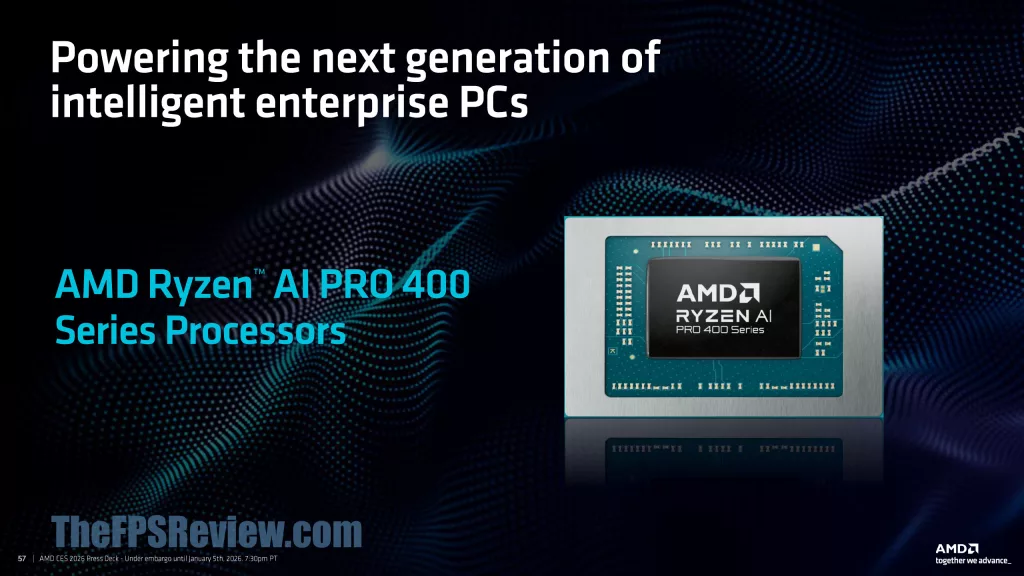
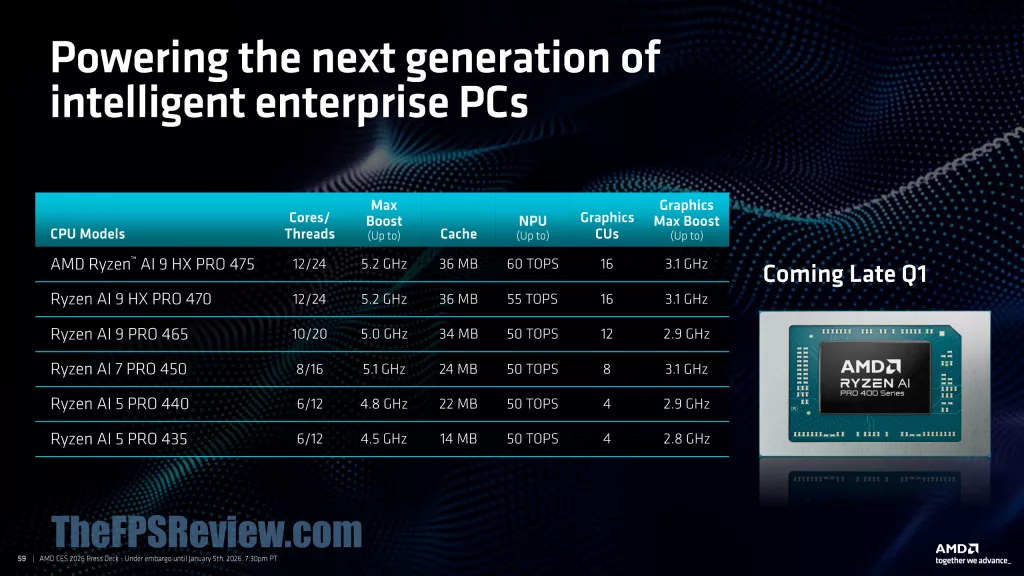
The new AMD Ryzen AI PRO 400 Series Processors are designed for enterprise PCs. The max configuration is the AMD Ryzen AI 9 HX PRO 475 with a 12/24 core/thread configuration at 5.2GHz, 60 NPU TOPs, 16 Graphics CUs at up to 3.1GHz. This goes down to the Ryzen AI 5 PRO 435 with a 6/12 configuration at 4.5GHz, 50 AI TOPs and a 4 Graphics CU config.
AMD ROCm

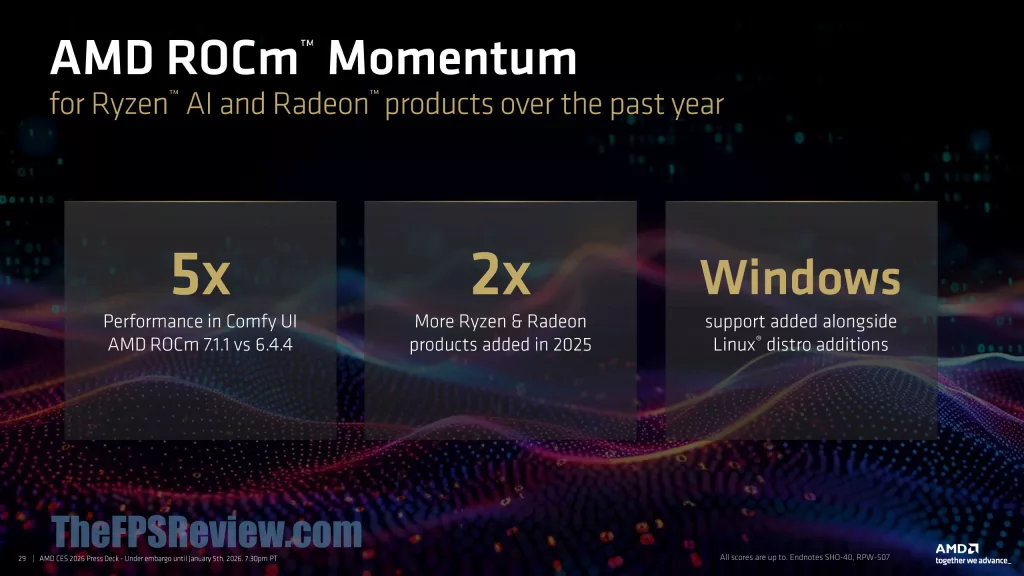
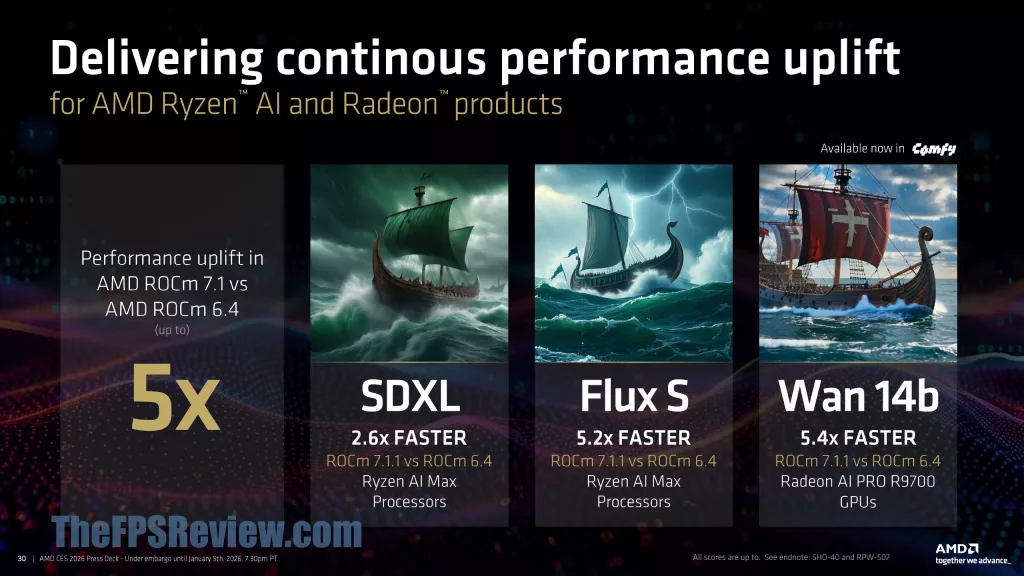
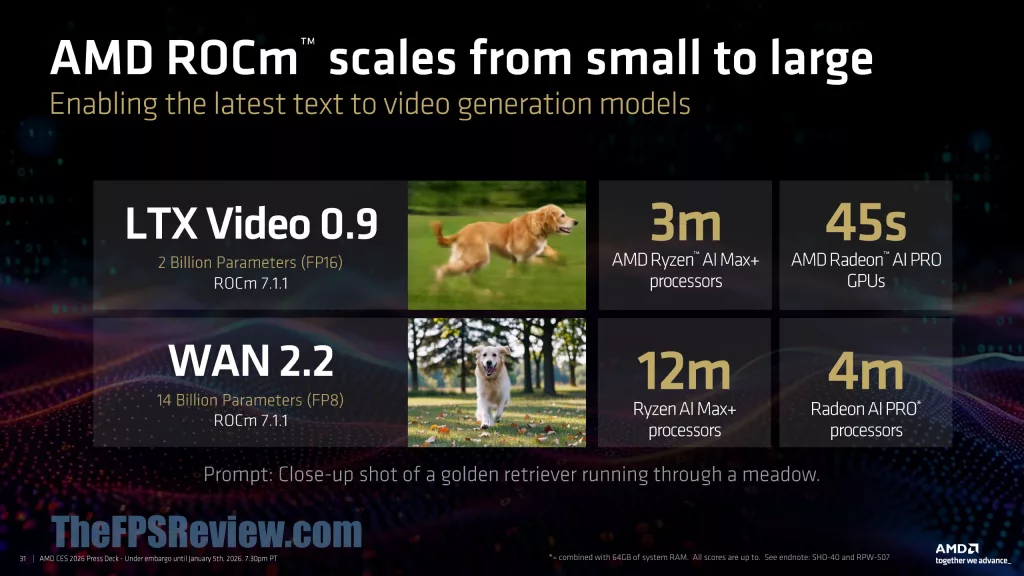
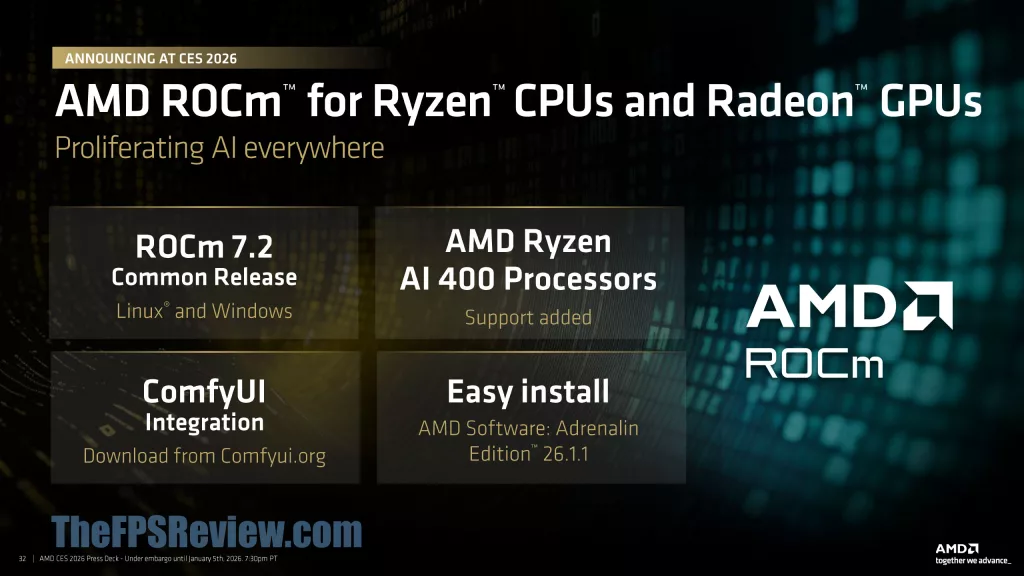
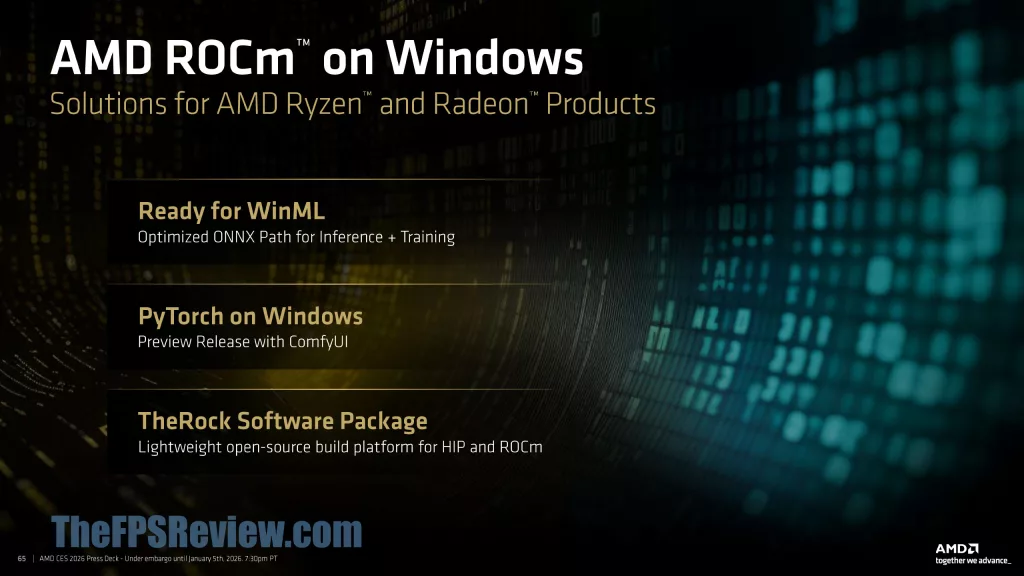
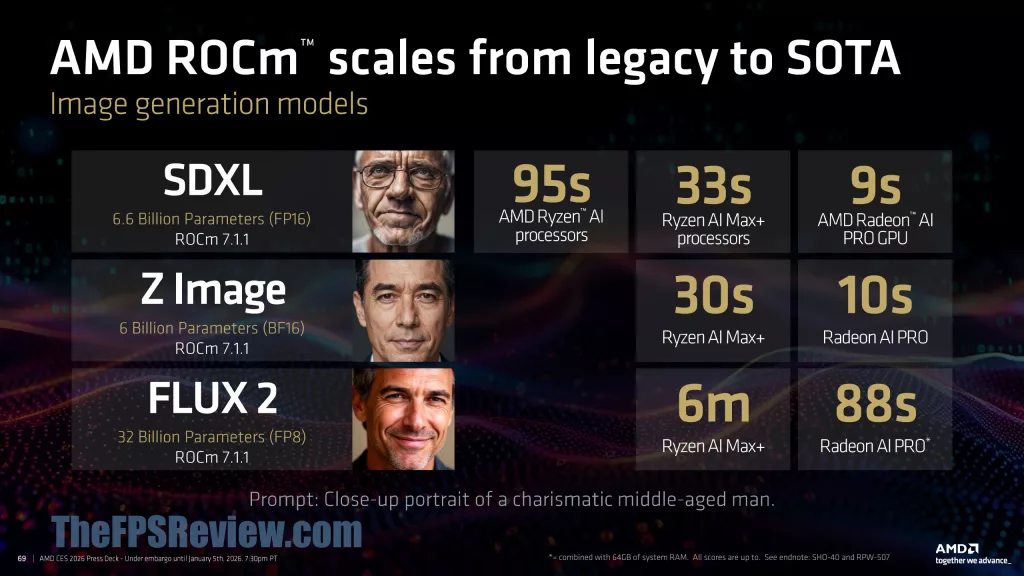
AMD ROCm is being expanded in 2026, with the ROCm 7.2 Common Release on Linux and Windows. It will now support the refreshed AMD Ryzen AI 400 Processors, as well as ComfyUI integration and an easy install method in AMD Software: Adrenalin Edition 26.1.1.
Conclusion
At the end of the day, AMD’s CES 2026 announcements are about building on the brand it has created across the Enterprise, Workstation, AI, Desktop PC, and mobile processor arenas. For us DIY Enthusiasts focused on desktop gaming, the most interesting new announcement will be the AMD Ryzen 7 9850X3D CPU and the continuation of FSR Redstone features expanding in games.
The AMD Ryzen 7 9850X3D isn’t that exciting compared to the already existing Ryzen 7 9800X3D, as a comparison. Knowing that the Ryzen 7 9800X3D will continue in production with the Ryzen 7 9850X3D existing alongside it, and will no doubt be more expensive, it makes it a rather hard sell out of the gate with the very minor clock speed difference. However, if you are coming from a previous-generation CPU on AM4 and are now making the upgrade, or you have a lower-end AM5 CPU, then a direct leap or upgrade to the Ryzen 7 9850X3D could be worth it. Right now, AMD is claiming a 7% difference over the Ryzen 7 9800X3D, but we will have to see what our real-world gaming performance testing actually tells us. At the very least, it could be a new leader against the competition at this price point, and perhaps that is the goal.
For the mobile processors, the AMD Ryzen AI 400 Series are a slight refresh over the Ryzen AI 300 Series. It might be a hard sell as an upgrade from a Ryzen AI 300 Series mobile device, but if you are making the leap from something much older to something brand new, it could be worth the leap. The Ryzen AI Max+ Series continues to be a unique offering in the industry, and the new SKUs offer a very GPU-focused platform with 40 GPU cores. They really are a force to be reckoned with on the mobile side or mini-PC side.
As for FSR Redstone, in our latest testing, we found that image quality is looking good, and that it is very much worth it to take advantage of FSR 4 ML-Upscaling when you can. The only thing holding FSR Redstone back is adoption in games; we still haven’t seen Ray Regeneration be used in a meaningful game, nor AMD Radiance Caching. Perhaps 2026 will be the year those technologies will become interesting. As for AMD at CES 2026 – End of Line.