
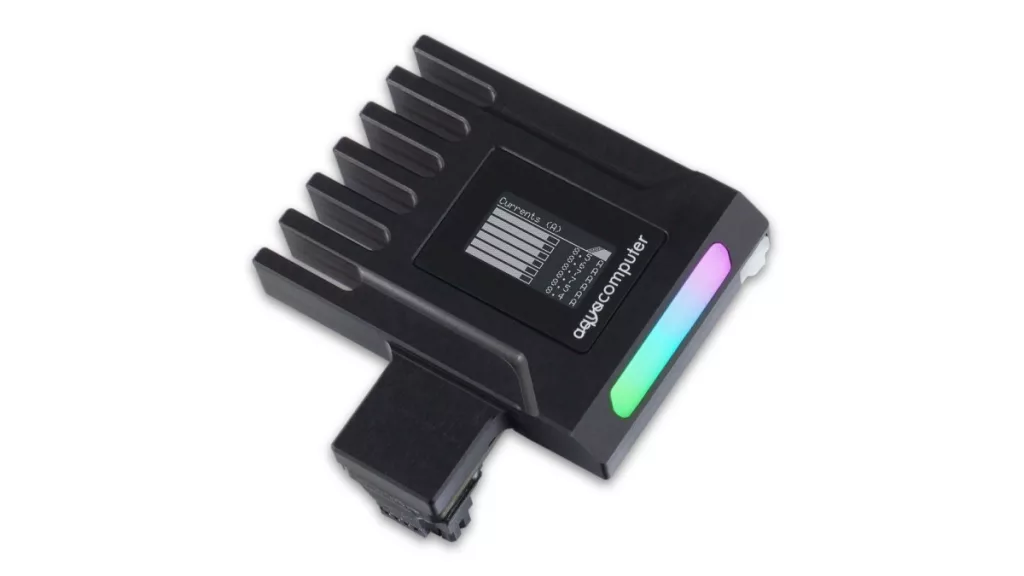
The Aqua Computer Ampinel is now available for purchase, bringing users with GPUs featuring the 12V-2×6 connector another option for increased protection. Announced back in October, the Ampinel could be the best line of defense for owners of RTX 40 and RTX 50 series graphics cards that use the 12V-2×6 connector, which has plagued many with burnt connectors/cables and damaged cards. Igor Wallossek (igor’sLab) called it “a fireman, referee and night watchman all in one” in his review of a pre-release prototype.
Numerous other adapters and PSU integrated solutions have surfaced in the last year or so, offering different levels of protection and/or monitoring, but none are quite as encompassing as what the Ampinel offers. One of the key features is active load balancing, something that NVIDIA has been criticized for not including in its RTX 40 and RTX 50 series cards or requiring its AIB partners to employ due to imbalanced loads being suspected for some incidents involving burnt connectors. However, overclockers and enthusiasts seeking to exceed the 600W power rating of the 12V-2×6 connector should be aware that not all of Ampinel’s features support more than that, and according to the adapter’s specs, it has a maximum input/output of 650W.
The Ampinel had originally been planned to launch for €80, but Aqua Computer’s engineers encountered delays while refinining its firmware, which led to additional costs. The following features and technical details come directly from the official site, where there are also many more details regarding it.
Features:
- Finely nuanced alarm management: These range from pop-up messages to automatic termination of software that causes a high GPU load, sending of definable hotkeys, shutdown of the PC, switching of alarm outputs, switching off of the Sense lines, and hard shutdown of the graphics card power supply via AMPINEL.
- Power limitation via Sense contacts: The maximum power reported by the power supply via the Sense contacts can optionally be reduced by AMPINEL to put the graphics card into a more economical operating mode. AMPINEL supports power levels of 600 watts and 450 watts.
- Configurable balancer: The balancer can be limited to a control range of 0-100%. If you only want to use the alarm functions in the event of an alarm and do not want to use balancing, you can configure the control range to 0%.
- Display and lighting: AMPINEL has an OLED display, a button, and multicolor lighting. The data to be shown on the display can be selected in aquasuite. Several alternating views are possible. Currents, voltages, and other AMPINEL measurements are quickly visualized and can assist in troubleshooting the cable.
- Connector orientation type A and type B: The difference is the connector orientation of the 12V-2×6 connector for the graphics card, corresponding to the different assembly variants of the graphics card manufacturers.
Technical Details
- Graphics card connector orientation type A or type B, fixed
- Input connector: 12V-2×6
- Output connector: 12V-2×6
- Maximum power input/output: 650 W
- Nominal Voltage: 12 V, alarm if lower than 10 V
- Nominal current per rail: 9.2 A, alarm if higher than 9.6 A for 8 seconds, immediate shutoff if higher than 20 A
- Maximum total current: 55 A, alarm if higher than 57 A for 10 seconds
- Ambient temperature range: 15 °C – 45 °C
- Maximum temperature AMPINEL: 90 °C
- Maximum power dissipation AMPINEL: 6 W, short-term 15 W for less than 10 seconds
- Display: OLED 128×64 pixels, 0,96″ black/white, 10 configurable display pages
- Illumination: 8 RGBpx LEDs, configurable