
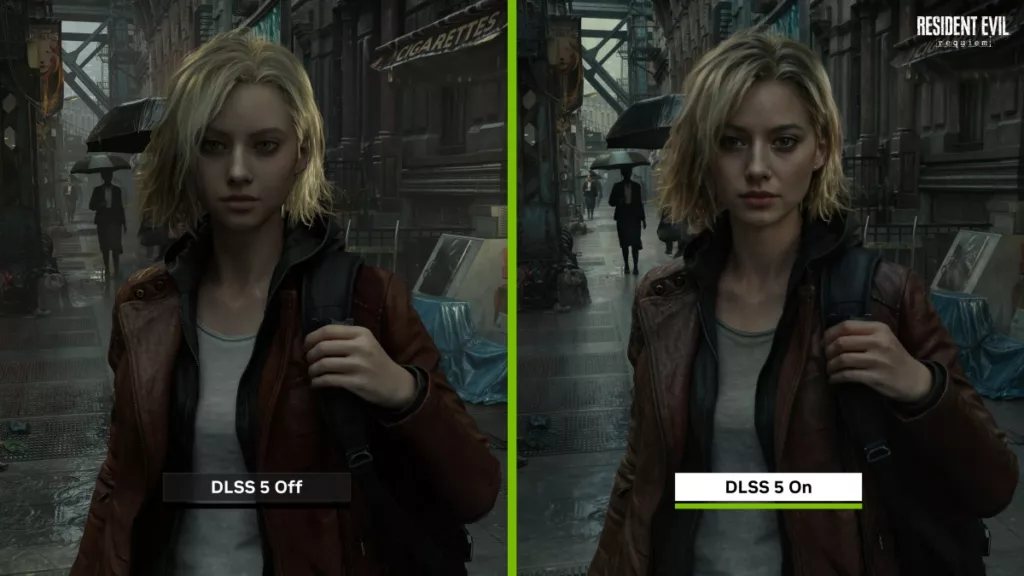
NVIDIA has introduced DLSS 5, its next iteration of upsampling technology, which is now aimed at rendering photorealistic images. DLSS 5 will utilize a real-time neural rendering model to “infuse pixels with photoreal lighting and materials,” and NVIDIA claims it is the biggest breakthrough since it first debuted real-time ray tracing in 2018 and the first version of its AI-based DLSS technology.
“Twenty-five years after NVIDIA invented the programmable shader, we are reinventing computer graphics once again, DLSS 5 is the GPT moment for graphics — blending handcrafted rendering with generative AI to deliver a dramatic leap in visual realism while preserving the control artists need for creative expression.”
– Jensen Huang, NVIDIA Founder and CEO
According to the press release, NVIDIA first began its path in advancing graphical innovations in 2001 with programmable shaders on the GeForce 3 generation. Since then, from CUDA in 2006 to ray tracing in 2018 and then path tracing and neural shaders in 2025, the GPU manufacturer has continued its goal of adding more graphical features for consumers and professionals alike. DLSS 5 is planned to launch later this year in the fall and will adhere to retaining the game’s original artistic content by using color and motion vectors for each frame input to produce photorealistic lighting and materials based on the 3D source.
“DLSS 5 provides game developers with detailed controls for intensity, color grading and masking, so artists can determine where and how enhancements are applied to maintain each game’s unique aesthetic. Integration is seamless, using the same NVIDIA Streamline framework used by existing DLSS and NVIDIA Reflex technologies.”
– NVIDIA
NVIDIA debuted DLSS 5 using 2x RTX 5090’s, one was dedicated to rendering while the other ran the DLSS 5 model. NVIDIA is currently working on optimizations so that it will run on a single GPU and will reveal which GPUs will be capable of using DLSS 5 later on. Path tracing will not be replaced by DLSS 5 but is intended to complement features such as super resolution, ray reconstruction, frame and multiframe generation by providing lighting accuracy for shadows and reflections.
Key Benefits of DLSS 5
- Cinematic Lighting: Reconstructs complex effects like rim lighting, subsurface scattering for realistic skin, and contact shadows with high-fidelity.
- Material Depth: Enhances PBR properties like roughness and adds micro-realism to complex objects such as eyes and hair.
- Temporal Consistency: Provides stable image quality from frame-to-frame that adheres to the underlying game content.
- Real-Time Performance: Delivers photorealistic enhancement at up to 4K resolution while maintaining smooth, interactive gameplay.
- Controllability: Allows game developers to tune intensity, color, and masking to determine where and how enhancements are applied to maintain the game’s unique aesthetic.
NVIDIA has partnered with game developers and publishers for the launch of DLSS, who include: Capcom, Bethesda, Warner Bros. Games, Ubisoft, Hotta Studio, NetEase, NCSOFT, Tencent, and S-Game.
Current list of titles to support DLSS 5 at launch:
- AION 2
- Assassin’s Creed: Shadows
- Black State
- CINDER CITY
- Delta Force
- Hogwarts Legacy
- Justice
- NARAKA: BLADEPOINT
- NTE: Neverness to Everness
- Phantom Blade Zero
- Resident Evil Requiem
- Sea of Remnants
- Starfield
- The Elder Scrolls IV: Oblivion Remastered
- Where Winds Meet