
S.T.A.L.K.E.R. 2: Heart of Chornobyl
S.T.A.L.K.E.R. 2: Heart of Chornobyl was released to PC in November 2024 and is based on Unreal Engine 5. S.T.A.L.K.E.R. 2: Heart of Chornobyl features UE5’s Lumen and Nanite. Lumen is used for direct and indirect global illumination, realistic reflections and a detailed environment. Nanite is used for complex geometry and detailed terrain with high-quality props. High-poly models are also used, along with physically based materials. There are post-processing effects, including volumetric smoke and fog. The game supports NVIDIA DLSS, AMD FSR 3, and Intel XeSS as well as TAA. We will be using the game’s built-in graphics preset options and adjust Upscaling where needed. We perform a manual run-through in the open world of the Lesser Zone, in an outdoor environment in the daytime in a GPU-oriented run-through.
Native Resolution
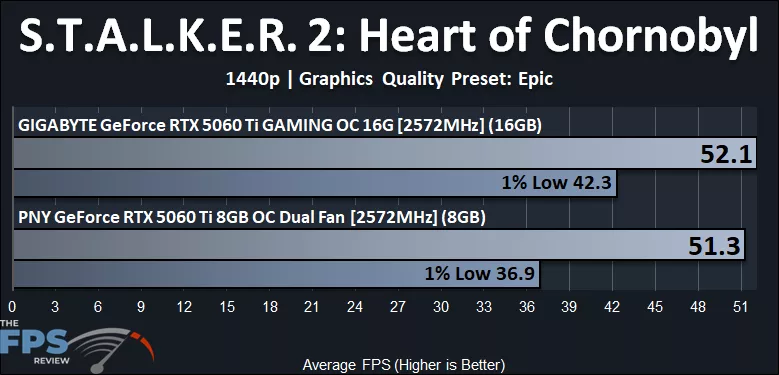
In S.T.A.L.K.E.R. 2 Heart of Chornobyl, we have the game set at 1440p native resolution on the “Epic” game quality setting. In this game, it is not playable at these settings on the GeForce RTX 5060 Ti. You will either need to enable DLSS Upscaling at 1440p or lower the in-game graphics. We do see that the GeForce RTX 5060 Ti 16GB is advantageous due to its VRAM capacity, however. The GeForce RTX 5060 Ti 16GB has a 15% faster 1% Lows.
DLSS Upscaling
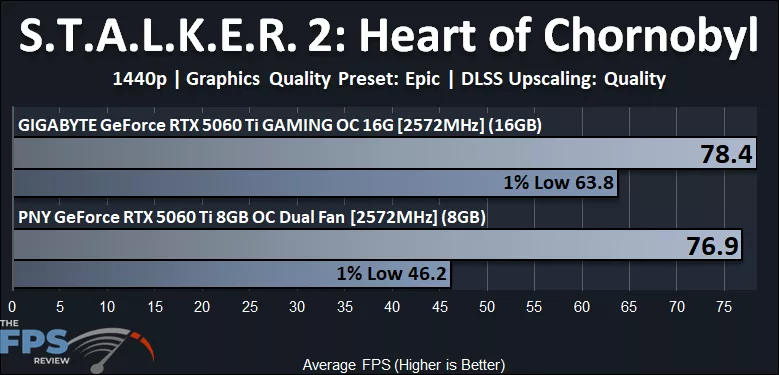
Enabling DLSS Upscaling at 1440p allows this game to be playable on the GeForce RTX 5060 Ti, but more so on the GeForce RTX 5060 Ti 16GB model. While the average framerates are close, the 1% Lows or minimums are a lot better on the GeForce RTX 5060 Ti 16GB video card. The GeForce RTX 5060 Ti 16GB is 38% faster in 1% Lows.
4K with DLSS Upscaling
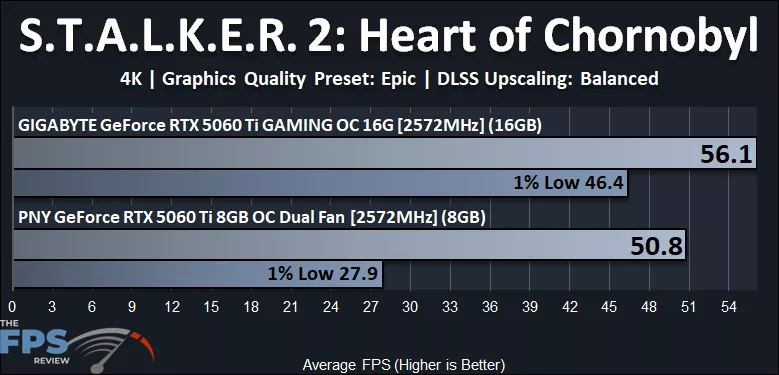
With this game being so demanding, we had to use “Balanced” DLSS Upscaling at 4K. Only the GeForce RTX 5060 Ti 16GB is near playable. The GeForce RTX 5060 Ti 16GB is 10% faster on average and 66% faster in 1% Lows.