
Black Myth: Wukong
Black Myth: Wukong was released in August of 2024 and is based on the Unreal Engine 5. Black Myth: Wukong features realistic lighting, shadows, a detailed environment detailed by motion capture, and utilizes the Lumen Global Illumination lighting system. The game also features Ray Tracing, global illumination, and shadows. We are utilizing the game’s built-in graphics preset options for main graphics and Ray Tracing. We are also using the DLSS and Upscaling option at 66% quality mode for all GPUs. We utilize the built-in benchmark for testing. We are reporting the Low 5th result from the benchmark result.
Native Resolution at Cinematic
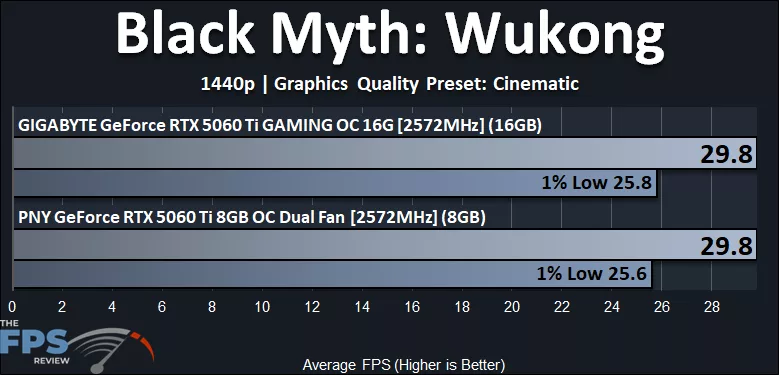
We really wanted to stress the GeForce RTX 5060 Ti in this game, so we first tried to run the game at 1440p and “Cinematic” image quality. Well, that was a bit too much for the GeForce RTX 5060 Ti to handle, with unplayable performance at 29FPS average and 1% Lows at 25FPS; both cards are the same.
Native Resolution at High
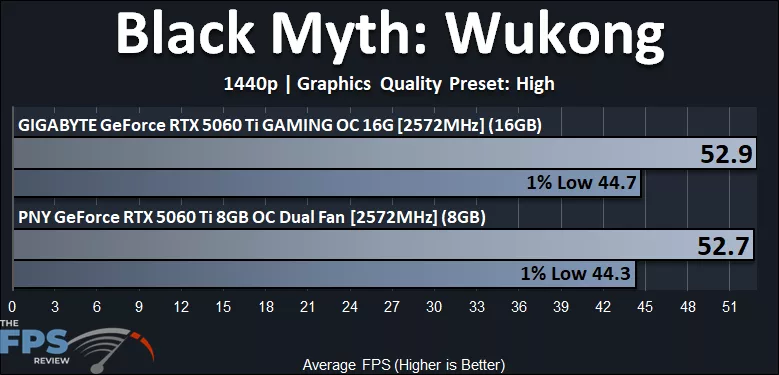
We lowered the game down to the “High” image quality setting at 1440p native resolution. The GeForce RTX 5060 Ti gives somewhat playable performance at 52FPS average, and 1% Lows in the lower 40’s. In this game, we don’t really see any difference between them in performance.
DLSS Upscaling
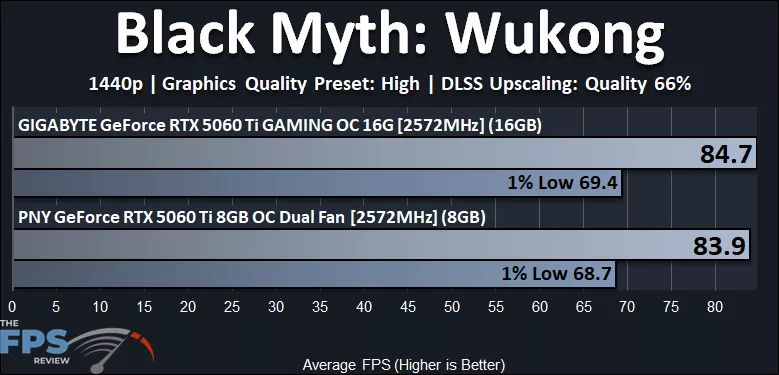
Turning on DLSS Upscaling on “Quality” at 1440p does wonders for the GeForce RTX 5060 Ti in this game, and it is now playable at 84FPS average and 1% Lows above 60FPS. The GeForce RTX 5060 Ti 16GB is only slightly faster than the GeForce RTX 5060 Ti 8GB, about 1%.
Ray Tracing with DLSS Upscaling
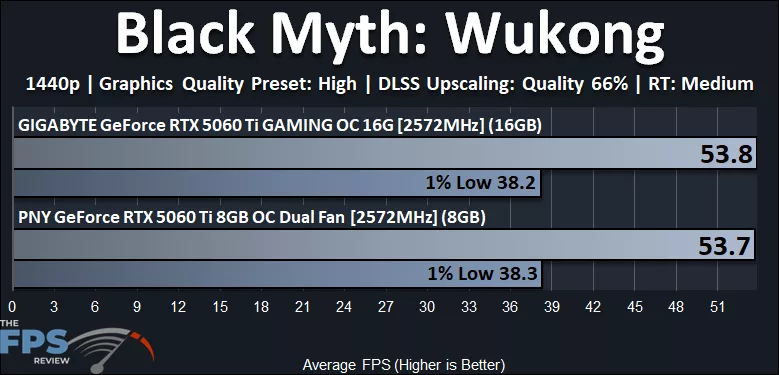
We can enable Ray Tracing in this game, but of course, the game is very demanding with it enabled, and even with DLSS Upscaling at Quality, the game is not playable on the GeForce RTX 5060 Ti. We see that both cards perform the same here, as they are render bottlenecked.
4K with DLSS Upscaling
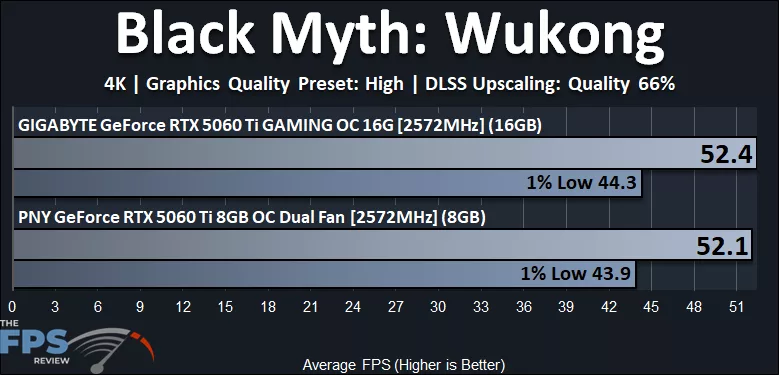
This game is also not playable at 4K with DLSS Upscaling Quality enabled; you would want to enable Balanced or Performance Upscaling to be playable at 4K. Even at this high resolution, performance is pretty much the same, with only a slight 1% difference in the 1% Lows.