
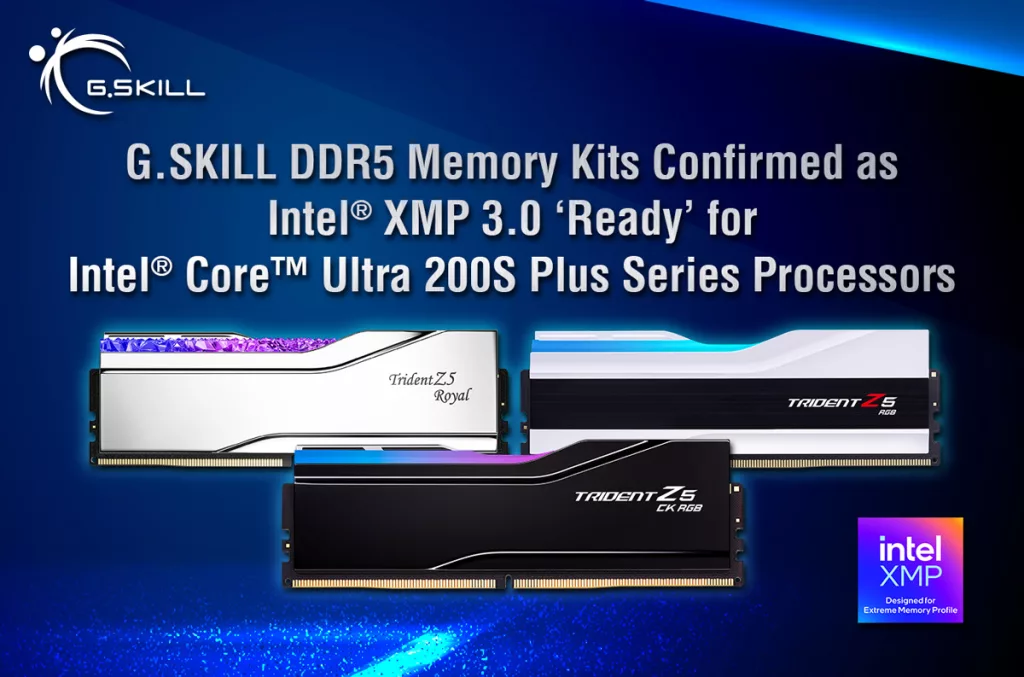
G.SKILL decided that ludacris speed wasn’t quite enough, so it has shouted from the hills about its memory overclocking prowess. Yesterday, the company announced that its existing and new DDR5 memory kits have gained Intel XMP 3.0 overclock readiness (Ed: What exactly is readiness?) for the Core Ultra 200S Plus desktop processors and compatible Z890 motherboards.
XMP 3.0 lets users enable a validated overclock profile in BIOS with a single toggle, without the trial-and-error of manual tuning. G.SKILL’s announcement covers both U-DIMM (Unbuffered DIMM) and CU-DIMM (Clocked Unbuffered DIMM) memory kits, and the company confirmed that Intel’s updated XMP memory datasheet includes its validated kits.
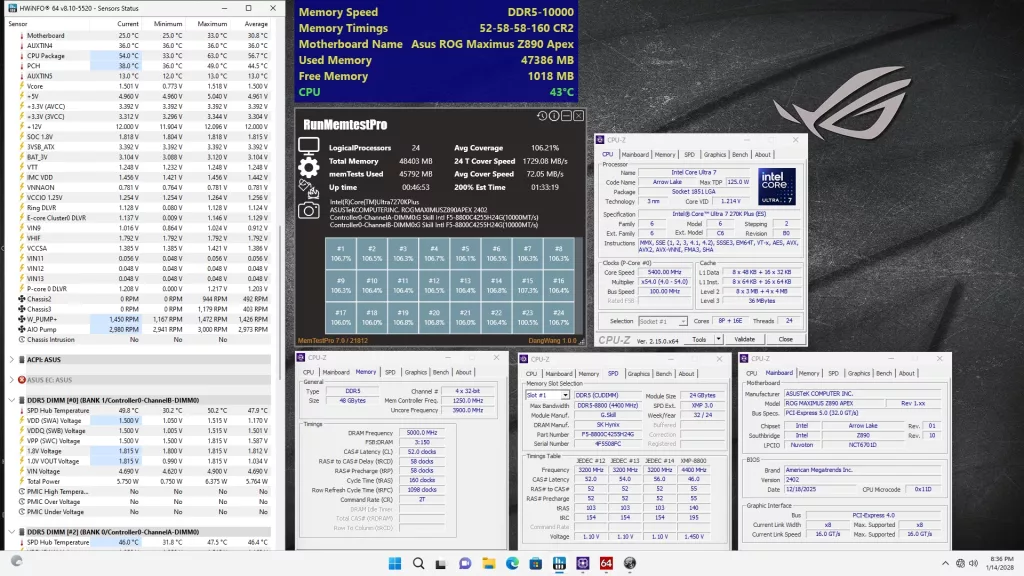
The more headline-grabbing result is the overclock demonstration that accompanied the announcement buried towards the end. G.SKILL showed a Memtest validation run at DDR5-10000 using an ASUS ROG MAXIMUS Z890 APEX motherboard paired with an Intel Core Ultra 7 270K Plus. That is a plaid number, and while DDR5-10000 is firmly in enthusiast/record-chasing territory rather than everyday builder territory, it signals that the Core Ultra 200S Plus platform has a memory overclocking headroom well beyond its rated DDR5-7200 baseline (which Intel calls a ceiling).
The official DDR5-6400 ceiling on original Arrow Lake desktop chips was one of the more criticized aspects of that platform’s launch. The jump to DDR5-7200 with the Plus refresh is an improvement for buyers using XMP kits in the DDR5-7200 range, where memory bandwidth gains can show up in gaming frame times and content creation workloads. G.SKILL also noted its existing memory kits previously validated for Intel 200S Boost overclocking profiles (rated to DDR5-8000 at 1.4V maximum) extend their validation to the 200S Plus platform.
G.SKILL is also branding this around Intel’s 200S Boost compatibility, which is an overclocking profile for unlocked Core Ultra 200S desktop CPUs on Z890 motherboards that was already in place for the prior platform generation. The new Plus CPUs inherit that support with formalized documentation.
Realistically, builders targeting the Core Ultra 7 270K Plus for a new system should plan memory budgets around DDR5-7200 or DDR5-8000 kits at most for day-one reliability. The DDR5-10000 figure is a proof-of-concept showing how far the ceiling goes for dedicated overclockers. Given the current DRAM price environment, spending on a DDR5-10000 kit as a daily driver would be a comically expensive way to get a few bits of bandwidth per second.
The updated Intel XMP 3.0 support list from G.SKILL applies to both existing Trident Z and Ripjaws families and will extend to new kits shipping in the coming months.