
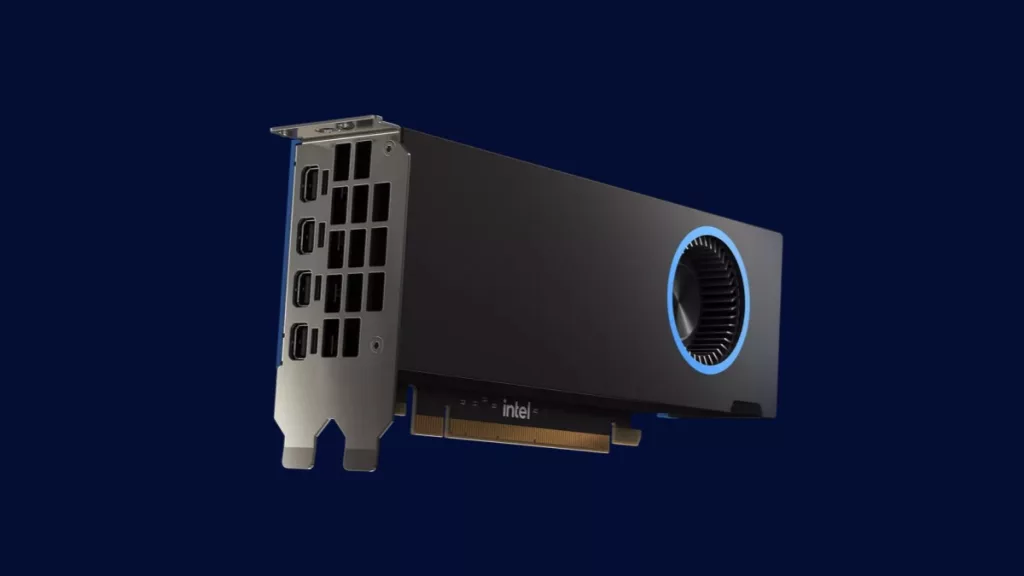
Patience has a price, and apparently that price is $949. After months of hints, leaks, and a whole lot of “any day now” energy, Intel today officially launched its Arc Pro B70 and Arc Pro B65 graphics cards: the first products built on the larger BMG-G31 silicon that enthusiasts have been calling “Big Battlemage” for over a year.
The bad news first, because you already know it if you’ve been following the story: these are not gaming cards. Intel positioned both products squarely at pro workstations, local AI inference, and multi-agent software development workloads. The Arc B770 that gamers have been hoping for remains quieter than the crickets chirping in my backyard in the dead of winter.
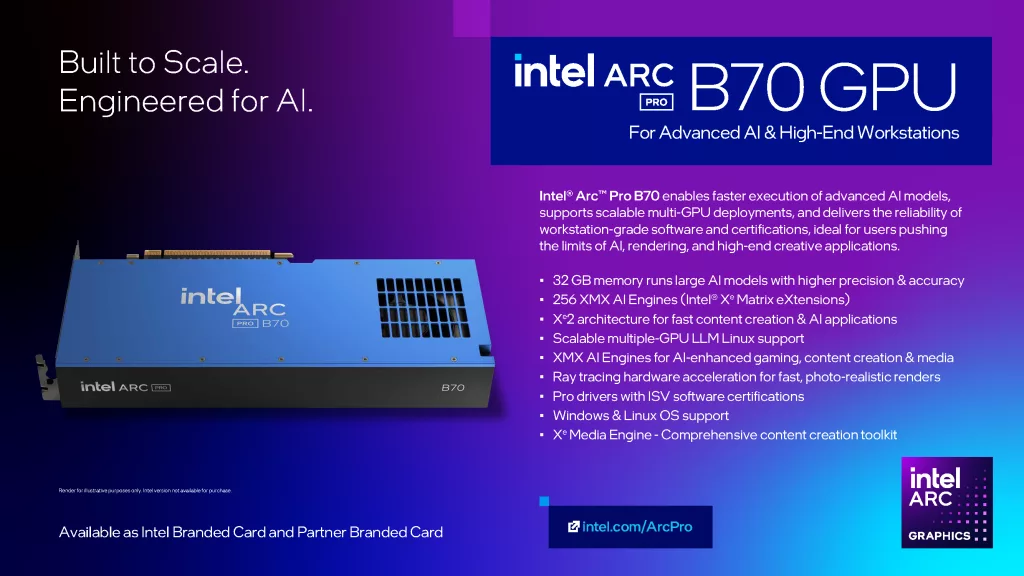

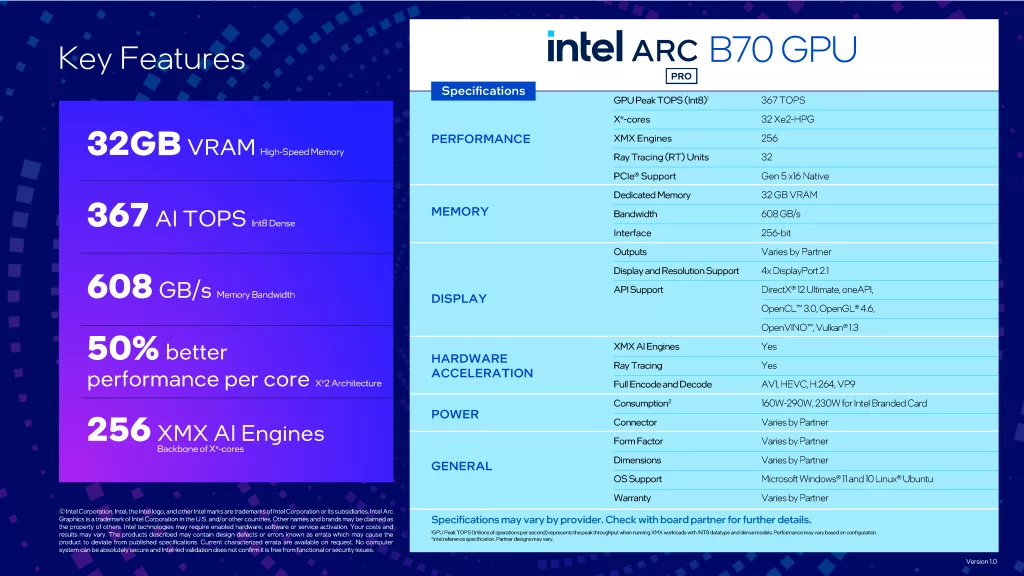
The Arc Pro B70 is the flagship. It carries the full BMG-G31 die with 32 Xe2-HPG cores, 256 XMX AI engines, and 32 ray tracing units, clocked at a rated 2800 MHz. Peak INT8 compute lands at 367 TOPS. Memory is 32GB of ECC GDDR6 on a 256-bit bus running at 19 Gbps, delivering 608 GB/s of bandwidth. Board power is configurable from 160W to 290W depending on the AIB design, with Intel’s own reference card rated at 230W. The starting price is $949, with cards available today from Intel directly and from partners including ASRock, Gunnir, MAXSUN, Sparkle, and several system integrators.
The Arc Pro B65 uses a cut-down version of the same chip: 20 Xe2 cores, 160 XMX engines, and up to 197 TOPS, clocked at 2400 MHz. Interestingly, it keeps the full 32GB of GDDR6 memory and 608 GB/s bandwidth of the B70, which makes it a compelling option for inference workloads that are memory-bound rather than compute-bound. The B65 is AIB-only, pricing is TBA, and it arrives in mid-April.
Intel’s positioning is aggressive against NVIDIA’s RTX Pro 4000, the second-cheapest Blackwell workstation card. The company claims the B70 offers up to 2.2x larger context windows and up to 6.2x faster time-to-first-token in multi-user workloads for selected large language model configurations. Intel leans heavily on BF16 quantizations in those comparisons, which favors its XMX engines; how the comparison shakes out with lower-precision formats like NVFP4 is less flattering for the blue team.
We covered the pre-launch leaks last week and at the time the gaming community was split between guarded optimism and outright resignation. Intel’s decision to push Big Battlemage into the pro market first is probably the right make the money call: smaller, more predictable customer base, better margins, and fewer driver-support headaches than the consumer gaming market, leaving a gap in the mid-range gaming GPU space. Neither AMD nor NVIDIA have yet to drop a new mainstream gaming GPU in 2026, the memory shortage is keeping prices elevated, and Intel’s consumer Arc lineup tops out at the B580. There is a real opening for a B770 or similar part, and the silicon clearly exists. Whether Intel ever fills it is an open question.
For AI developers and workstation users, though, today is a good day. Thirty-two gigabytes of ECC memory for under $1,000 is unusual in this space, and the open-source software stack Intel has been building around OpenVINO and oneAPI is more mature than it gets credit for.