
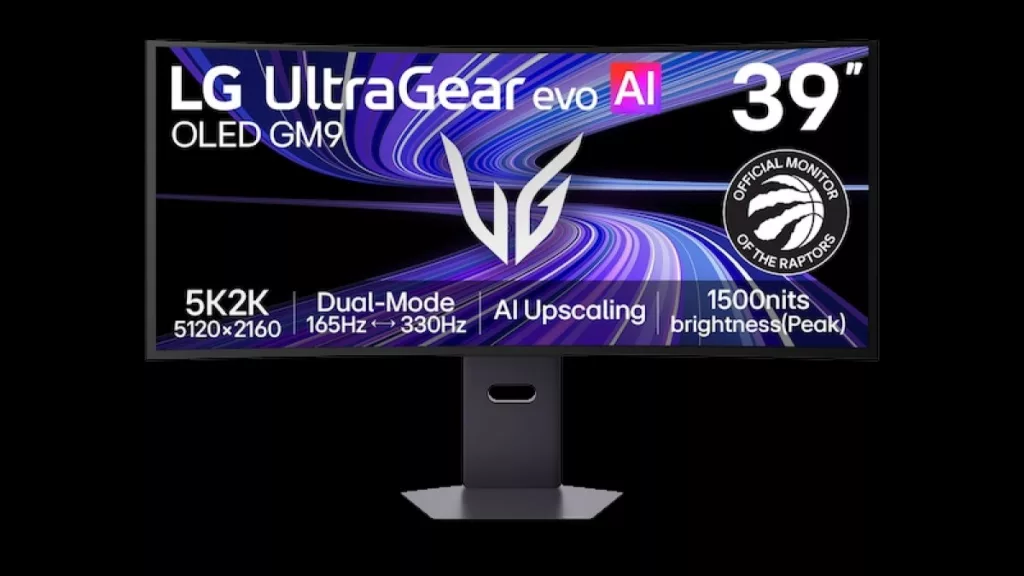
LG has launched an official product page for the LG 39GX950B GX9, which was revealed at this year’s CES, featuring a range of premium features. This 39″ 21:9 display utilizes a 4th Gen Tandem WOLED panel supporting dual 5120×2160 / 2560×1080 resolutions at 165 Hz/330 Hz, respectively, while being NVIDIA G-Sync Compatible and supporting AMD FreeSync Premium Pro. As the world’s first 5K/2K gaming monitor, the 10-bit panel is also VESA DisplayHDR True Black 500 certified with a peak HDR brightness of 1,500 nits. A 1500R curvature gives users a less aggressive curve while providing an immersive experience. LG states that with 143 PPI, the display is capable of not only producing crisp graphics but also clear text.
“With a 143 PPI (Pixels Per Inch), it delivers a precise gaming experience and better productivity. During gameplay, in-game texts, UI elements, and fine details appear clearer and well-defined, making HUDs (Head-Up Displays), menus, and on-screen information easier to read. It also enhances clarity for text-heavy tasks such as document editing, web browsing, or coding.”
– LG
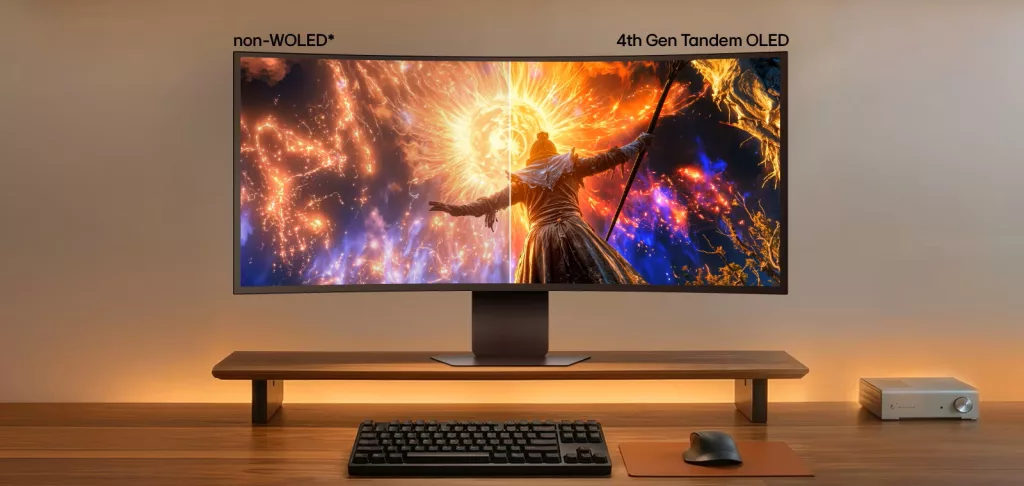
“UltraGear isn’t just for gaming — its expansive 5K2K resolution with 143 PPI delivers sharp, detailed visuals that are ideal for creators and multitaskers alike. While a typical 16:9 dual or triple monitor setup can lead to interruptions in your view due to bezels between displays, a wider 21:9 aspect ratio allows you to manage your entire workflow on a single screen. Whether you’re retouching photos, editing videos, or searching for references, everything stays visible.”
– LG
One of the standout features for the LG 39GX950B GX9 is its built-in AI processor, which can upscale content without the need for external GPU upscaling thus reducing the workload for a PC or console. In addition, AI enhances audio for clearer-sounding voices and effects to produce a virtual 7.1.2 soundscape. AI scene optimization adjusts picture temperature, sharpness, and color enhancements per content, such as office work, movies, gaming, and sports modes.
This flagship display has connectivity via DisplayPort 2.1, featuring the full UHBR20 bandwidth plus 2x HDMI 2.1 ports and a USB Type-C port supporting 90W PD. A headphone jack is provided along with 2x 7W speakers as well. LG has yet to reveal pricing for the LG 39GX950B GX9, which also marks the debut of its UltraGear evo line, but product availability details could soon be forthcoming. According to TFT Central, LG is initially offering this display with a Matte screen, but has indicated there could be Clear screen panels made available to other manufacturers for their monitors.
- Aspect Ratio: 21:9
- Brightness (Min.) [cd/m²]: 300cd/m²
- Brightness (Typ.) [cd/m²]: 335cd/m²
- Color Bit: 10bit
- Color Depth (Number of Colors): 1.07B
- Color Gamut (Min.): DCI-P3 94.0% (CIE1976)
- Color Gamut (Typ.): DCI-P3 99.5% (CIE1976)
- Contrast Ratio (Min.): 1480000:1
- Contrast Ratio (Typ.): 1850000:1
- Curvature: 1500R
- Panel Type: OLED
- Pixel Pitch [mm]: 0.1776 mm x 0.1776mm
- Refresh Rate (Max.) [Hz]: 165
- Resolution: 5120 x 2160
- Response Time: 0.03ms (GtG)
- Size [cm]: 98.7
- Size [Inch]: 38.86
- Surface Treatment: Anti-Glare, Low-Reflection of the front polarizer
- Viewing Angle (CR≥10): 178º(R/L), 178º(U/D)
- DisplayPort: YES(1ea)
- DP Version: 2.1
- HDMI Version: 2.1
- Headphone out: 4-pole (Sound+Mic)
- USB-C: Yes (1Up)
- USB-C (Data Transmission): YES
- USB-C (Max. Resolution at Hz): 5120 x 2160@165Hz
- USB-C (Power Delivery):90W
- USB Downstream Port: YES(2ea/ver3.2 Gen2)
- USB Upstream Port: YES(via USB-C)