
A round of new Arm-powered Windows laptops that feature Qualcomm’s new Snapdragon X Elite CPUs are on the horizon, and they happen to be powerful enough to beat Apple’s M3-powered MacBook Air not only in terms of CPU performance, but also AI-accelerated tasks, according to sources close with Microsoft. Qualcomm unveiled its Snapdragon X Elite brand in October 2023, calling it an AI super-charged platform that would be set to revolutionize the PC.
The Verge reports:
- “…Snapdragon X Elite processors…will ship in a variety of Windows laptops this year and Microsoft’s latest consumer-focused Surface hardware.”
- “Microsoft…is planning a number of demos that will show how these processors will be faster than an M3 MacBook Air for CPU tasks, AI acceleration, and even app emulation.”
- “…these new Windows AI PCs will have ‘faster app emulation than Rosetta 2’ — the application compatibility layer that Apple uses…to translate apps compiled for 64-bit Intel processors to Apple’s own processors.”
- “…Microsoft is planning to ship consumer models of its upcoming Surface Pro 10 and Surface Laptop 6 with Qualcomm’s Snapdragon X Elite processors inside instead of Intel’s Core Ultra chips.”
- “…Microsoft is also looking to improve video streaming on Arm-powered Windows devices with a new AI-powered feature that will ship on these ‘next-gen’ AI PCs.”
- “Microsoft’s big AI PC reveal will take place on May 20th, just a day before the company’s annual Build developers conference.”
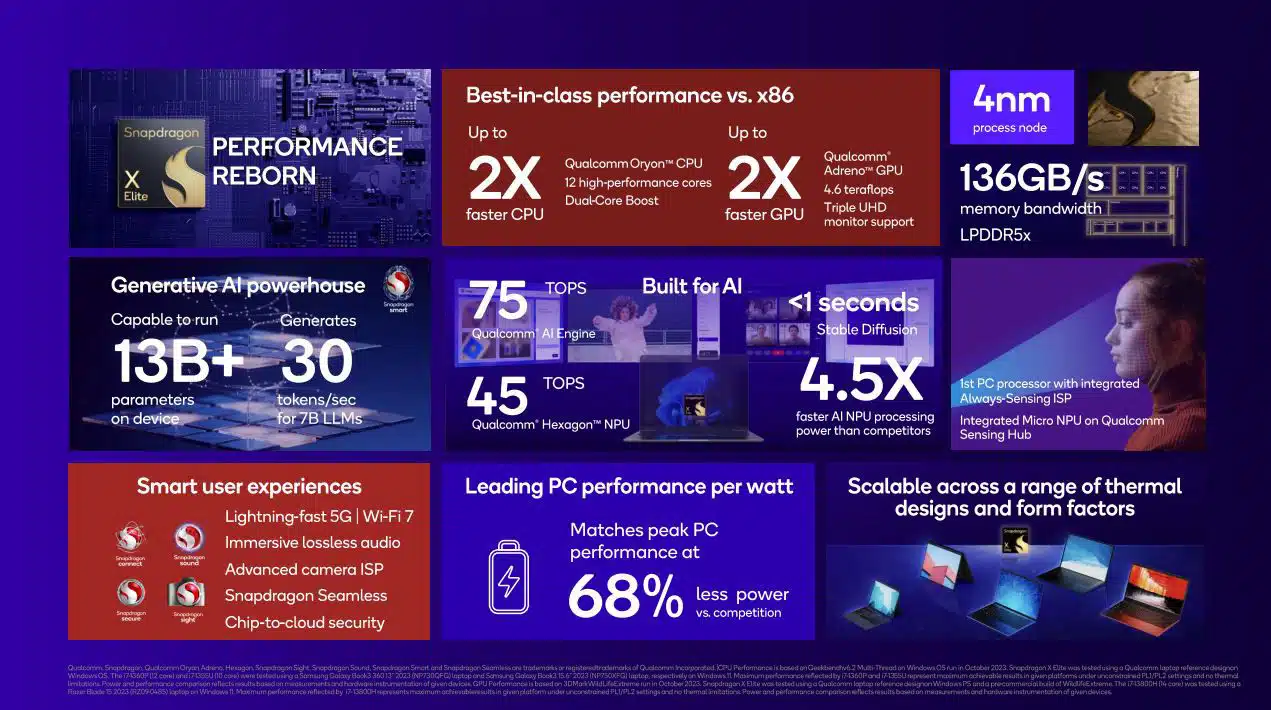
An overview of Qualcomm’s new chips:
Qualcomm on Snapdragon X Elite:
The Snapdragon X Elite platform features the custom integrated Qualcomm Oryon CPU – the new CPU leader in mobile computing – and delivers up to 2 times faster CPU performance versus the competition, matching competitor peak performance with one-third of the power. Built for AI, Snapdragon X Elite is capable of running generative AI models with over 13 billion parameters on-device and continues to expand Qualcomm’s AI leadership with 4.5 times faster AI processing power than competitors.
Discussion (6 replies)
Join Discussion →I would love to see some 3rd party results for this.
On that front are you guys putting together some sort of AI test suite for these newest CPU's?
Hmm.
So one thing Apple figured out - it’s not about having the fastest.
I have an M1 MacBook, and while it’s plenty fast enough for what I do - that isn’t what makes me like it. There are plenty of faster options if speed were the top priority.
I think that's a good question and it would really be @David_Schroth to give the best answer.
UL, the owners of PCMark, have an AI benchmark that might fit the bill here (we'll probably have access to it). Given that both next gen AMD and Intel desktop chipperies will have "AI" capabilities, I'm guessing @Brent_Justice will include this in the CPU reviews of the next gen chippries...
I have a laptop with a 155h if you want me to give it a try.
that's one of the Intel Core Ultra CPU's.
Good idea, I have downloaded our copy of UL Procyon, and they have indeed updated it with the two latest AI benchmark tools now, which weren't there before. I checked it out, it appears that one of the benchmarks is for GPU and the other lets you switch and test between GPU and CPU. It looks like I'll have to use the AI Computer Vision Benchmark, which uses the Windows ML API on the CPU. The AI Image Generation Benchmark only seems to provide GPU testing with different LLMs. In the AI Computer Vision Benchmark, you can test Float32, Float16 and Integer, so I'll have to figure out which is more relevant. Once I figure it out, and the data it provides, I'll figure out how to graph it, and then I should be able to use it in upcoming Zen5 launch.
I wasn't using Procyon previously because it requires you own licenses for the apps it tests, for like content creation, and office programs, and such, so I'd have to have separate licenses for software for the benchmarking PC, and that gets expensive, but thankfully the two new AI benchmarks do not require extra software, all the benchmarking and LLMs seem to be included, so I'm able to use that part of it.