
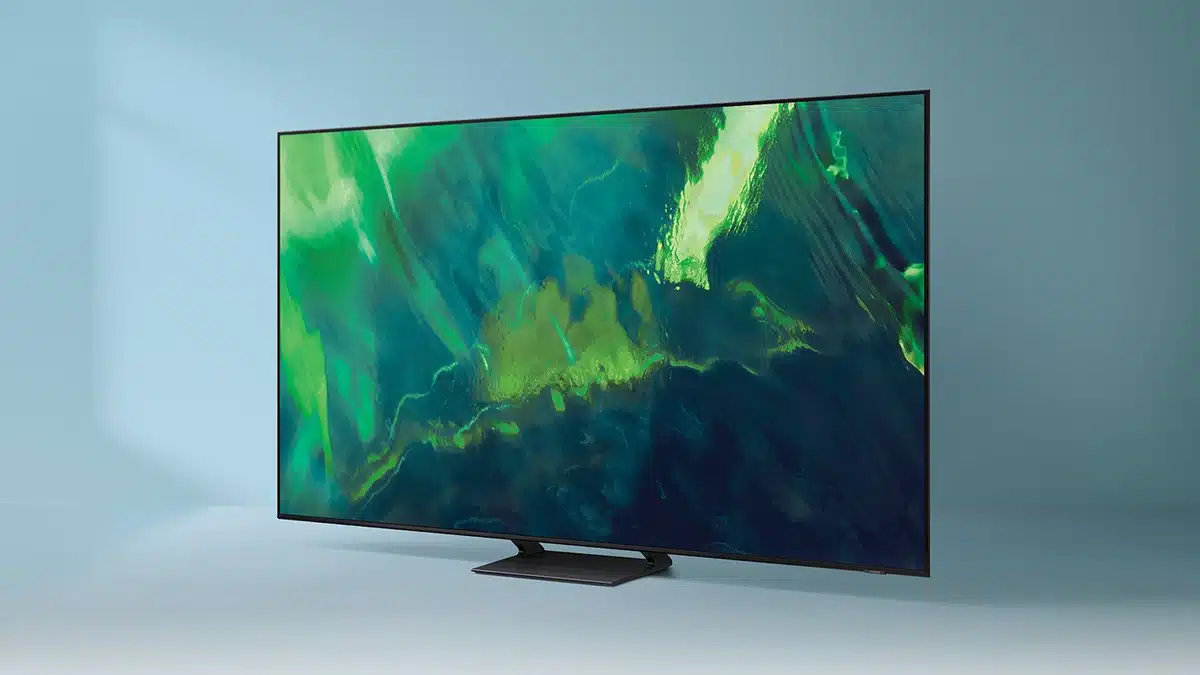
Edge-Lit TVs, a type of LED television that places light-emitting diodes around the perimeter of the screen in order to illuminate the display, may suffer from signs of deterioration, including visible uniformity issues, as early as 2,200 hours of use, according to new tests that have been published online. This is around one year of use for a typical U.S. household, per a report that explains how thin LCD TVs break faster under prolonged use, derived from data that was gathered after running 100 TVs for over 10,000 hours.
Some of the TVs where uniformity issues appeared relatively quickly:
- Samsung AU8000 2021 (2,200 hours)
- Samsung Q70A QLED 2021 (2,200 hours)
- Samsung Q60A QLED 2021 (2,200 hours)
- Samsung The Frame 2022 (3,300 hours)
- LG NANO85 2021 (3,300 hours)
From a report:
- “Not considering major electronic or electrical failures (e.g., power supply failures, motherboard failures, burnt connectors, etc.), many uniformity issues have popped up on TVs in our test.”
- “Excluding the 18 OLEDs, which have burn-in from constantly streaming CNN, over 25% of the 82 LCD TVs in our test suffer from visible uniformity issues.”
- “Seven out of the eleven (64%) edge-lit models in our test suffer from uniformity issues, one has outright failed, and others are in the process of doing so. In contrast, only 14 out of the 71 (20%) full-array local dimming (FALD) and direct-lit TVs have uniformity issues.”
- “It didn’t take 10,000 hours for issues to appear on our tested edge-lit TVs. Of the seven with visible uniformity issues, three started showing signs of deterioration at 2,200 hours of testing or sooner…”
A video that reveals many of the problems, including warped reflector sheets, cracked light guide plates, and burnt-out LEDs:
RTINGS added:
Our sample size is modest in absolute numbers, but it offers good insights into the long-term durability of edge-lit TVs from both Samsung and LG when subjected to our test conditions. So many LG and Samsung edge-lit TVs are in our test because they’re the market leaders for these products, with Samsung being the most represented manufacturer with eight edge-lit TVs in our test. For reference, they’re run at their maximum brightness setting and subjected to thermal cycling through on/off cycles every day.
Discussion (5 replies)
Join Discussion →That sucks.
Luckily these are usually pretty low cost units though, right? Still, I wouldn't want to replace my TV every year.
Edit:
After some googling I have found that they may be cheaper than an equivalently sized OLED TV, but that doesn't mean they are cheap.
That sucks a lot.
Don't buy these folks.
I also never quite understood peoples obsession with thin TV's which is what drives this demand. Just make them nice and thick, and design them to work well instead. The aesthetics of the screen itself don't matter. It's what is displayed ON the screen that is the important part.
I got a 75" Hisense for ~$400 on BF deal from Bestbuy back around 2019-2020. It lasted about 3 years until one of the arrays gave out. At that point I googled how to replace and the process is a bit insane and totally not worth it. It got replaced by an LG C3 OLED and couldn't be happier.
Thin TVs are also a pain in the @ss to hold and move, and way too fragile. The flex on those things make me hella nervous. My Samsung HDTV from 2009 with its nice thick frame is easy to carry and hold, but modern TVs? No way man. And I hope you keep the retail box around in case you ever need to transport such a TV somewhere.
I had to help a friend and his dad wall-mount a 77" OLED. Yeah, that was a fun time...
It's astounding how the masses don't really seem to get this. And because that's what the masses want, that's what the stupid-@ss manufacturers make and sell.
Yep, felt that with our LG C9. Wife and I have our share of injuries and age related stuff and that thing scared the crap out of me when I was trying to install its stand, and with her help just to keep it balanced on a coffee table and then help hoist a few feet to the TV table. Speaking of boxes, I've noticed after having a couple of TV's delivered now that they will usually use the box as support to install stands and whatnot. It was probably true of the C9 but I didn't catch that detail back then.
Too true but a mixed blessing as well. I had a buddy come over a couple of months ago to help move the Sony Z9D 65", definitely not a thin one, from one room to the next, all we had to do was carry from one desk to the next, and wow, I was really surprised how heavy that thing got when traveling around 50+ feet.
Hell.. I still have an old Vizio 32" TV from back in 2007?? Damn thing is still kicking and screaming to this day. Thick sides.. Little heavy to carry but damn, that thing takes a licking and keeps on ticking.