
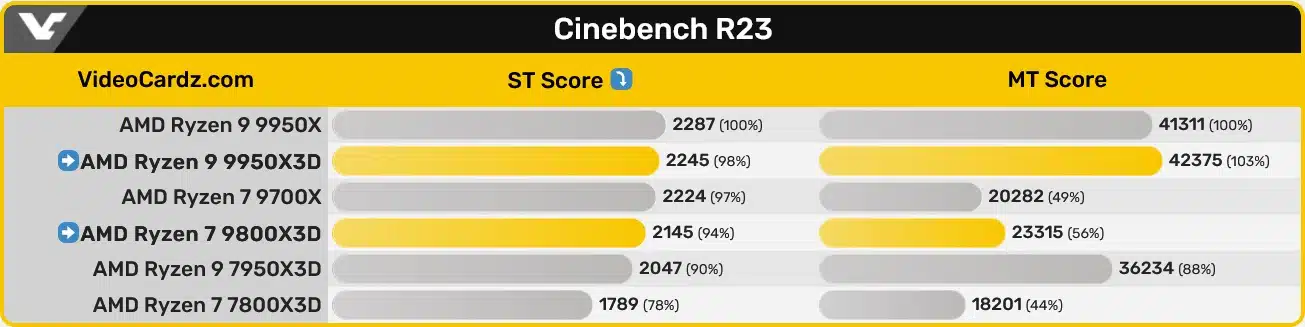
Rumored AMD Ryzen 9000X3D Cinebench R23 benchmark scores have been leaked and if accurate, things are looking good for the upcoming chips. Folks who skipped the 7000X3D series could be in for a treat if these rumored AMD Ryzen 9000X3D scores pan out to be true. This latest leak comes via Code Commando who previously, and accurately, leaked info for the Ryzen 9000 series prior to AMD’s official announcement. This latest batch of data does not identify specific processors but does break them down by specifications and scores.
CodeCommando (via X formerly Twitter):
- 8-Cores Ryzen 9000X3D on Cinebench R23:
- Single-Core: ~2,145
- Multi-Core: ~23,315
- 16-Cores Ryzen 9000X3D on Cinebench R23:
- Single-Core: ~2,245
- Multi-Core: ~42,375
Ryzen 7 9800X3D Cinebench R23 breakdown:
The 8-Core CPU is believed to be the Ryzen 7 9800X3D and if this data is accurate it is showing significant gains over the previous Ryzen 7 7800X3D. These scores show the upcoming gaming CPU is 20% faster in single-core usage and up to 28% in multi-core scenarios. For those still holding onto their AM4 platform with a Ryzen 7 5800X3D, the Ryzen 7 9800X3D could have as much as a 69% gain in single core and a 64% gain in multi-threaded usage.
Ryzen 9 9950X3D Cinebench R23 breakdown:
The 16-core CPU is believed to be the Ryzen 9 9950X3D and if this data is accurate, it is still showing gains, albeit not quite as impressive, over the previous Ryzen 9 7950X3D. These scores show the upcoming gaming CPU is 10% faster in single-core usage and up to 17% in multi-core scenarios. While these synthetic benchmarks might not be as impressive, gaming performance might be substantially better if another rumor pans out to be true. It’s been said that both the Ryzen 9 9950X3D and Ryzen 9900X3D will feature 3D V-cache on both CCD chiplets, which could give them a significant leg up in select games.
VideoCardz has combined scores from a recent review from Guru3D for the Ryzen 9 9950X processor, which narrowly loses out to the Intel Core i9 14900K in single-core performance but then takes a major lead in multi-core use. Below is the VideoCardz table but then also scores from our own review.


Discussion (19 replies)
Join Discussion →I may just end up plopping one of these in my current board and sell the 7800X3D at some point. I guess we'll see when they'll release them.
With both CCDs having X3D cache... aside from applications getting scheduled across both CCDs and then incurring the inter-CCD latency penalty, these SKUs should be good to go for both gaming and productivity.
So now to direct-die and forget about CPU temperature for 5+ years!
Is this for 670e or 870e boards? Does it even matter?
Yes to both, and no.
From what I've seen and read, the X870 series is really not worth it.
I'd say that comes down to prices, features, and availability of individual boards for individual usecases. For those at all budget conscious, they're probably not worth buying up for, sure.
Wait, the 9950X3D will have 3D Cache on BOTH of the CCDs this round? Say it's not so.
I've got a link for that in the article. 9900X3D and 9950X3D if I remember correctly.
That's the rumor!
Cinebench is an odd benchmark to use to show off an X3D part as the extra cache usually does not benefit that type of load.
...unless the intent is to illustrate that - unlike previous X3D chips - it does not suffer at that type of loads due to reduced clock speeds.
I randomly watched this video last night:
[embedded media]
I am not familiar with the channel at all, but they made some interesting points about how the interconnects (TSV's) for the 3D V-Cache look very different than the previous gens.
There is a suggestion that AMD may have some sort of surprise in mind for the X3D parts in Zen5 because if they are the same size as in the past, they will block large portions of the integer cores due to the new layout of Zen5. This would be disastrous for heat dissipation.
The above Cinebench scores (if the rumor is real) in combination with these findings on the TSV locations and Zen5 layout makes you wonder if AMD maybe has devised some new way to dissipate heat over 3D chip stacks, allowing the 3D V cache to sit there without trapping heat as much, and thus allowing them to have better clocks on X3D parts.
This is all speculation, but still kind of interesting. I think the 9000 series X3D launch may be an interesting one.
And there we have it.
[URL unfurl="true"]https://www.techpowerup.com/328160/amd-ryzen-7-9800x3d-has-the-ccd-on-top-of-the-3d-v-cache-die-not-under-it[/URL]
Nothing as complicated as I was thinking. They are simply reversing the order of the chips in the stack. 3D-Vacahe (which produces much less heat) goes on the bottom, and hot main Zen5 chip with all of the integer and floating point cores goes on the top. This allows the X3D to have the same clocks as non-X3D variants.
It's a stupid simple solution in a "why didn't we do it this way from the beginning" kind of way. I bet there was a collective "duh" moment when someone thought of it.
@Peter_Brosdahl and/or @Tsing This is probably front page news worthy.
Man, please have it on both CCDs. PLEEEEEEEEEEEEASE
I wonder, what workloads do you see benefiting from that?
Gaming is generally best if restricted to the same CCD anyway due to cross-core latencies. Isn't that what the Microsoft game bar thing tries to do for you whenever you launch a game?
Primegrid will benefit from it greatly.
What is Primegrid?