

ASRock has listed the AMD Ryzen 9 9950X3D2 processor on a now-deleted news page announcing support for the unreleased AM5 processor. Rumors about AMD’s first-ever dual CCD package featuring dual 3D V-cache have circulated since last year, and at one point, it was expected to be released in early 2026. The processor’s X3D2 designation indicates that each of the dual 8-core/16-thread CCDs will have its own 96 MB L3 cache, for a total of 192 MB L3, compared with the single 3D cache in the previous Ryzen 9 9950X3D, which had been released in November 2024. AMD has been silent on the release of this flagship part, but ASRock may have seemingly jumped the gun in its own announcement, which had been spotted by VideoCardz before being taken down.
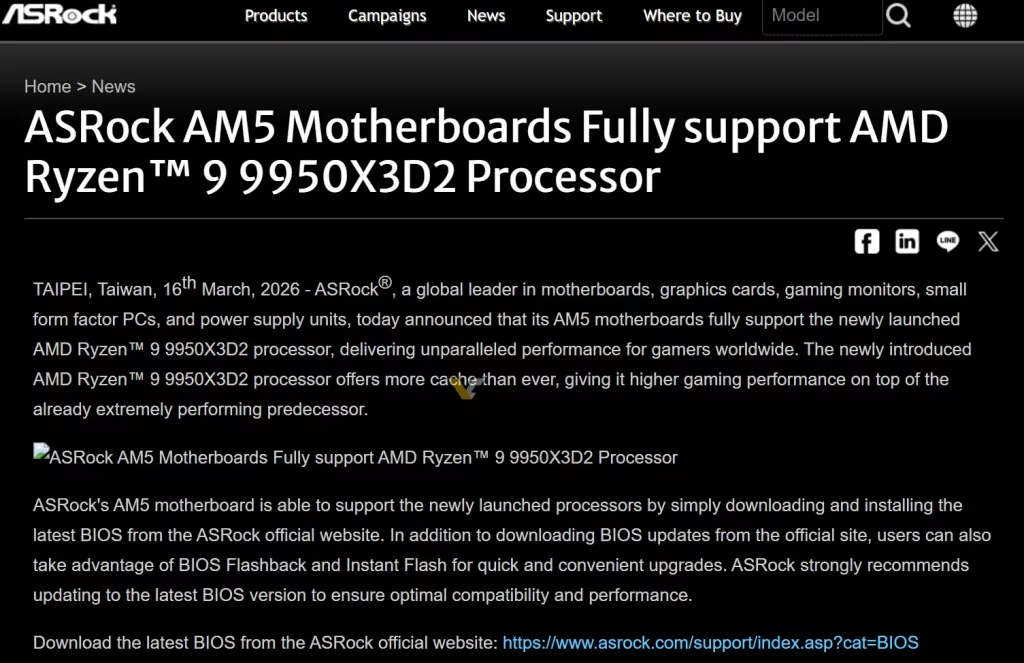
The 16-core / 32-thread Zen5 package would supposedly be only slightly downclocked to 5.6 GHz compared to that of its predecessor, which tops at 5.7 GHz. TDP is said to be increased to 200 Watts from 170 Watts. This processor would be the cherry on top for the Zen 5 Granite Ridge lineup and a true HEDT part claiming the throne for both gaming and productivity, although good luck affording the memory if wanting to provide it with its max limit of 256 GB DDR5. Below is a table listing of Granite Ridge processors featuring 8-core CCDs.
| Processor | Cores/Threads | Maximum Clock | L3 3D V-Cache | TDP |
| Ryzen 9 9950X3D2 | 16/32 | 5.6 GHz | 192 MB | 200W |
| Ryzen 9 9950X3D | 16/32 | 5.7 GHz | 128 MB | 170W |
| Ryzen 7 9850X3D | 8/16 | 5.6 GHz | 96 MB | 120W |
| Ryzen 7 9800X3D | 8/16 | 5.2 GHz | 96 MB | 120W |
Anything is possible these days when it comes to new product releases, and since it’s common for competitors to wait until a rival unveils something, AMD could be waiting to see Intel’s hand before officially announcing the Ryzen 9 9950X3D2. One thing that is odd and worth mentioning is that normally, by now, there would’ve been benchmark leaks online, and so far, none have been confirmed. Gamers have largely been interested in this part, and more so are curious to see if AMD has refined scheduling between the two CCDs and what gains can be seen with games, so a lack of benchmark leaks is curious to say the least.
Discussion (2 replies)
Join Discussion →Ill be interested to see if AMD was full of crap or not about 3dvcache on two cpu chiplets.
They made thenstatement that there was no tangible benefit to that when we were all hoping that would be the 9950x3d.
[URL unfurl="true"]https://www.phoronix.com/news/AMD-Ryzen-9-9950X3D2[/URL]