
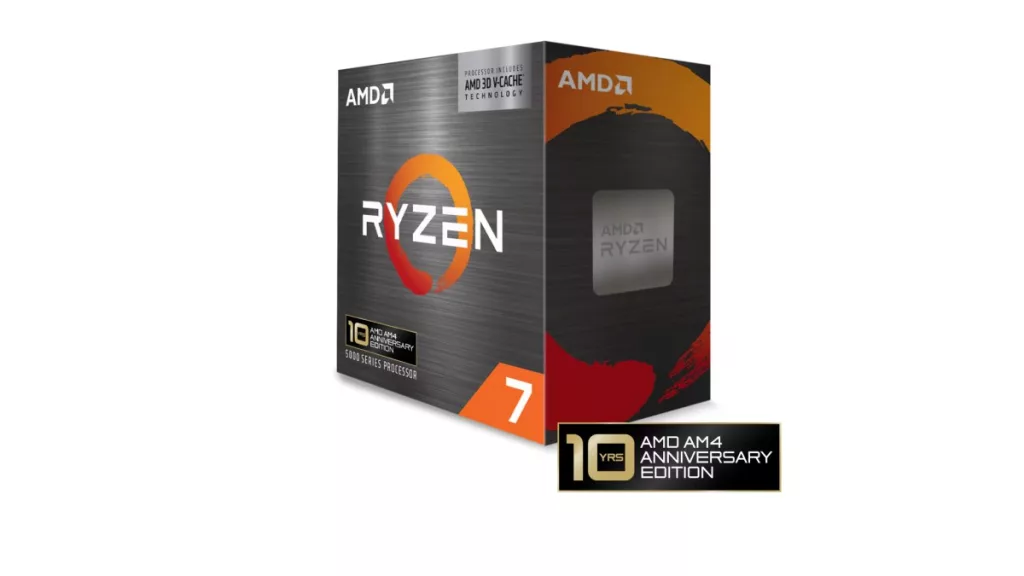
While the AMD Ryzen 7 5800X3D 10th Anniversary Edition may share the exact specifications with the original model, there is a notable change in its manufacturing process. Those who may have believed that AMD simply flipped the switch to restart fabbing of the iconic processor should know that is not the case, and the chip manufacturer actually had to re-engineer it so that a newer process could be used. David McAfee, VP and GM of AMD’s Radeon and Ryzen divisions, clarified (via Tom’s Hardware) how the Ryzen 7 5800X3D made its comeback.
“It’s not as simple as just bringing back the 5800X3D,” McAfee said. “The original stacking process that was used at TSMC changed when we went from first-gen to second-gen cache, so we had to re-engineer that product, and there actually was a fair amount of development that went into bringing back the 5800X3D.”
– David McAfee, AMD VP and GM Radeon and Ryzen
Now, when McAfee refers to the 2nd-gen CACHE, he is not talking about the reversed stacking seen with the Zen5 9000-series X3D processor, where the 3D-CACHE was “flipped” to the top of the die. Here, the devil in the detail is the bonding process being used. The original 5800X3D used a different bonding process, which has since been phased out and changed when the 7000-series launched, and then used again when the 9000 series was released. This new 10th Anniversary Edition 5800X3D, a reference to 10 years since the AM4 platform launch and not the 2022 release of the original 5800X3D, used the process seen with the 7000 series, aka 2nd gen.
“It completely changed the characteristics of how those two pieces of silicon are bonded together and how they were stacked together, and so when that first-gen facility really kind of went offline, then it meant there was a whole, you know, body of engineering work that had to be done to understand if we could even migrate the 5800X3D to the new, second-generation stacking process,”
– David McAfee, AMD VP and GM Radeon and Ryzen
So there you have it. Something sort of old matched with something slightly newer to bring back a classic. It’s also been theorized that the old process getting phased out played a contributing factor to the disappearing inventory of original 5800X3D and 5700X3D processors.
Discussion (13 replies)
Join Discussion →Pretty insane that they thought the effort was necessary for an old Zen3 chiplet rather than doing something slightly more ambitious and useful like getting 7500X3D backported to AM4.
Maybe they were sitting on a huge inventory of Zen 3 CCDs?
People don't have money for new hardware so they just keep shilling 3 gen old hardware... sounds right to me. Gotta make money somehow.
Hey, I've still got one of the originals running with a RTX 5090 and it's doing well. Sure my 9800X3D is a bit better in various ways but I'm very impressed with how the 5800X3D is holding up.
Cache is king!
One of my clients grabbed a 5700X3D at the end of 2024 so he's happy about that. His brother, another one of my clients, missed out on that. He had been hoping for the 5800X3D to come back. Now it is, but it's too expensive forr him. So he's thinking he will probably just grab a Micro Center bundle and move to AM5. As for me, @Peter_Brosdahl hooked me up with my 5800X3D, and I am very grateful.
I didn't realize it was gonna be so much trouble for AMD to bring it back though. Props to them for the effort.
Nothing wrong with the 5800X3D yesterday, today or tomorrow. It still holds its own amongst the top contenders.
Nothing wrong with the 5700X3D either. Still a beast. I gave mine to my nephew. With a 4070 Ti Super it rocks any game quite well.
Shot straight to the top spot and somewhat radically shook up the top 8 positions. I can't remember the 9800X3D falling below 2. 4 5000 CPUs in the top 6 spots, over half way through 2026 is beyond remarkable.
That kind of happens when RAM is 50% of the entire computer budget on a newer platform.
Yea it's stupid and over on the reddit's you know the experts over there. Claiming DDR4 3600MHZ is slow... it's like guys eat a dick for DDR4 that's great!
And so many of us have 32GB or more already, bought when it was dirt cheap.
That's what I'm running in my 5800X3D rig, and I've got no complaints for gaming. My 9800X3D rig is slightly faster but not enough for me to jump up and down about; it's just more efficient with lower power and heat.
Im still kicking myself for not buying a couple more 32gb kits of the cheap patriot ddr4 a couple of years ago. $72 for good 3200mhz ddr4.