
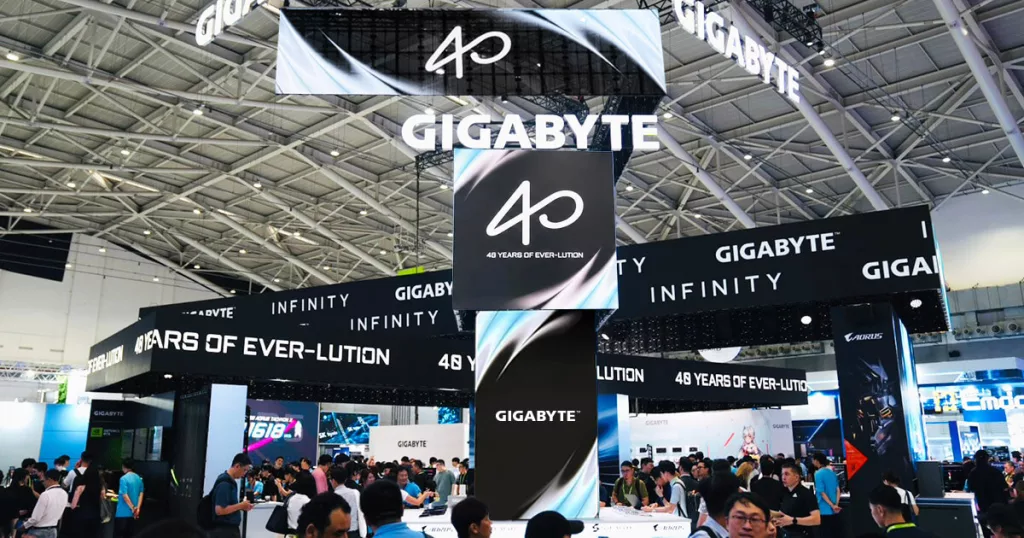
Forty years in, GIGABYTE is not exactly slowing down. The company used Computex 2026 to unload one of its largest single-show product dumps in recent memory, spanning graphics cards, flagship motherboards, a local AI computing platform, a pair of new monitor lines, and a full peripheral refresh, all united under the “ENTER INFINITY” banner and the company’s 40th anniversary branding. There is a lot here, so let’s work through it category by category.
AORUS GeForce RTX 50 INFINITY Series GPUs
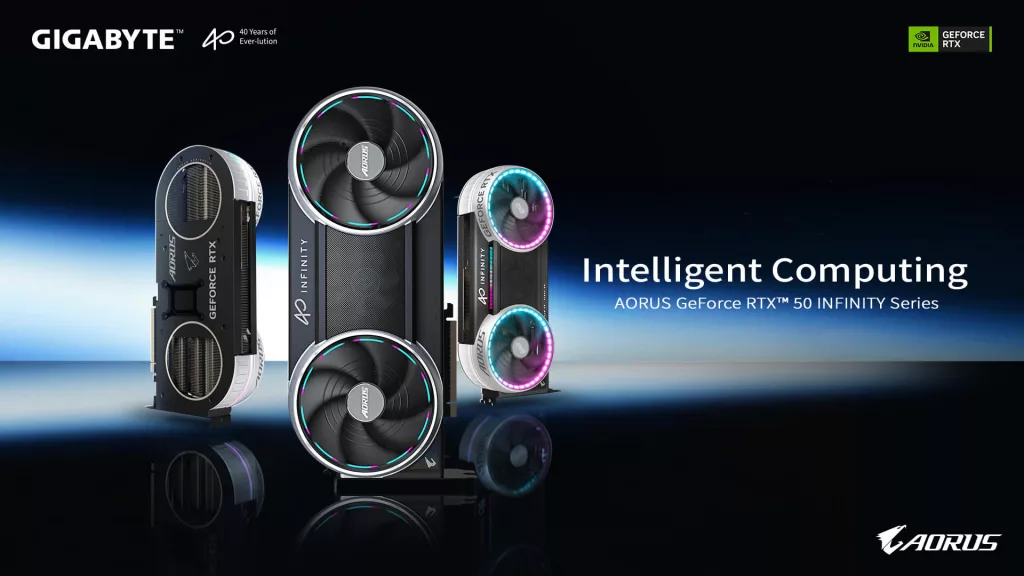
The most immediately relevant announcement for PC builders is the expansion of the AORUS RTX 50 INFINITY GPU lineup. The AORUS RTX 5090 INFINITY debuted at CES earlier this year, and GIGABYTE has now filled out the stack with the RTX 5080, RTX 5070 Ti, and RTX 5070 all receiving the INFINITY treatment. The headlining cooler across all four SKUs is the WINDFORCE HYPERBURST system, which uses a Double Flow Through design to push air through both sides of the backplate. GIGABYTE claims the patented Hawk fan design delivers 53.6% more air pressure and 12.5% more air volume compared to conventional fans, with a dedicated Overdrive fan in the center spinning up independently under heavy load.
The more interesting detail for builders is the rear-routed power connector. GIGABYTE has moved the connector to the back of the card on all new INFINITY models, so cables route behind the motherboard tray rather than dangling in front of the GPU. It is a clean solution to a persistent aesthetic headache, and one that a growing number of AIB partners are starting to adopt. The familiar RGB Halo lighting ring rounds out the visual package for those who want it.
X870E and X870 AORUS INFINITY Motherboards
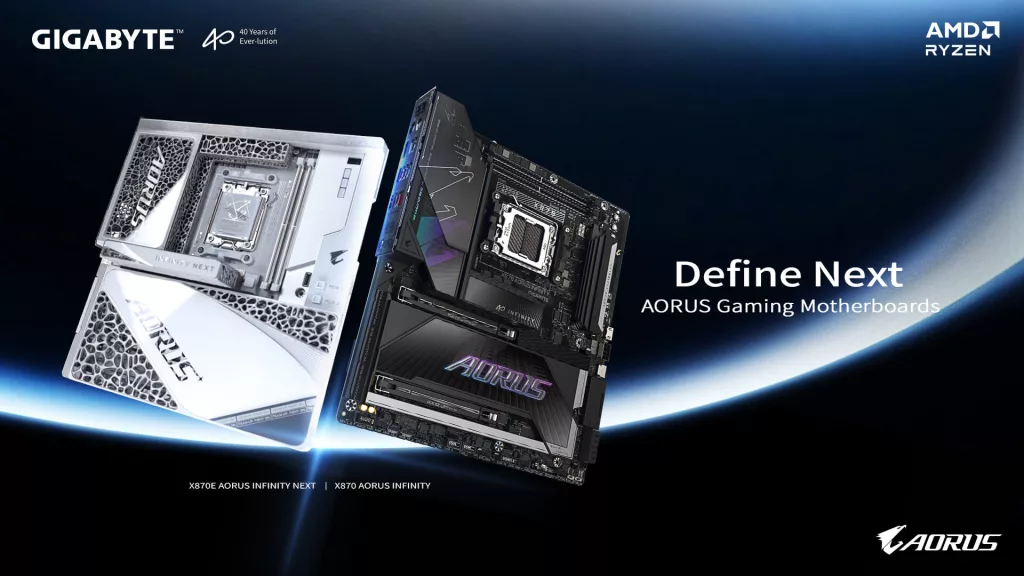
On the platform side, GIGABYTE debuted the X870E AORUS INFINITY NEXT and X870 AORUS INFINITY as its 40th anniversary flagship boards, both targeting AMD Ryzen 9950X3D2 platforms. The headline feature is X3D Turbo Mode 2.0, an onboard hardware chip that monitors workload behavior in real time and applies AI-trained overclocking decisions on the fly, rather than relying on static profiles.
The X870E AORUS INFINITY NEXT is the wilder of the two in terms of engineering theater. Its AI Gyroid M.2 heatsink is only manufacturable via 3D metal printing and reportedly delivers 44% greater cooling surface area than conventional designs. The board also carries a 3D-printed vapor chamber, honeycomb metal backplate, and 64 power phases using Quad OptiMOS technology rated for a claimed 5,120 amps of total current capacity. The X870 AORUS INFINITY takes a more targeted approach, pushing CL24 DDR5 timings, claimed to be twice as tight as standard timings, for a 20% memory latency advantage on the AM5 platform. Memory support tops out at 11,400 MT/s across both boards. Pricing and availability were not announced.
AI TOP 100 B850: Local AI Workstation Tier Expands
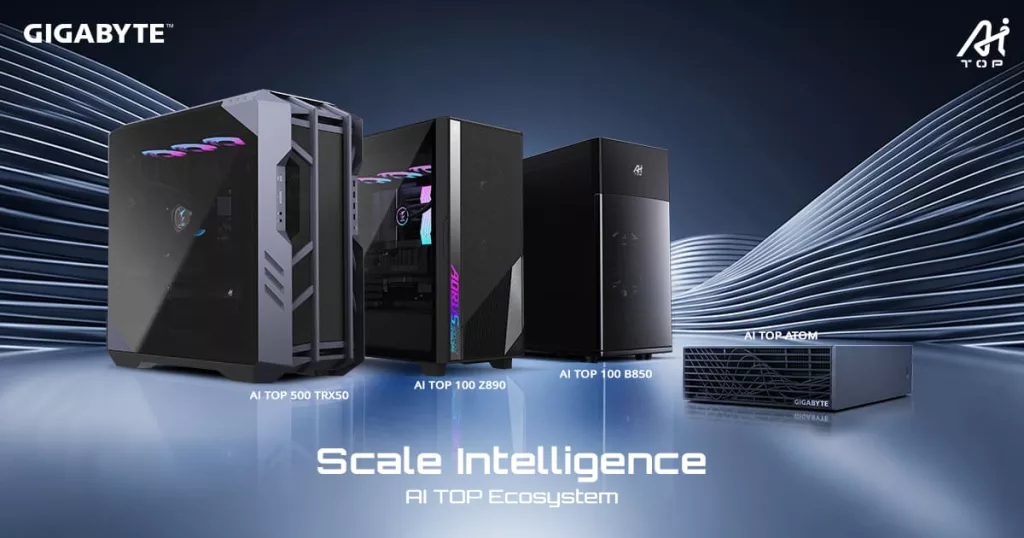
GIGABYTE’s AI TOP ecosystem picked up a new mid-tier entry with the AI TOP 100 B850, slotting between the entry-level AI TOP ATOM and the top-end AI TOP 500 TRX50. The B850 is built around an AMD Ryzen 9 9950X with a choice of GeForce RTX 5090 or Radeon AI PRO R9700 graphics, up to 128GB of DDR5-5600, and a server-grade 1600W 80 PLUS Platinum PSU. The pitch is local AI model execution at a developer or small-team scale, with pre-validated support for over 100 frameworks including PyTorch and TensorFlow, and claimed compatibility with models exceeding 200 billion parameters.
The “no cloud dependency” angle is increasingly common positioning in this space, and frankly it makes sense for anyone running sensitive workloads or doing iterative model development where cloud API costs add up fast. The RTX 5090 config should handle most practical LLM inference loads at this parameter range; the Radeon AI PRO R9700 option is more interesting from an ecosystem competition standpoint, since GIGABYTE validating it explicitly alongside an NVIDIA option gives AMD’s AI-targeting GPU a meaningful vote of confidence.
AORUS ELITE Monitor Series: Tandem OLED and 5K Mini LED
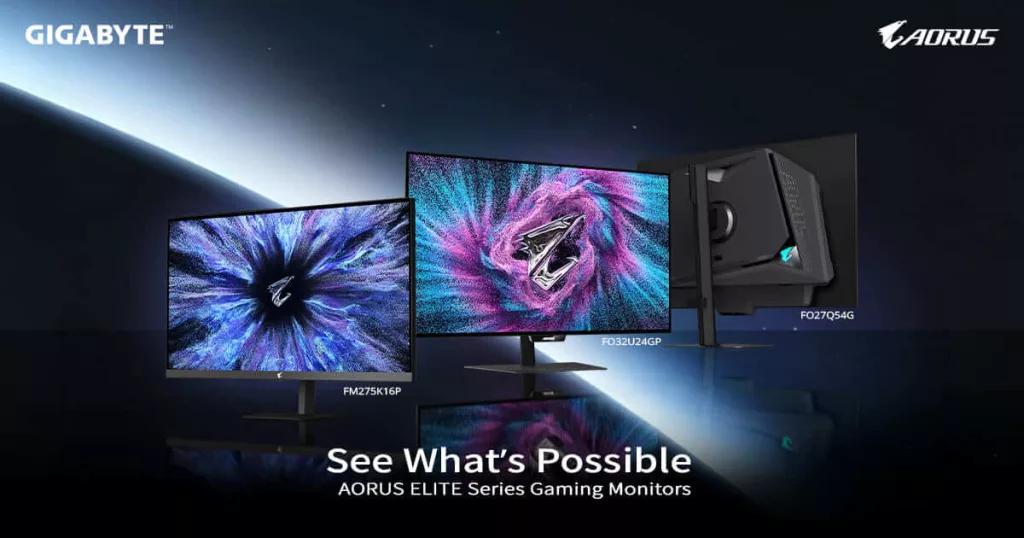
The AORUS ELITE monitor lineup brings two distinct panel technologies under one series umbrella. The OLED side runs fourth-generation Tandem OLED panels with a RealBlack Glossy surface and HDR peak brightness up to 1,500 nits. The flagship OLED model, the FO32U24GP, adds DP 2.1 UHBR20 connectivity at full 80Gbps bandwidth and supports Dual Mode for resolution flexibility. The FO27Q28G rounds out the OLED side.
More noteworthy is the FM275K16P: a 27-inch 5K Mini LED monitor with a claimed 218 PPI, 2,304-zone local dimming, and Multi-Mode support for 5K at 165Hz, 4K at 220Hz, or QHD at 330Hz. A 5K gaming monitor that can also drop to QHD at 330Hz for competitive play is a useful combination, and 218 PPI at 27 inches is enough to make text rendering meaningfully sharper for anyone coming from a standard 4K panel. Whether the pricing will reflect the panel cost or aim for a competitive launch is the key unknown right now.
Software features across the series include AI Picture Mode for SDR optimization, Tactical HUD for screen zone anchoring, and Tactical Crosshair with adaptive red/green contrast switching. OLED protection is handled through AI OLED CARE PRO with an ambient sensor, automatic pixel cleaning, and integrated heat pipes for sustained thermal management.
AORUS K10 INFINITY Keyboard and M10 INFINITY Mouse
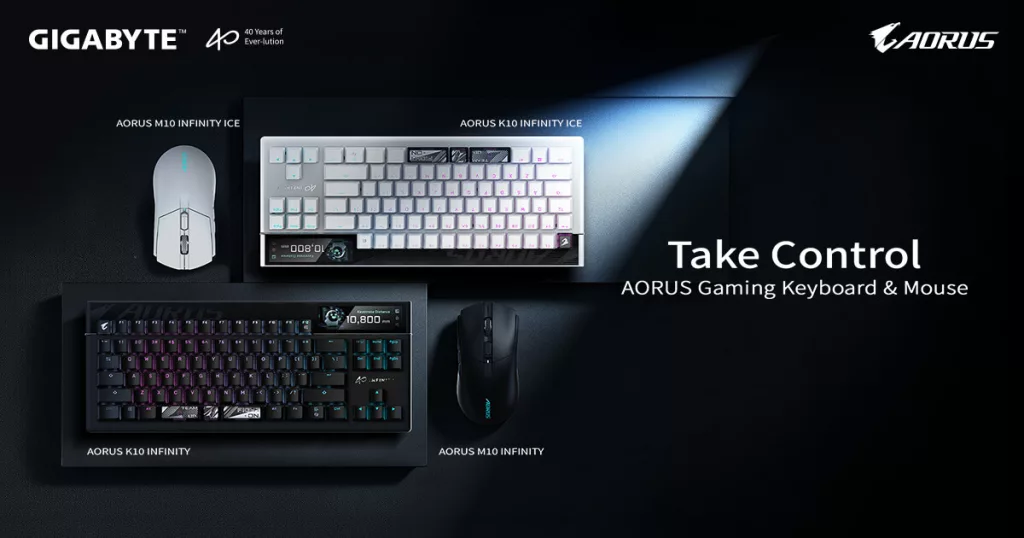
Rounding out the INFINITY lineup, GIGABYTE unveiled the AORUS K10 INFINITY keyboard and M10 INFINITY mouse. The K10 uses tactical magnetic switches with 0.1mm trigger-point adjustment, 8000 Hz polling, and a 100-million-keystroke lifespan rating. The standout feature is the built-in 3.1-inch full-color OLED touchscreen at 311 PPI, offering direct access to profiles, audio, and a “Combat Power” display showing APM, key mileage, and error counts in real time. Variable tilt support at 6, 8, and 13 degrees covers the ergonomic bases.
The M10 INFINITY pairs optical switches and an 8K polling rate with an excimer-coated shell and an aluminum-magnesium alloy base. Both devices are managed via GiMATE Web Edition, a browser-based configuration tool that requires no driver installation, which is a welcome departure from the bloated peripheral software suites that have plagued this space for years. Both K10 and M10 will be available in ICE white editions alongside the standard black.
The “ENTER INFINITY” Booth Summary
GIGABYTE’s full showcase overview also touched on items not covered by dedicated press releases, including the AORUS C510 GLASS INFINITY chassis with a 16-inch integrated side display, the AORUS ELITE 360 AIO cooler, the Z890 Plus Series with CQDIMM support for 256GB at full DDR5 performance in dual-DIMM configurations, the AORUS RTX 5090 AI BOX and RTX 5060 Ti AI BOX external GPU enclosures targeting laptop users, and updated AI gaming laptops spanning the AORUS MASTER 16 and AERO X16.
GIGABYTE is building everything around INFINITY branding for its 40th anniversary and has used Computex as the moment to plant the flag. Whether all of this hardware lands at competitive prices or gets priced purely at the premium end remains to be seen. The AORUS INFINITY GPU and motherboard lines especially need pricing to make sense of their positioning against other AIB partners and competing flagship boards. Still, the rear-routed GPU power connectors and the 5K Multi-Mode Mini LED monitor are both ideas worth watching closely.
Discussion (2 replies)
Join Discussion →Huh thats quite the bevy of products. Its interesting to see the continued iterations of existing tech to make up the lack of new tech in the DIY space.
Here's a new video card same as the old card.. but we moved the fans and power connector so its new again...
Here's the motjerboard the same as the last but with may more power phases and a special heat sync.
And on....and on...
Yep, it's been crazy the last few weeks watching them, MSI, and ASUS, all coming out with re-done versions of the last round of GPUs. Shame that it doesn't seem to be bringing prices down though but maybe that'll change by the end of summer.