
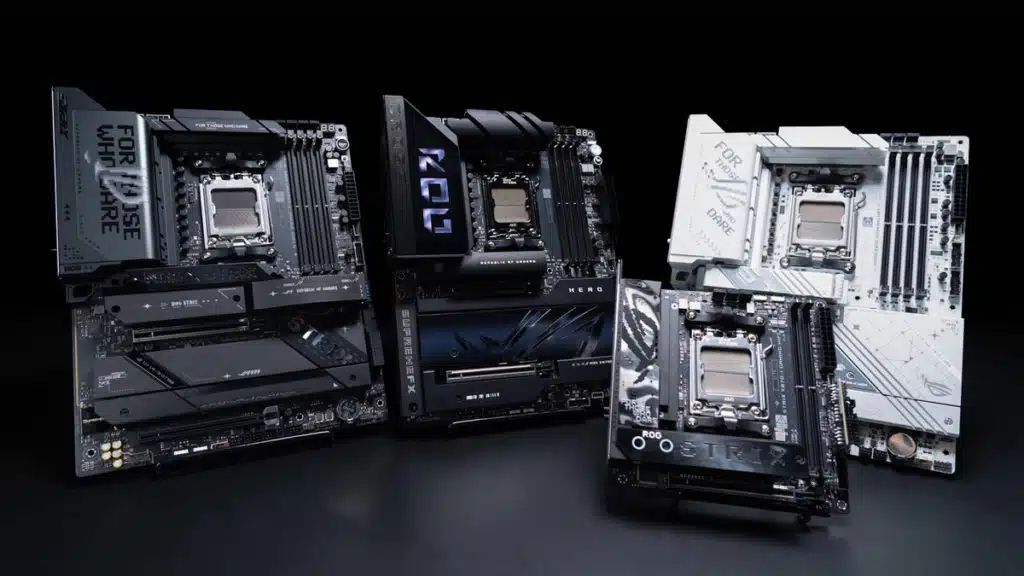
It is perhaps the worst time in PC enthusiast history, as one component after another sees price increases, and there’s no end in sight to the bad news. Just when you thought it couldn’t get any worse for those looking to upgrade or build a new system in 2026, another dark cloud looms on the horizon. This time around, the next victim is yet another core piece: the motherboard. Manufacturers have already been bearing the brunt of the side effects brought on by the current memory (DRAM) and storage (NAND) component shortages and price hikes, whereby many consumers are avoiding buying a new motherboard due to the added component costs. Furthermore, a lack of any significant new GPUs from AMD or NVIDIA lessens the need to buy a new motherboard because, let’s face it, an RX 9050 or the resurgence of the RTX 30-series is not likely to inspire anyone to need to upgrade their PCs.
The above factors have already been attributed to plummeting motherboard sales in 2026, but there’s another monstrous thing lurking in the shadows to make matters worse: the rising costs of copper. It’s been theorized for some time that this primary material used in motherboards, whose cost has been increasing over the last decade and has led to many copper thefts across the globe, would eventually play a factor in motherboard pricing, and that bill (of materials) has come due. According to a new report from the overseas site Board Channel (via VideoCardz), ASUS, GIGABYTE, and MSI are all expected to begin implementing price hikes by Q3 2026.
“Research on the upstream supply chain of Taiwanese motherboard manufacturers reveals that the price of PCBs used in consumer motherboards is expected to increase by at least 50% in 2026. In addition, the price of raw materials such as copper, surface-mount capacitors, power devices, and supporting controlling chips has also risen significantly, with multiple factors contributing to the overall increase in motherboard material costs.”
– Board Channels (machine translated)
So there you have it: from the rampocalypse to rising costs of BOM and other shortages, motherboard prices are expected to rise in the coming months as manufacturers seek ways to cover costs and their profit margins. For those wondering, some have theorized that the rising cost of copper may also lead to price increases for power supplies as well, but for now that idea is akin to a rumor.
Discussion (14 replies)
Join Discussion →Whaaat everyone is increasing prices because everyone is increasing prices... I mean... why be the odd man out when you could be making more for less?!
Since about 2018 motherboard prices have skyrocketed at an alarming rate. A lot of things have.
It's getting so bad that I'm considering buying laptops from here on out. The PC I have may end up being my last custom rig if things don't change. $1,000+ for top end motherboards is bullshit. $5,000+ for a top end GPU, get fucked. $400-$500 for just 32GB of RAM? That licks horse anus. $1,300 for top end SSDs? I'd rather deep throat a fucking cactus than pay those kinds of prices.
Meanwhile a friend of mine picked up a laptop with an RTX 5090 mobile in it for $3,600 a few days ago. I realize the performance of laptops and desktops isn't 1:1, but the prices are way easier to stomach.
As an enthusiast, I hate the current landscape of the industry.
Always get an extended 3 year warranty with a laptop. Gaming laptops have a propensity to fail or develop annoying problems, especially ones from HP and Lenovo.
I'm aware. Parts costs outside of warranty and having to let mouth breathers at some "authorized service center" like Microcenter try and repair it are my biggest turn offs with laptops. I used to repair them for a living myself, and I know all too well how the quality of hardware technicians has declined in the last few years.
That said, my last one was an ASUS G75VW that lasted 13 years. Granted, it wasn't usable as a gaming laptop the entire time, but I still have it and it works fine. I did go through three AC adapters for it over the years though.
I'm not doing a gaming laptop.
I'll switch to gaming on a potato first.
It's definitely the worst time in history to be a PC enthusiast. In the past we've seen volatile memory prices, much more expensive CPU's, high storage prices, etc. However, we've not really seen them all super expensive at the same time.
What's not easy to stomach is the noise a gaming laptop makes when at full load.
However this is worth considering: https://www.gigabyte.com/Graphics-Card/GV-N5090IXEB-32GD
I just don't know if gaming would work properly on an external GPU.
What does "near desktop level" means exactly?
Only issue is that it's Gigabyte. They don't have the best reputation. Who knows what kind of cheap PSU they have paired with that in the enclosure. There will be a performance hit but it would still be faster than a 5080 and of course, more VRAM.
It's their way of acknowledging that Thunderbolt still can't provide throughput that truly equals what we get with PCIe. Over the years, I've done a lot of research on these types of solutions, and ultimately, increased stuttering and lower FPS can become a major issue, but it has come a long way.
I looked into it and finding a laptop that has thunderbolt 5 doesn't seem that easy to start. The ones that have it already have at least a 5070 Ti built in, but most have a 5090 or 5080. It would make more sense to buy an external GPU if it had no dedicated GPU just an integrated one. But I haven't been able to find any with Thunderbolt 5 that is not a hiend gaming or workstation laptop.
Your not wrong. I've experienced this gaming on my own laptop from time to time. I recently had issues with my desktop and hooked my laptop up to my monitor and I had to game with my headphones on. My desktop isn't nearly that loud despite having 9 case fans, an SSD fan and of course, my 5090's GPU fans.
To be clear, laptops (especially on the high end), aren't 1:1 with their desktop counterparts for performance. You have slower RAM, GPU's are limited in the power available to them. For example, the mobile 5090 is limited to 150w of power consumption while their desktop counterparts take upwards of 600w. You aren't going to get the same GPU and memory clocks with those limitations. Those limits are partly due to cooling limitations in a laptop and partly due to the limits of the power available in such platforms.
Even if the external GPU is the same as say a 5090, it doesn't mean that you'd get the same performance as a pure desktop running a 5090. Again, slower RAM, less CPU cooling, etc.
I hate noise, and I also hate headphones, even on my desktop I had to make a custom fan curve for my GPU for it to be barely tolerable.
Of course not, but it is a waste of money to have any kind of dedicated gpu internally if I'm going to use an external GPU. That was my point.
Honestly 3 years ago I would have said a gaming laptop as your primary device is a waste of money, you're over paying for sub standard performance. Now a days... you're paying less of a performance tax for a high end gaming laptop than you are for a 5090... so go for it.
Oh, no I don't intend to buy anything. But for someone who wants to do a new build from scratch a laptop might be better value than a desktop at this point.