
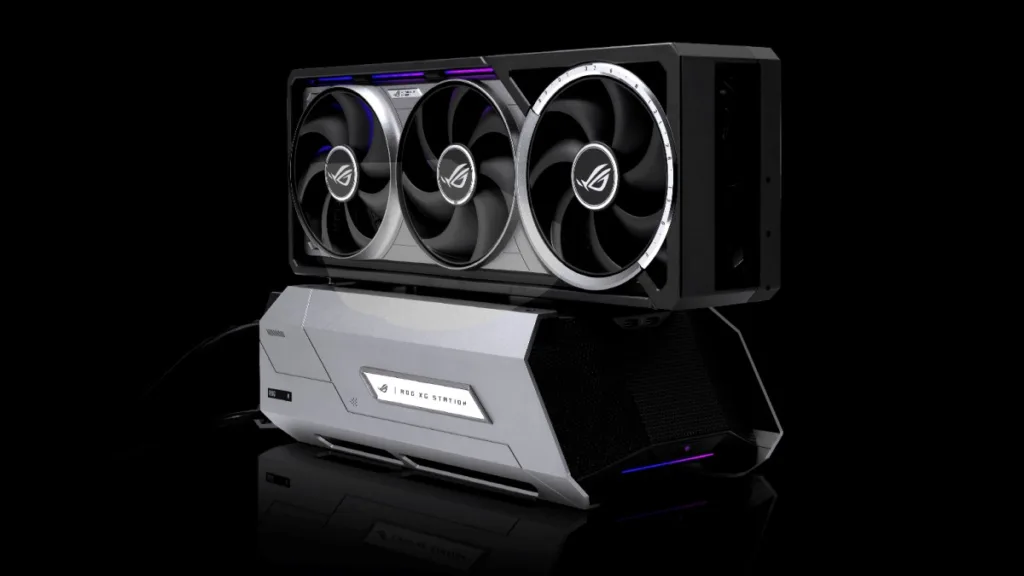
ASUS has revealed pricing for its ROG XG Station X3 GPU enclosure, which is powered by a separate PSU and supports GC-HPWR (aka Back to Front) power delivery. At $399 (per Videocardz), and reportedly on sale for $350 by some retailers, there’s no denying this is a premium option that is unlikely to be sought after by the average PC user, but those with the means may want to consider the possibilities it presents. ASUS was one of the first PC component manufacturers to explore options in alternative means of power delivery to GPUs. Up until the last few years, most GPUs relied on 8-pin PCI-e connectors, with as many as three being used for power-hungry flagship cards, but that changed with the arrival of the highly controversial 16-pin 12VHPWR connector. Simultaneously, during this time period, PC builders increased their efforts in making cleaner builds and hiding cables, resulting in manufacturers such as ASUS exploring designs that could relocate connector placement, making it easier to conceal cables, and this resulted in the back-to-front idea. ASUS took these concepts and created its GC-HPWR connector, an extra contact point on the graphics card, which allows up to 1000W of power to the card w/o using the aforementioned 12VHPWR connector.
Now users could still opt to use both means of power delivery to compatible cards with ASUS motherboards, and it would only really be necessary for an RTX 5090 since it’s really the only GPU that can make use of the extra power. The big thing to note is that this GPU, with its kaiju-sized appetite for electricity, could finally stretch its legs and, furthermore, thanks to an external location, could breathe and expel heat more easily, without adding temps to a desktop system or drawing power from its PSU. The recent jokes about just powering a card like the RTX 5090 with its own PSU have become reality, but this is still only part of the story.
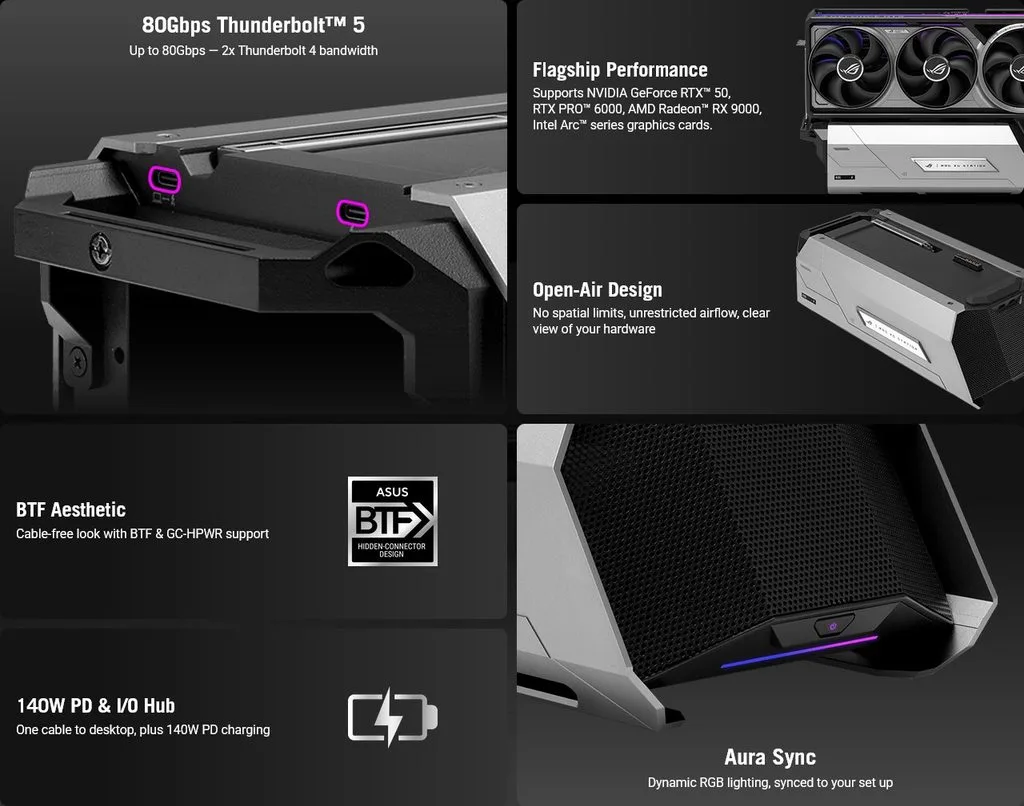
Features
- System Connectivity – Thunderbolt 5 up to 80 Gbps
- GPU Compatibility – Up to 361 × 139.3 × 93.9 mm (L × W × H) sized cards are supported
- 140W PD charging / IO Hub
- Back-to-Front cards are supported
- 2x USB Type-C 10 Gbps ports
- PSU Compatibility – SFX / SFX-L units (min 750W recommended)
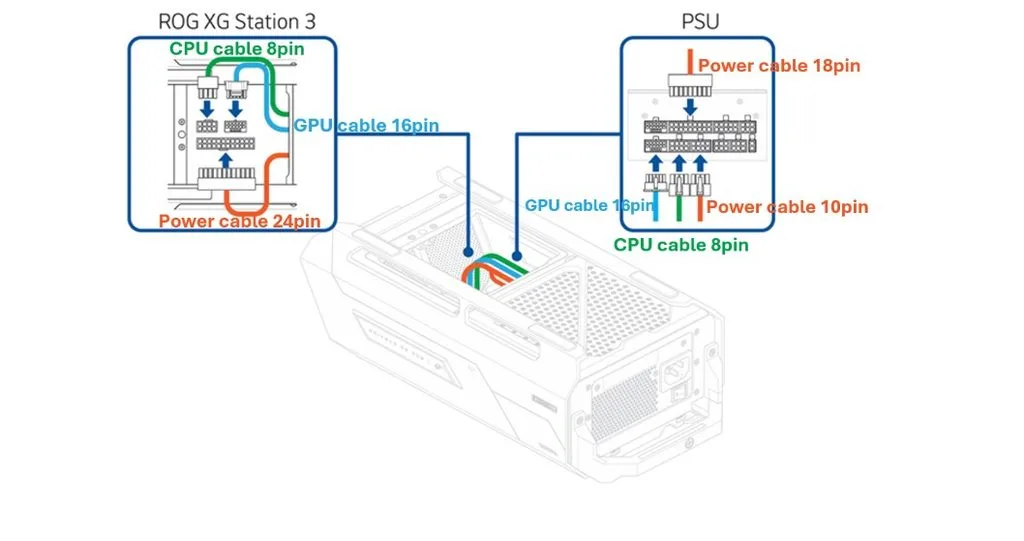
ASUS has designed the ROG XG Station X3 so that a small form factor PSU is inserted into it and then connected much the same as you would to a motherboard. Per the install FAQ, once the PSU has been installed, there’s a panel to remove, allowing access to the PSU and the unit’s connectors. The above slide shows the CPU and motherboard connectors being used. For those not using a BTF card, there’s an option to utilize a 12VHPWR connector instead, but, well, you know the risks involved there. Now, ASUS does not specifically mention whether both its GCHPWR and a 12VHPWR power connector can be used together with the ROG XG Station X3, as seen with its motherboards, but even then, the GCHPWR connection is rated for up to 1000W, which ought to be more than enough for most folks.
There’s no denying this is a niche-within-a-niche product, and given current GPU prices, one would need Tony Stark’s budget to tinker with. However, for those able to get one, there are some interesting potentials for gaming and AI workloads. From a high-powered laptop to a mini-PC acting as the head, the unit is self-powered by its own PSU, and as an external dock, users have a level of adaptability and customization not commonly seen outside of a desktop. In terms of gaming, however, the biggest questions aside from budget are stuttering and lag, which have commonly been issues for GPU docks, but perhaps Thunderbolt 5 has finally managed to overcome those issues.
Discussion
Join Discussion →No replies yet. Be the first to reply on the forum.