
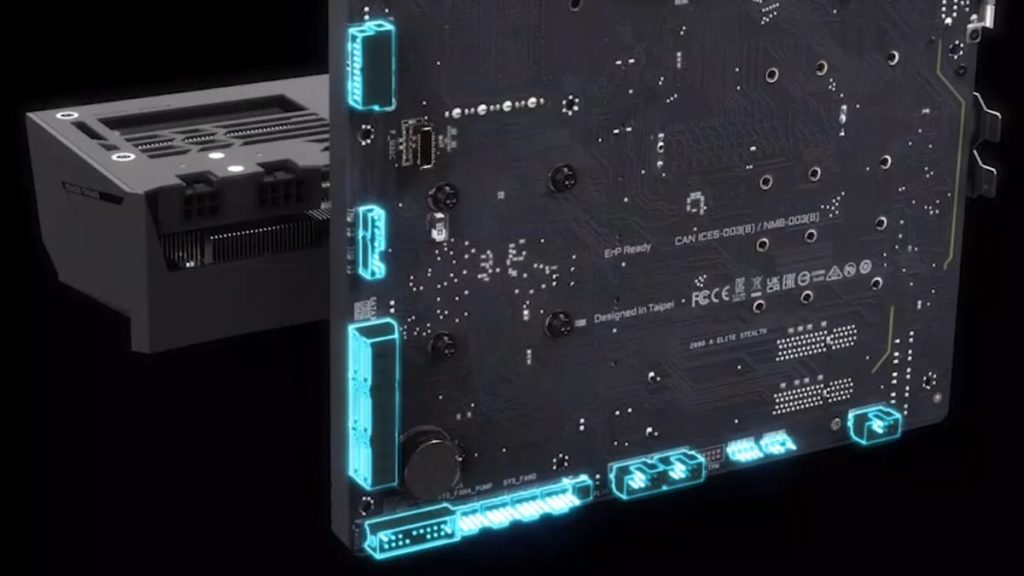
GIGABYTE has shared a press release detailing Project Stealth, a new specially designed collection of PC components with a unique motherboard that attempts to eliminate “the headaches of cable clutter, installation challenges, and obstructed airflow” by shifting most of the usual connectors to the back of the board. Users will find the sockets for ATX power, CPU power, fans, USB, audio, front panel, and more on the back side of the Z690 AORUS ELITE STEALTH motherboard, something that GIGABYTE and collaborator MAINGEAR believe should help simplify cable management and installation. Other unique design elements presented in the Z690 AORUS ELITE STEALTH include an NVDIA GeForce RTX 3070 GAMING OC STEALTH graphics card with an underside PCIe power socket design and a AORUS C300G STEALTH case with custom cutouts for increased ease of assembly. GIGABYTE says that its Project Stealth kit will be available “soon” on the market.
Z690 AORUS ELITE STEALTH moves all sockets like ATX power, CPU power, fans, USB, audio, front panel, etc. to the back of the motherboard, designed to simplify cable management and installation. RTX 3070 GAMING OC STEALTH combines an underside PCIE power socket design with the best-of-class gaming performance. With this exclusive motherboard and graphics card design, users can line their cables up to achieve a stylish, and sleek build with a clean look that compliments both tower coolers and AIO liquid coolers. To tie it all together, the AORUS C300G STEALTH case features custom cutouts, providing seamless integration with both the motherboard and graphics card, enabling easy cable routing for clean aesthetics and ease of assembly.
For those looking for a full solution featuring this innovation, MAINGEAR is announcing the Stealth Gaming PC, a fully integrated solution featuring all Project Stealth components. The Stealth Gaming PC will feature the same industry leading build quality and support of MAINGEAR’s award-winning custom gaming desktop PCs and workstations.
MAINGEAR’s Stealth Gaming Desktop will be available in custom configurations, giving customers the freedom to select from the latest high speed DDR5 memory and high speed PCI-E Gen 4 NVME storage solutions. Each desktop will be hand assembled by MAINGEAR’s team of passionate enthusiast builders in New Jersey.
Source: GIGABYTE
Discussion (19 replies)
Join Discussion →Seen this a while ago. It would certainly be a nice change for cleaner builds.
It's not just about a cleaner build, but the fact that this design could eliminate a lot of pain points as the guy in the video touches on. You run all your wiring on the back of the motherboard tray anyway. It only makes sense to have the connectors back there if it all possible. Additionally, things like the 8-pin power connectors for the CPU are almost always a huge pain to deal with even in some extra large cases. Moving the CMOS battery to the back is also a nice touch.
Like the built-in I/O shield, the second I saw this I had to wonder why it took this long for someone to come up with this, and why we haven't been doing this for a decade or more.
Only downside I see is needing a case specifically designed for this.
Be nice to see this become a standard.
Correct, but in the end the thing most people will notice and like is a way cleaner build. Hopefully other manufacturers are able to follow suit with something like this.
Yea this actually. Case builders would love this because diy people would be all over it and buying new cases slash motherboard trays. Me.. I'd just get out a Dremel tool if needed.
But more importantly ... how well does this motherboard perform? It's one thing to look good, and another to perform well.
I have a Dremel, and many other tools, sharp and not so much, that I'd be willing to apply to a case to fit one of these. It would not be the first time I've... "abused" a personal case to fit hardware. Obviously review cases are reviewed as delivered ;).
Only downside to this I can see is that all power supply and most fan cables (and any other cables) are sized for having to be run through the motherboard tray and be plugged in to all those awkward upward-facing connectors.
That leaves a lot of slack on the backside of the motherboard - you can certainly go to town bundling them all up, but in addition to motherboard manufacturers potentially following Gigabyte's idea / lead here, you then of course have cases that need revisions, and you'll probably want to look at power supplies with appropriately shortened cables. And then the GPU with the power on the bottom - which assumes that the GPU is longer than the motherboard, and is installed directly into a PCIe slot, i.e. without a riser cable or riser board.
It's a lot of variables covering a lot of industries to cover, and you'd pretty much need all of it to happen at once to take advantage of the benefits.
Or you know go to cablemods and just order cables pinned for your power supply at the appropriate lengths.
Not that I'm above doing that where needed, but man, that can cost more than a premium PSU.
Oh I see, it's a whole complete system. Time will tell if DIY parts will do this in the future, but if so, likely to involve new case designs.... or handy work with a dremel.
I like the video card with power on the bottom too. I have always thought the top mounted power wires were dumb and ugly... and cards just want more and more.
[embedded media]
I don't know but what a pain in the ass it would be to test. I'd have to figure out some way of doing that unless I got a compatible case with the review sample.
The Linus video is funny. He starts out all impressed but then he starts putting it together..... He discovers cables won't reach, plugs don't fit right, and there is like zero airflow. Fast forward to 14 min mark for his thermal "solution". Hey at least it worked :unsure:
Literally my first thought when someone mentioned too bad you need a case specifically made for this.
Form factors and standards never bothered me much.
I am not a hack. I prefer to use properly engineered things over crap I cut up with a dremel.