
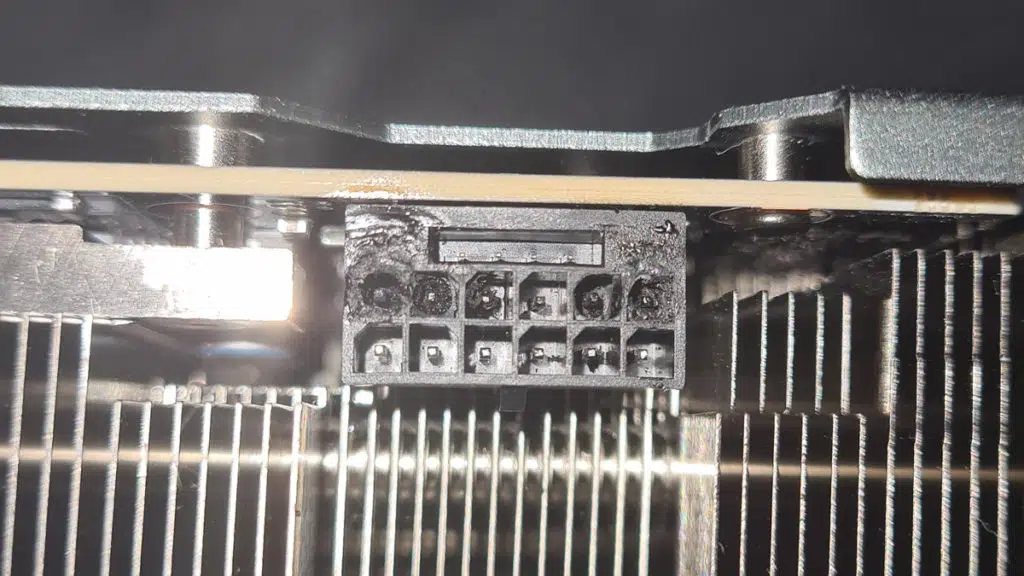
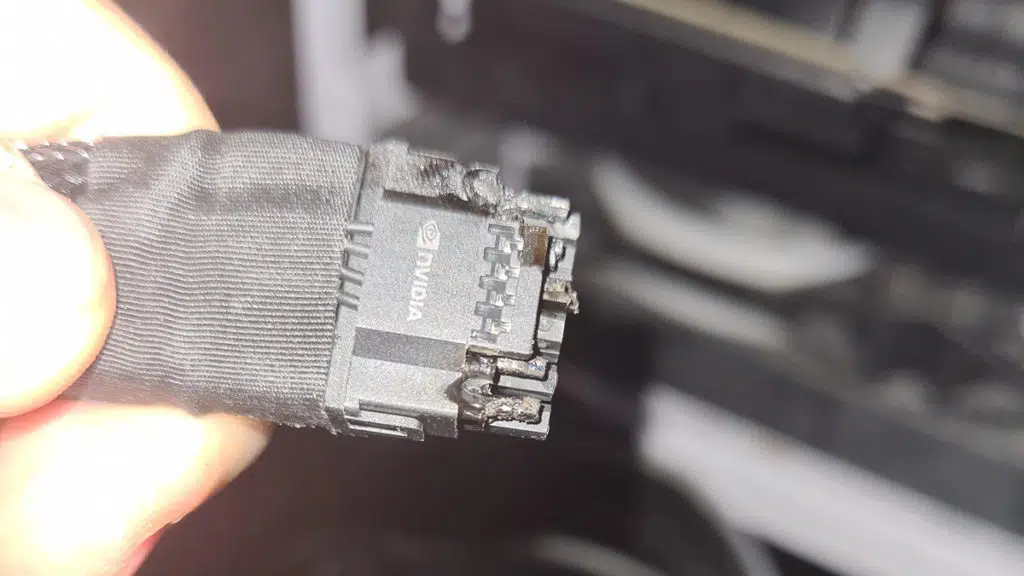
A redditor has shared what is believed to be the first report of a GeForce RTX 4090 12VHPWR 4x 8-pin to 16-pin adapter melting, stirring fears of the power connector being a potential fire hazard. While many have pointed out that this could simply be user error, the photos shared would imply that things did get a little too hot, with some obvious damage on the adapter, as well as around the first row of main pins on the power connector. The user claims that his GeForce RTX 4090 only had a 400-watt load during a Red Dead Redemption 2 session when the cable melted.
As spotted by Tom’s Hardware:
The Redditor asserts he was simply playing Red Dead Redemption 2, with a relatively modest GPU load of 400W, when the cable melted, which appears to rule out extreme overclocking. Assuming that’s true, we still have several potential points of failure.
All power connectors need to be seated properly and fully engaged to ensure trouble-free conductivity. This is a particularly crucial concern with higher power components where a poor connection might cause overheating or even electric arcing, with disastrous consequences. Reggie_gakil’s images show signs that there was a connection issue present, causing the connector and socket to melt.
Discussion (3 replies)
Join Discussion →"only" had 400W of load.
Reading the Tom's article - they seem to think the cable had too tight of a bend in it. They went so far as to publish what the bend specifications are for that cable adapter (which, I assume, are in addition to the 30 insertions recommendation), which only made me think of one thing:
[embedded media]
If your product has more limitations and installation guidelines than instructions - then you should probably consider re-engineering it. That said, apart from some rumors early on before the release of issues, this is the first post-release occurrence I've seen.
I really want to give NV and the others that have supported this new standard the benefit of the doubt since I'm not any kind of expert on high-powered electrical specs. However, from day one I've had doubts about the size of the port and its cabling. I like the idea of getting down to one cable since we really are up to 3 or 4 8-pins now but I'm really starting to doubt if this new spec is such a good idea with its size/gauge.
When you are dealing with a product, you get some leeway - UL certifications and the like take precedence over other published specifications, and you can use real-world measurements rather than just broad guidelines. So the statements below don't exactly directly apply.
The real limit on cable size is amps. The higher the voltage, the lower the amps for a given power, which is nice, given that Watts = Volts x Amps
I'm assuming that most of that power being delivered is at 12V. At 12V, 400W would be 33.3A (400W / 12V). That's a good bit of current -- most household outlets, for instance, are only rated for 15A (they are higher voltage, so more power, but the governing limit is still Amps -- amps governs how big the wire is, voltage has to do with how much and what type insulation is on the wire).
If I were doing an installation for 33A - that would be at least a #10 wire, and probably a #8. That's a pretty good sized wire. Granted, that's rated for 100% duty cycle inside a wall or other inaccessible area, so that's probably overkill... but it's a whole lot more copper than a handful of #18 wires that are probably on that adapter.
Now, #18 can carry amps just fine - in fact, for automotive and other "Chassis" applications, it's rated to carry up to ~14 amps. But for "power" applications, where you care about power quality and line heating and wires can be bundled together (wires are really just big long heaters, they have internal resistance, that's why Amps are the governing spec when sizing cable) -- #18 is only rated to carry about 2.5A.