
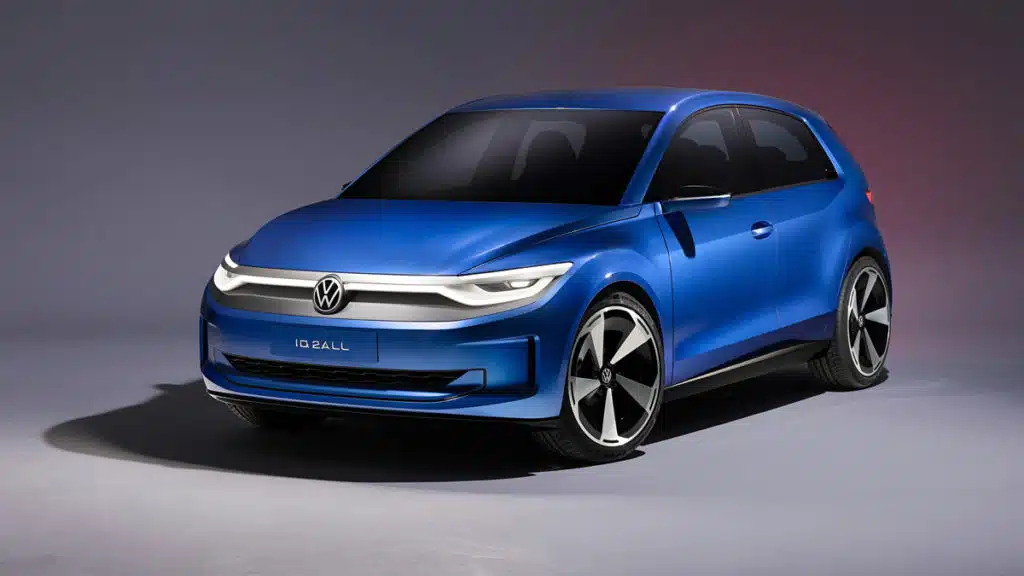
There’s already a decent number of affordable EVs on today’s market, but Volkswagen is working on something that may beat them all on the value scale. As part of its world premiere for the ID. 2all, a new all-electric concept car that costs less than 25,000 euros (~26,522 USD) and features a range of up to 450 km (279 miles), Volkswagen confirmed that it is developing an electric car that can be purchased for less than 20,000 euros (~21,217 USD). The production version of the ID. 2all is one of ten new electric models that Volkswagen plans to launch by 2026, while this year alone will see the introduction of the new ID.3, the ID. Buzz with long wheelbase, and the ID.7. Tesla’s cheapest EV, the Model 3, is listed for $42,990 on its official website.
“We are transforming the company rapidly and fundamentally – with the clear objective of making Volkswagen a genuine Love Brand. The ID. 2all shows where we want to take the brand. We want to be close to the customer and offer top technology in combination with fantastic design. We are implementing the transformation at pace to bring electric mobility to the masses.”
From a Volkswagen press release:
The Volkswagen brand is continuing the success story of its compact cars in the age of electric mobility and is providing a first glimpse of an all-electric Volkswagen costing less than 25,000 euros with the ID. 2all concept car. Initial facts: front-wheel drive, range of up to 450 km, innovative technological features such as Travel Assist, IQ.LIGHT or Electric Vehicle Route Planner and a new Volkswagen design language. The production version will be based on the MEB Entry platform and is one of ten new electric models that Volkswagen will launch by 2026.
The production version of the ID. 2all is one of ten new electric models that will be launched by Volkswagen by 2026. This year alone will see the introduction of the new ID.3, the ID. Buzz with long wheelbase and the ID.7. This will be followed by a compact electric SUV in 2026 and, in spite of all the challenges, Volkswagen is also working on an electric car at a price of less than 20,000 euros. This will give the car manufacturer the widest range of electric vehicles compared with its competitors, and the company is aiming to achieve an electric car share of 80% in Europe. Volkswagen Passenger Cars has previously based its calculations on a share of 70%.
Discussion (19 replies)
Join Discussion →Remember when Tesla was going to have a sub-$30k vehicle?
Yeah. I guess when you tack on a crapload of subsidies you may or may not qualify for…
This is.... interesting to say the least.
It's a VW so a no for me.
If this is Golf-sized it could be neat.
If it is smaller, it is not.
Looks like it is ever so slightly smaller than a Golf, but not enormously so.
I could see buying something like this as a second car dedicated to commuting and grocery store runs.
That said, differences in car lenght matter more than you think, and it is about 9" shorter....
Still a 220ish HP equivalent for less than 24k is kinda big.
Yeah, if I just needed a cheap commuter car, I'd totally buy one of these as an extra.
it's worth noting though, that it won't enter production until 2025. Who knows what other more affordable options will be on the market by that time.
I think they're pricing it to compete with Nvidia's next flagship video card.
They aint meeting that price. Guaranteed.
When will electric cars become standard in the third world? 50 - 100 years? Heck not even just the 3rd world, in the former and current eastern bloc most people drive old cars. Over two thirds of new car sales is to companies. Only the cheapest budget cars have higher ratio private ownership as new.
Even if they do meet that price, which will translate into something like €30.000 with taxes and usual shenanigans, it will be unattainable by 99% of people here in Eastern Europe still. Electric cars are the toys of the 1%, who probably already own a gas guzzler and the EV is only a second or third vehicle for them.
So the idea that EVs are somehow good for the environment is beyond ridiculous, even if we don't consider the massive headache with lithium mining, the massive headache they will cause for the electric grid (because EV makers won't pay for grid upgrades), and the massive headache that will come when we need to start recycling EV batteries en masse.
We should just go back to horses. At least you can eat those when the apocalypse hits.
$22,000 .... sounds nice ..... buuuuuuut when they hit lots dealers will say "we're seeing such a high demand that we've tacked on a $10,000 market adjustment, and we're only ordering fully loaded models, so out the door non-negotiable price will be $43,000. Thank you, come again!"
If the market hasn't corrected you are 100% correct. Also it depends on the contracts any remaining dealerships have with the makers. I don't see VW dealers all over the place and I know technicians are paid based on expected job hours.... And I haven't seen my independent dealerships for VW's so I expect they are a bit more strict. Dealers may not be allowed to tack on huge market adjustments.
The VW dealers around me were doing market adjusted pricing when we went looking at SUV's in 2021. So I don't think they were restricted by VAG. Whether they are still doing that I don't know, haven't been back since.
As for the techs, all dealer service techs are flat rate, as far as I know. GM, FCA, Ford, VW/Porsche/Audi, BMW, Volvo, all flat rate.
Even with Battery production, the total lifetime emissions of EVs is lower than ICE vehicles.
[URL unfurl="true"]https://www.epa.gov/greenvehicles/electric-vehicle-myths#Myth2[/URL]
As for Eastern Europe, I have colleagues in both the Czech Republic and Poland driving EV. I’m not sure where you’re speaking of, but I believe both those countries are Eastern European. To put numbers to it, it looks like between 5-10% of new cars registrations in those countries are EV:
[URL unfurl="true"]https://www.eea.europa.eu/ims/new-registrations-of-electric-vehicles[/URL]
Norway is a rocking 90%!
As for the grid, micro grids (solar panels with energy storage) and inertia grids ( https://www.pv-magazine.com/2022/07/27/tesla-big-battery-begins-providing-inertia-grid-services-at-scale-in-world-first-in-australia/ ) are probably the solution as opposed to massive centralized plants.
The true large scale energy storage solution is likely gravity batteries: https://www.popularmechanics.com/science/energy/a42613216/scientists-turn-abandoned-mines-into-gravity-batteries/