
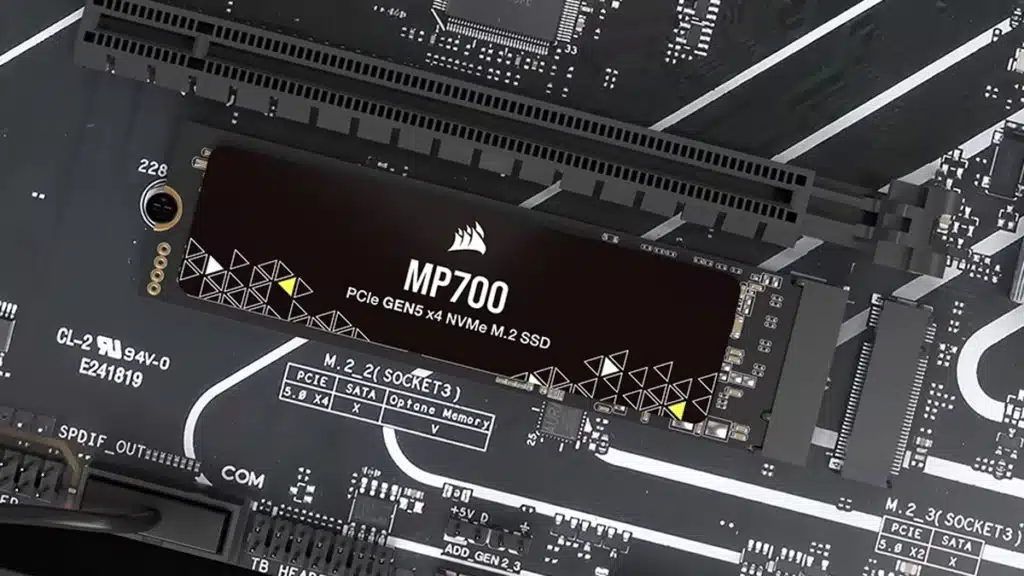
Corsair has announced that the MP700, its first PCIe 5.0 NVMe M.2 SSD, is now available through the Corsair webstore and its worldwide network of authorized retailers and distributors. Available in 1 TB ($169.99) and 2 TB ($289.99) capacities, the “blazing fast” MP700 delivers up to 10,000 MB/s sequential read/write speeds, which would amount to a 40% improvement over the best PCIe 4.0 SSDs that are available today, according to Corsair. “SSD cooling required,” reads a disclaimer on the MP700 product page.
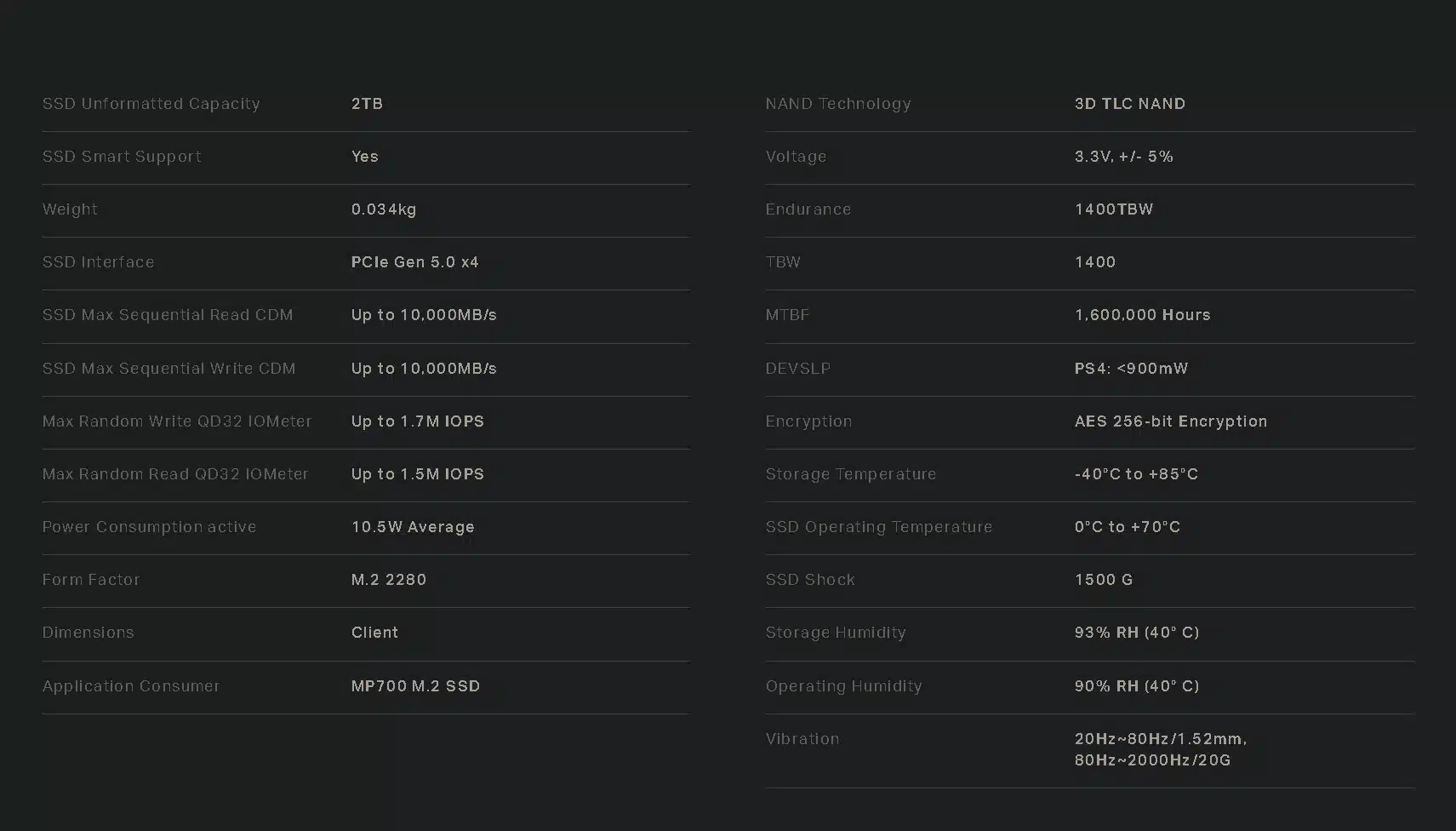
Corsair MP700 2TB PCIe 5.0 (Gen 5) x4 NVMe M.2 SSD (2 TB) Specifications
From a Corsair press release:
On top of the impressive sequential throughput, the random read and write performance of up to 1.5 million read and 1.7 million write input/output operations per second (IOPS) put the MP700 way ahead of the best PCIe Gen 4 drives. The MP700 is backward compatible with PCIe 4.0 motherboards, making this an upgrade that will last you for years to come. Native support for Microsoft DirectStorage ensures that you’ll get the most from the latest games, while copying files in Windows and loading applications has never felt so fast.
Utilizing the industry-standard M.2 2280 form-factor, the MP700 installs easily into desktop motherboards for great all-around compatibility. To achieve its optimal performance, the MP700 requires additional cooling, with users able to choose between using their motherboard’s integrated M.2 cooling system, or an aftermarket M.2 SSD cooler such as the CORSAIR Hydro X Series XM2 Water Block. This water block fits easily into your custom cooling loop, delivering top-of-the-line cooling and performance while virtually eliminating throughput throttling.
Like all CORSAIR SSDs, the MP700 is supported by free CORSAIR SSD Toolbox software, enabling convenient features such as secure erase and firmware updates directly from your desktop. With a five-year warranty for extended peace of mind that your storage will remain fast and reliable, the MP700 takes full advantage of PCIe Gen 5 technology to set a new standard for M.2 performance.
The MP700 is backed by a five-year warranty, alongside the CORSAIR worldwide customer service and technical support network.
Be an early adopter of the next generation of M.2 technology with blazing fast speeds.
— CORSAIR (@CORSAIR) May 1, 2023
🛒 Limited Availability: https://t.co/63Df1wzTmg pic.twitter.com/oZPIw7Fo8Z
Discussion (11 replies)
Join Discussion →That's.. fast.. and makes me think about it for my next system if we arn't already on PCIE 6 or 7. Because FREAK are we moving through PCIE versions fast now. I mean WTF I took YEARS to get off of Vesa Local Bus video cards.
In the past 4 we went from pCIE 3.x to 4.xc to 5.x. SLOW THE FREAK DOWN. lol. at least on those.
I have the MP600 PRO XT as my boot drive, and it's been a great drive so far. I'm usually a Western Digital user, but this drive has impressed me. I don't think I'd be in the market for one of these new drives any time soon, but if I were I'd give Corsair a look again.
Why do you care? These numbers are almost completely meaningless in 99% of real world applications. When do you utilize 10GB/s sequential transfer? Never, outside of moving large sequential files from one drive to another equally fast drive. I can't think any use case outside of cutting RAW uncompressed 8K video where this would be meaningful.
Yyyyyeeeeeeaaaaahhhhh...
And poor SATA been stuck on the same version for eons. No wonder storage drives abandoned it for PCIe. SAS keeps getting updated too.
I seem to remember it taking a while to go from PCIe 2.0 to 3.0. Don't recall about 1.0 to 2.0.
Because if I was only interested in meeting my base Need I'd be on a 15 year old laptop running windows 7 so I could look at the web and read email and watch the occasional youtube video.
I don't live my life wanting the minimum or the good enough. I strive for the best when and where the cost difference makes sense to me. That's why.
Perhaps you don't and you like the aesthetic approach. Good for you.
You completely missed my point, or deliberately choosing to ignore it. There is no difference in real world use, nada, nilch, zero, nothing. So unless you are going for e-peen enhancement, owning this over a Gen4 is pointless.
Why don't you also install a fire a hose as a shower then? You'd never actually open the tap more than 1%, but it would be the same as buying this over any gen4 or even gen3 SSD. Gen4 over Gen3 is already within measurement error in most real world applications.
If you want a faster SSD you need to look at IOPS and random read / write performance which has been stagnating since SATA SSDs.
Don't diss SATA, it is still good. I'd challenge anyone to a blind test to tell if a PC has a decent SATA SSD or an NVME Gen xbillion one in normal usage, not synthetic benchmarks.
I agree that the performance difference for gaming is negligible. Try getting into running a local AI. Watch what it does with your system resources. You need OODLS of speed across the board to properly care and feed even a moderate locally ran AI.
It's playing with things like that and teaching myself about new upcoming technologies that have me wanting bigger and better hardware that they can actually utilize.
IF I were just concerned about game load times you would be correct.
I'll be honest I'm not in the market yet for a PCIE5x storage. When the time comes I will look into IOPS. Part of my professional role is digesting and configuring Storage technologies for our infrastructure critical space needs.
And for all the aps I currently am responsible for hosting in the enterprise hell ALL of them could run on a single NVME if IOPS was my only need.
So yes I know that PCIE 5 or 6 or whatever it is when I'm ready might not help my gaming experience. I'm interested in things other than raw gaming.
So much so that if it were in budget I'd go with enterprise class NVME drives. Because lets be honest.. the DWPD rating of consumer grade stuff is not up to snuff especially if you're going to be flexing that raw throughput with any consistency.
also would love to afford some video cards with actual AI compute units. Have to be happy with what I can afford for regular desktop cards that can offer some assistance.
And yes I've gone way off and redefined the conversation. Just wanted to share I'm not only concerned with gaming experience.
I'm still booting from a SATA SSD on my main system. My board doesn't support booting from NVMe drives.
I run most of my games from a SATA SSD - can't really tell any difference between that one and a PCI 4 NVMe drive if I'm honest.
Going further, I have a beefy SSD/RAM cache on a spinner, and while you can definitely tell when you are hitting the spinner on a clean cache, after you play the game a couple of times and let the cache work itself out, it's hard to tell even from that.
IDK, I run stable diffusion locally and while it is compute intensive it's IO load is negligible after the initial loading phase.
I do a lot of things that are not considered regular use cases, still most of them run out of GPU/RAM/CPU long before they run out of IO performance, unless ran from a spinner. As I've said the only case I found where 10GByte over 6GByte sequential read speed might* have a benefit is processing raw uncompressed video.
*might because I have not tested it yet.
I have a suspicion that enterprise grade is the same, they only write a larger number on the specification sheet. I've been using consumer SSDs almost exclusively since 2011 for data intensive work, and literally none of them died since. Sure my 50-100 SSDs is not that significant of a sample size as say backblaze, but it is certainly much more than the average user.
I'd never go for that. Something that is only good for a single specific use case is a waste of money imo. Worst decision of my career was once buying Quadro cards instead of Geforce for work thinking how much better supported it would be. It literally had zero benefit while paying 2x as much for HW that was 2 generations behind the then current top gaming cards.
And I didn't just mean gaming either, I meant all use cases outside of moving large pieces of monolithic data sequentially between drives.