
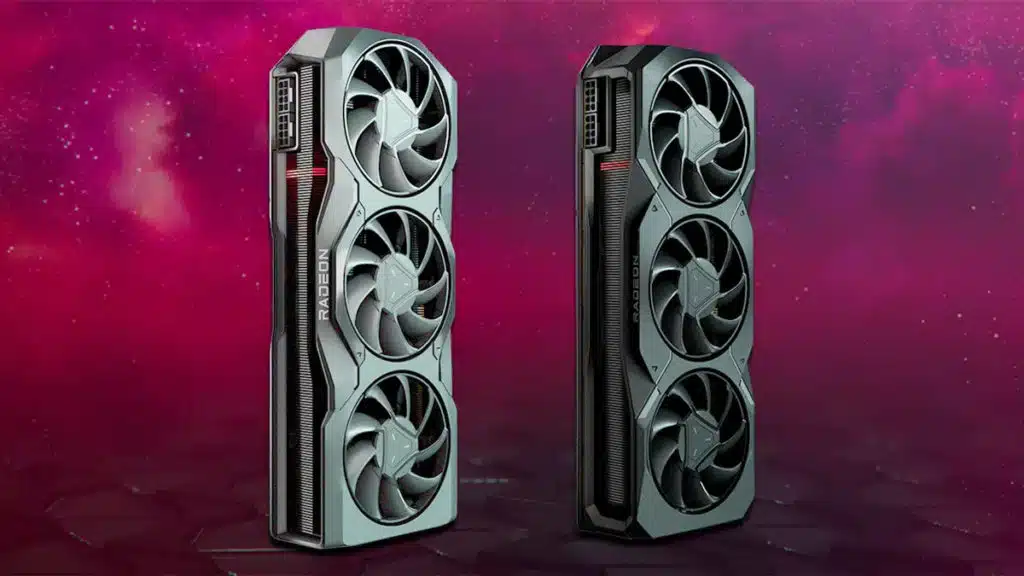
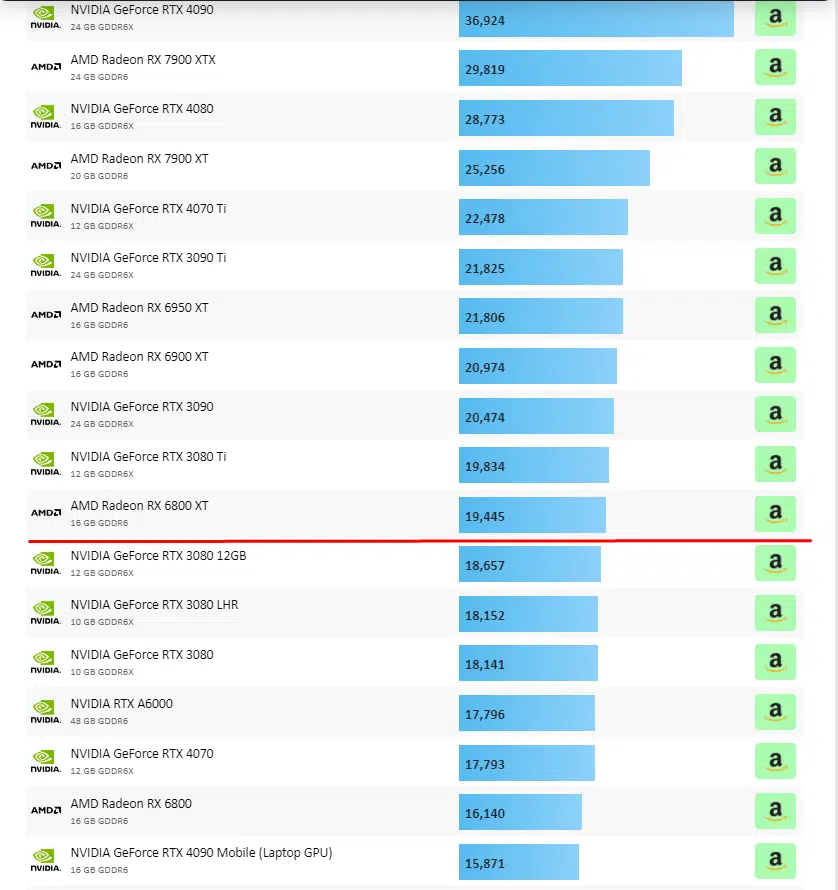
3DMark Time Spy scores for the AMD Radeon RX 7800 have appeared online, revealing that the new RDNA 3 GPU can reach 18,957 points in the popular DirectX 12 benchmark test. This score seems to suggest that the Radeon RX 7800 will be around 17% faster than its predecessor, with performance on par with the Radeon RX 6800 XT, lying somewhere between NVIDIA’s GeForce RTX 3080 and GeForce RTX 3080 Ti.
The RX 7800 will reportedly make use of the full-fat Navi32 chip with 60 CUs. Furthermore, we see 16GB (19.5Gbps) of GDDR6 memory, which over a 256-bit bus sums up to 624GB/s of effective bandwidth. The rated TDP stands at approximately 260W, which is almost similar to its predecessor. So, in synthetic applications, we can expect a roughly ~15% increase in overall efficiency.
— All The Watts!! (@All_The_Watts) July 16, 2023
Discussion (8 replies)
Join Discussion →That same person has leaked the scores for the "7700" also
3d mark time spy scores for 7800 (60 CU 16gb) & 7700 (48 CU 12gb):
7800 — 18957
7700 — 15568
For reference:
7900 xt — 25256
4070 ti — 22478 ($800)
6950 xt — 21806
(70 cu Navi 31 — ~21000) ($600-$650)
6900 xt — 20974
3090 — 20474
3080 ti — 19834
6800 xt — 19445
7800 — 18957 ($500-$550)
3080 12gb — 18657
4070 — 17793 ($600)
6800 — 16140
7700 — 15568 ($400-$450)
3070 ti — 15159
2080 ti — 15045
3070 — 13751
6750 xt — 13563
4060 ti — 13468 ($400)
A770 16gb — 13400
6700 xt — 12834
3060 ti — 12595
I applaud your charting skills. Very good way to organize it.
ok... I'm confused now... where does this lie in comparison to next gen hardware like the 7900xtx?
7700 ~= 50% 7900xtx
7800 ~= 60% 7900xtx
Soo as always a bit lower price than nvidia with less features. Got it. They need to abandon this strategy, i don't know, are their sales unit numbers/ market share doing okay?
Performance > "Features"
Depends. I am not privy to AMD's internal strategy, but they are definitely not gaining GPU marketshare. They don't seem to be trying though, which is the confusing part.
There could be very good reasons for this. AMD has to use third party fabs, and those processes have limited capacity. They can get a lot more CPU SKUs out for a wafer than they can large monolithic GPU designs - so that makes the CPU lines more priority on the limited capacity. There's also the custom SOC that fights for attention (the console chips, Steam Deck, etc). They eat into that limited capacity as well.
I really think AMD just keeps the GPU folks around for the R&D to feed into the SoC/APU products, and whatever they have left over in capacity gets filled out in discrete GPU SKUs to keep some market presence, but I don't think it's their priority at all.
I have to admit, right now if I were shopping for a gaming GPU, it would be a 7000 series AMD.
Yeah, nVidia has a lot of feature advantage - but none of those are things I use (at least with any frequency), whereas I can always use raw rasterizing performance.
That, and I admit, I have a hard time swallowing a lot of nVidia's latest business tactics, and I don't really want to support that with my wallet.