
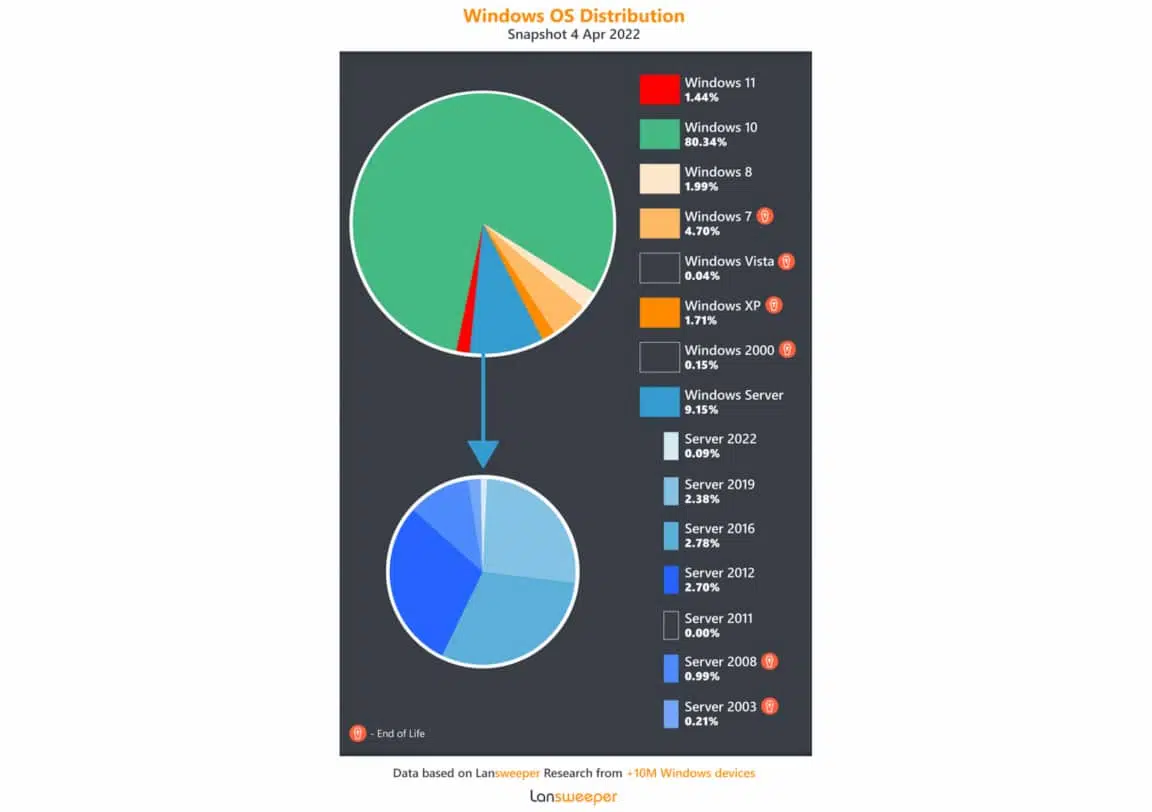
Can the modern version of a popular operating system turn out to be even less interesting to users than its 20-year-old predecessor? The answer seems to be “yes,” according to a new survey from IT management provider Lansweeper, which scanned 10 million Windows devices with its software this month to get an idea of how each version of the OS is faring among users. Metrics indicate that Windows 11 has a share of just 1.44%, a pretty sad number that ranks below even Windows XP, an ancient version of Microsoft’s operating system that released in the fall of 2001 but remains present on 1.71% of the devices surveyed. Windows 11 adoption is believed to be moving at a slower pace due to the strict hardware requirements that Microsoft enacted for the OS.
“Many organizations have been put off from having to buy new machines that meet these conditions, while others are simply happy with the current existence of Windows 10 which continues to be supported until 2025,” said Roel Decneut, Lansweeper’s Chief Strategy Officer, in a statement. “This situation will likely continue in the future unless businesses are given a compelling reason to upgrade.”
Windows 11 Adoption Is Lower Than Windows XP, Survey Claims (PCMag)
The results found that only 1.44% of the devices had Windows 11 installed, which is lower than the 1.71% for Windows XP. In contrast, Windows 10 maintains a dominant share at 80.34%.
Although Windows 11’s adoption is low at 1.44%, the number actually went up almost three times from 0.52% back in January.
It’s also important to note that other surveys have found much higher Windows 11 adoption numbers. Last month, the app advertising platform AdDuplex found Windows 11 usage was at 19.4%, although this represented a mere 0.1% growth from the previous month. Meanwhile, the Steam hardware survey from Valve estimates Windows 11 usage has reached 16.8%.
Lansweeper said its own survey comprises 20% enterprise systems and another 80% from consumer machines through polling done by the company’s Fing network security scanner product. All the data from the survey was collected “from aggregated, anonymized data points,” with user consent, the company added.
Discussion (19 replies)
Join Discussion →Well no kidding. Windows XP (After the server pack update) was one of the best Windows operating systems Microsoft put out.
This just in. People prefer a 2003 Ferrari over a 2022 Mitsubishi Mirage G4. Who would have guessed?
I remember when people griped over XP when it came out only for them to fall in love with it eventually. Happens every time when a new OS rolls out.
ehhh...ME, 8, 8.1 were all crap.
Not entirely true.
Windows 98 - We didn't know any better, but it was better than 95.
Windows ME - Crap, never recovered
Windows XP - Crap until SP1 (or maybe it was SP2) fixed all the major issues
Windows Vista - Crap
Windows 7 - Crap at first, SP1 (or 2, cant remember) fixed most of the issues)
Windows 8 - Crap
Windows 8.1 - Crap
Windows 10 - Crap, but less crappy than the 8 flavors.
Windows 11 - Don't think a service pack is gonna fix that horse #$@#$
Meh I've been doing fine with 11, even went to 11 pro.
With Red, the ones that I never adopted as a primary OS
Windows 95 - It was horrible, but it was this shiny new thing, so we had to try it
Windows 95 OSR2 - Much more stable, actually usable, but still even mild hardware changes necessitated a full reinstall
Windows 98 - This one really worked well for me, so I kept it as my primary OS until XP
Windows 98 SE - I had all kinds of issues with this, never could get it working properly.
Windows 2000 - Game and hardware compatibility issues killed any chance it had
Windows ME - I didn't hate it as much as everyone , it wasn't worse than 98 for me but the bloatware was strong with it, so I never adopted it
Windows XP - Iinitally it had the same issues as 2000, but eventually after the first or second service pack it got good.
Windows Vista - The sloth of windows, you really needed 2GB of ram for this at a minimum, but it came out when many PCs were still 512MB
Windows 7 - I had some reservations about the UAC, and some UI changes, but eventually got used to them.
Windows 8 - this left me dumbfounded, when I first encountered it on a prebuilt, I couldn't find the most basic things in it, I felt the same way as I did when I saw a PC for the first time and knew nothing about DOS, I had to refer to outside help to get anything done.
Windows 8.1 - Too little too late.
Windows 10 - I didn't like it, but I had to go along with it, and for the record I still don't like it, and it gets worse with every feature update, eroding user oversight and control panel features.
Windows 11 - The windows after the last version of windows, I don't know why this even exists, it's terrible at best, broken at worst.
Windows 98 - Never used it.
Windows ME - Used it and not impressed.
Windows 2000 Professional- Used it for a while with no issues.
Windows XP - Used it for a long time with no issues.
Windows Vista - Used it for a while with no issues.
Windows 7 - Used it for a long while with no issues.
Windows 8 - Didn't use it.
Windows 8.1 - Didn't use it.
Windows 10 - Used it for a while with no issues and so far the best of the bunch IMO.
Windows 11 - Been using it since the insider program with no issues.
Everyone has their own taste in OS's just like they do everything else, so not surprised by the varying opinions.
Wait wut?
I used 2000 until Vista and had no issues whatsoever with it, one of the best OS' I have ever used, can't say that of Vista which I dumped as soon as 7 came out.
I'm apparently one of the rare gamers that never used XP, I only used XP on a work PC and even then that was at the time when it was as good as obsolete.
I've been through most of those OS's listed. ME was painful but quickly replaced with XP that was oh so much better, I used 95 and 98 without issue. Vista was a challenge at first but quickly gained stability. But man that OS liked to burn CPU time. Movie backgrounds and such were very bad for anything not plugged in. 8 was just trying to force a tablet UI on desktop users. The UI SUUUUUUCKED. But otherwise was fine. 8.1 was minimal improvement. Windows 10 was awesome. And windows 11 has been just fine so far. I wouldn't call it awesome yet... I will say the difference between what you can do in Home and Pro versions is more drastic than before.
On the OP -- comparing XP today to 11 today, that is somewhat shocking.
XP hasn't even been supported for years now, and it's still ahead of 11 says a lot. Let alone the fact that 11 isn't even approaching what XP did in it's heyday.
I don't hate 11, I just don't really know why it exists. It doesn't advance 10 forward in any meaningful way, and includes a lot of UI regressions that don't make a lot of sense. There's no point to upgrading to 11 right now, other than just trying to be on the latest release. It eventually may have tighter security than 10, and it may catch on corporately because of that, but right now it's just a big bag of pain in the butt.
I think it's pretty self explanatory isn't it?
Some hardware had no drivers available for 2K for a long time after it launched, or in some cases ever. Of course you can blame that on the manufacturers, but that still doesn't make it an usable OS for me as an end user. In a way 2000 was needed to be sacrificed for the success of XP, because as far as I can remember 2K drivers were compatible with XP, so by the time XP came around almost everything had working drivers available.
And some games that I frequently played at the time didn't run or had issues with it.
To me that's reason enough to hate it. And I'm not going to play the whack a mole game with MS to try and get third party solutions to features they took away, only for them to break the solution with every update. Windows has enough points of failure built into it, no need to add to it with 3rd party UI software.
Perhaps... and I'm just spitballing here.. you're issue was running a SERVER OS as a desktop OS and expecting it to function well in a Desktop role?
You are just being coy. But in your defence, this seems to be a common misconception, as I've heard it before.
Windows 2000 Professional was a desktop OS, as were all Pro version windows releases since. You are mistaking it for 2000 server.
I have some insight into the Windows 2000 debate here. Windows 2000 started out as Windows NT 5.0. It was actually intended to entirely replace Windows 9x and move away from the 16/32bit hybrid model that existed at that point. However, Windows 2000 failed to measure up in a lot of ways. Primarily, the consumer hardware industry was not used to writing NT style drivers and Windows 2000 wouldn't get the hardware support it needed to be a consumer OS.
Additionally, tests were done on it back in the day between Windows 98SE, ME and 2000. The latter failed to deliver the same level of performance in games and video applications most of the time. In addition, there was still a large legacy code base that required some of the DOS compatibility that Windows 9x OSes offered. Windows 2000 was always intended to replace Windows 9x, but it was ahead of its time. Microsoft then rushed Windows ME to market. It was essentially Windows 98SE with some driver model changes and Windows 2000's interface.
It's problem was that hardware vendors weren't prepared for it and lacked the lead time for driver development that they ordinarily would have had. The new driver model caused all sorts of problems as Windows ME had a much smaller driver database so it flat didn't work on a lot of hardware. I saw this all the time when customers would try and upgrade to it. Windows ME was fast as hell when it worked but it only worked well if you had modern, higher end hardware from top tier brands that could actually write drivers for it. If you had a prebuilt that came with it your experience was a lot better than those people who ran older pre-builts or DIY boxes that had lower end hardware in them.
By the time Windows XP came out it was ready to replace the legacy Windows 9x OSes in the mainstream. So to be clear, Windows 2000 was supposed to be a desktop, workstation and server OS. However, in reality it wasn't ready to do that. Not only were their technical limitations of the OS at the time, but the market wasn't ready for it yet.