
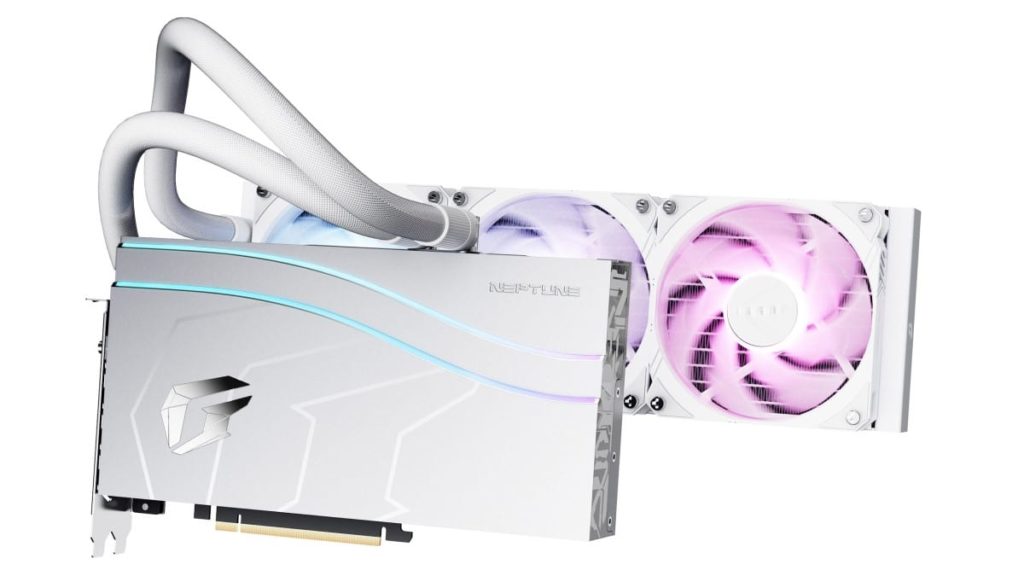
COLORFUL has announced its COLORFUL GeForce RTX 4090 Series Neptune Model Graphics Cards featuring an impressive AIO solution. As many are aware NVIDIA formally revealed its newest flagship graphics card, the GeForce RTX 4090, yesterday and board partners were quick to follow with their own announcements but one stands out from the rest. For months there have been rumors that the TDP for the RTX 4090 could be around 400+ Watts and when overclocked it could reach upwards or over 600 Watts. The question then is how to cool a card consuming such an incredulous amount of power? Air cooling is still an option but is also becoming more burdensome with cards now occupying between 3 and 5 slots, plus that added weight for those designs. Card sag is no longer a myth but a reality as some graphics cards reach gargantuan proportions and often come with straps or stands to support them. Meanwhile, GPU AIOs are slowly gaining in popularity and offer their own benefits for an enthusiast wanting the most out of their investment while not fully delving into a complete custom loop.
COLORFUL GeForce RTX 4090 Neptune Series
While some board partners are offering AIO solutions for the 4090 some are using a hybrid approach that uses a 240 mm radiator with 2x cooling fans and then another fan on the card itself. Additionally, the cooling block for some designs only covered the GPU and not the VRAM. This has been shown to be an effective solution with the previous RTX 3090/3090 Ti Ampere cards but it has also seen limitations. When those cards were overclocked beyond the manufacturer OC settings, or in a case with limited airflow, users have reported the cooling fans had to run at max resulting in much louder sound levels, something that most who use liquid cooling are trying to avoid. If any of the rumors of increased TDP for the GeForce RTX 4090 pan out to be true then a 240 mm hybrid solution might not work for all users. COLORFUL has addressed these issues with its Neptune series graphics cards that feature a 360 mm radiator with 3x 120 mm cooling fans and then a full-cover copper block that covers both the GPU and VRAM.
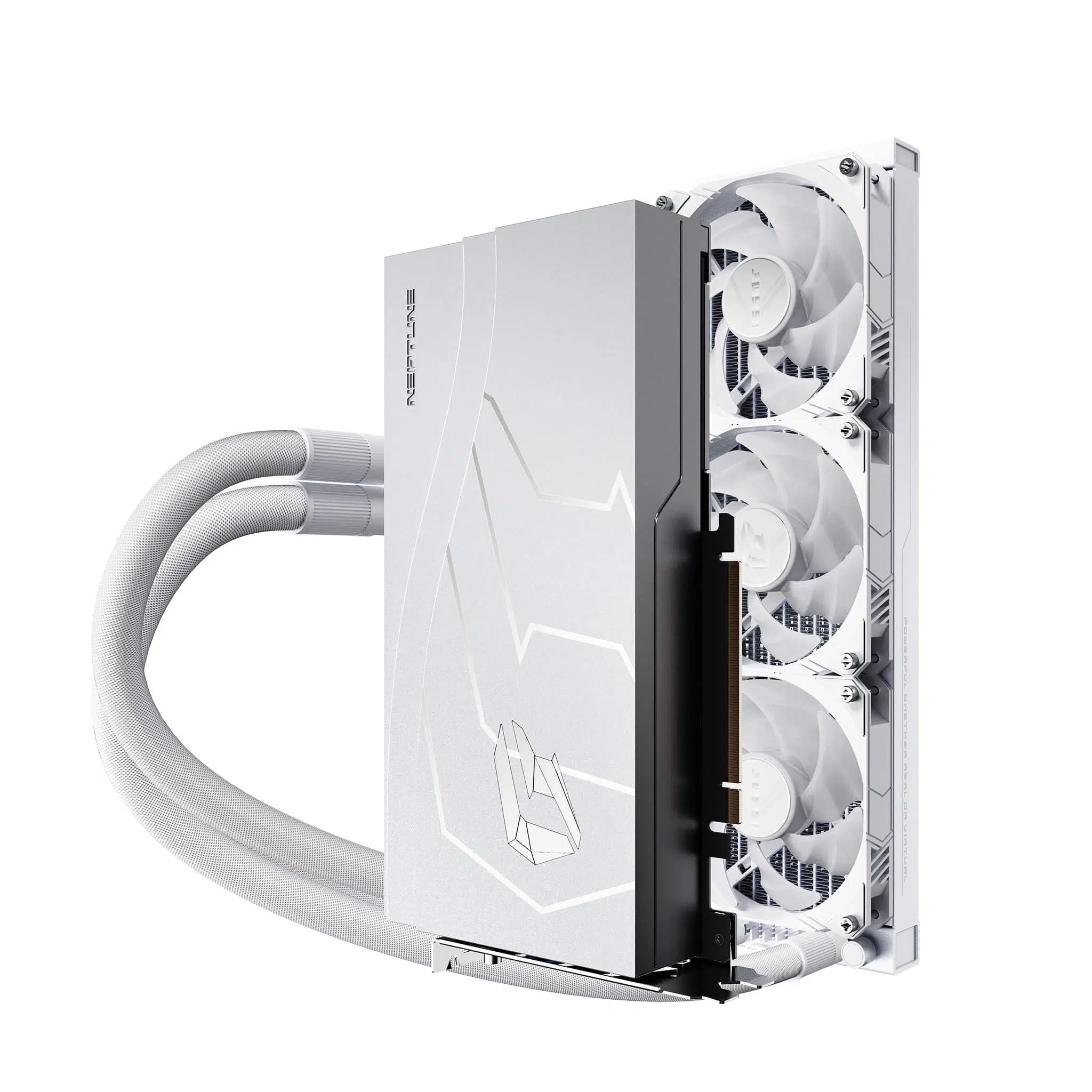
The all-new iGame GeForce RTX® 40 Series Neptune Series graphics cards will be sporting a new look and an upgraded liquid cooling solution compared to the previous generation. The new Neptune Series features a silver and white color scheme. The slim 2-slot graphics card comes with a metal cover with a matte finish – two RGB light strips run through the cover that provides ambient lighting. The RGB lighting is fully customizable using the iGame Center app.
The card itself is only 2-slots wide allowing the owner to reclaim those PCI slots that would’ve otherwise become unusable from a standard air-cooled card. The only caveat of course is that this is done at the expense of having to fit the radiator elsewhere in the case. Fortunately, most case manufacturers offer models with options to mount AIO solutions for both CPUs and GPUs, including mid-tower-sized models. Our own John Tharp recently reviewed the new Cooler Master HAF 700 which even allows up to 2x 360 mm radiators to be mounted, in the preferred orientation, at the top of the case, side-by-side. As white-themed cases have also gained in popularity these could be a welcome addition to keep that theme. There is also a button at the rear of the card for one-click overclocking without the use of any software.

COLORFUL is primarily only available in Asian markets but does have representatives in other areas who may be able to assist in purchases in other markets. COLORFUL has not released pricing nor other specifications for these new models yet but does have an English website for those interested in contacting them.
Source: VideoCardz
Discussion (16 replies)
Join Discussion →While cool, no pun intended, I often wonder why these cards with AIO's cost less than the same card with a waterblock only.
I've never even heard of Colorful before.
Are they related to PowerColor? :p
I'd love to get my hands on a white 4 series (preferably a 16GB 4080) but considering how rare and expensive white video cards seem to be I doubt that will happen. I Don't know Colorful nor do I want to deal with another AIO in my system so I'll probably pass on this one.
They're huge in Asia but we rarely hear about them stateside. Some of the European sites occasionally report on product releases as well because there are some sales reps in Europe. They and Galax are probably two of the biggest we don't get here, but probably should since both tend to make cards that easily rival anything from MSI/ASUS/GIGABYTE. I'm not saying those three are bad but they have stiffer competition overseas.
Are Galax and Galaxy the same? I remember Galaxy (but I don't think I've heard the name in a while)
Edit:
Wikipedia confirms Galaxy and Galax are both brands of Palit Microsystems.
I think so. At one point when I was chatting with David, he explained how Galax(y) used to be here in the U.S. and we both think that when it switched to overseas only it became Galax. I/we could be wrong but that's the ongoing theory. Oddly enough there is an online Galax store page but it almost never gets the latest launch products, only previous items. I originally was gaga over their 3090 last year and was never able to source one.
FYI I had no idea that if you put Y inside parenthesis it makes the thumbs up emoji. I had tried to do that above with Galaxy - with parenthesis and got the thumbs up instead.
Huh... maybe an AIO card this generation... that's something to think about.
Those with a nice custom loop will almost always fare better but the 360 mm AIOs can be really impressive as well. I'm so happy with the Hybrid EVGA 3090 Ti I got but an AIO coupled with a full block is the cherry on top. I have seen some OC limits with the VRAM on my Hybrid but the GPU purrs at 2040-2055 all day long and can even go above 2125 w/o going over 65c but I'm totally content with the stock speed and minimal noise.
Yup. But a nice custom loop will cost 3-5x more than an AIO will, so there is that.
That is true, but most of it is a one time investment.
You can keep the loop in there, usually the CPU block can be kept as well even through upgrades.
The only part you really need to change is the fullcover GPU block which is usually different from GPU to GPU.
And if you are a little smart about your build (don't use hard tubes, use soft tubes with a little slack) you don't even need to rework the loop when you upgrade stuff.
Because they know you'll pay it.
I think it's part that, and also part the fact that a big heavy solid copper block is expensive compared to the aluminum junk often used in AIO's.
Kinda, maybe....depends. If the card and waterblock bought separately is less than the combo I'll go that route. Most of the time that is the case. My last two Aorus cards were like that.
I went this route last time around for the first time with my XFX GPU, and honestly, I don't think I'd do it again.
Even with a separate GPU there is some waste. Usually you remove the water block, sell the old GPU and never find a buyer for the block. (I still have my Titan X / 1080ti block in my closet a year later. But with a separate water block, when you are done with it, it is fairly trivial to stick the stock cooler back on and sell it to a broad market of users or even use it in a secondary or friends or family system.
With only a water block, those options are much more limited. It winds up being difficult to sell (because most buyers don't have custom water loops, and those who do, usually buy latest gen stuff) and if you want to re-use it in a friends/family members system you have to build them at least a partial water loop.
Because of this, the risk of the GPU just sitting in a box and aging unused after I am done with it in my main system is not insignificant. it feels like a real waste.