

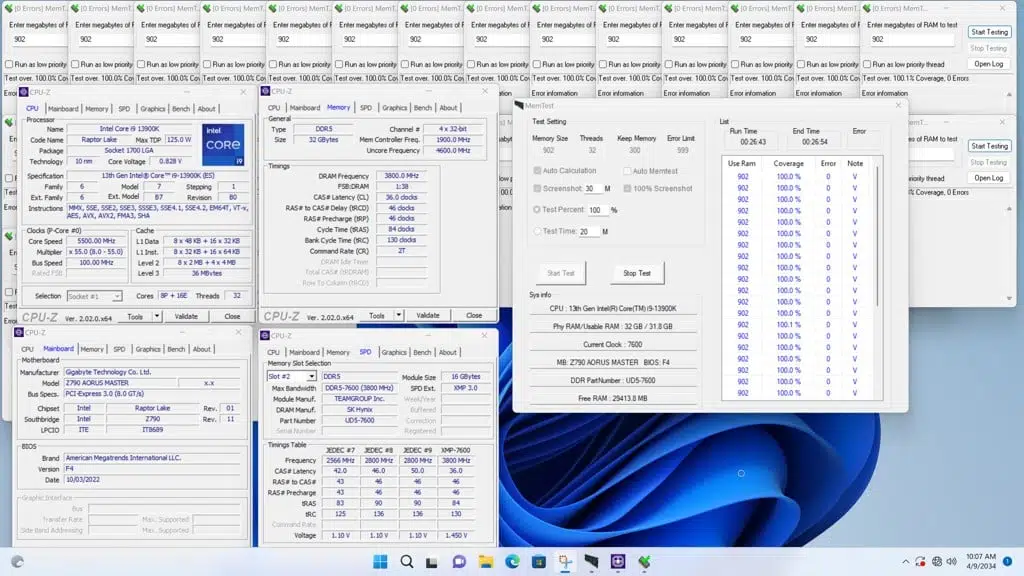
GIGABYTE has shown off how well its Z790 AORUS XTREME and MASTER motherboards can overlock the TEAMGROUP T-FORCE DELTA RGB DDR5 7200 memory. DDR5 is already maturing to allow the fastest speeds ever seen on home PCs without using exotic cooling such as liquid nitrogen but now we’re seeing it can be reliably pushed further on air with the right components. GIGABYTE used an Intel Core i9-13900K clocked at 5.5 GHz, and an updated XMP 3.0 profile, to overclock the 32 GB DDR5-7600 CL36 1.45V kit (a variation of the 7200 memory) up to 7950 MHz.
Press Release
GIGABYTE TECHNOLOGY Co. Ltd, a leading manufacturer of motherboards, graphics cards, and hardware solutions, today revealed the breakthrough DDR5 performance of XMP DDR5-7600 and O.C. performance to DDR5-7950 under fan cooling on Z790 AORUS XTREME and MASTER motherboards with TEAMGROUP gaming modules T-FORCE DELTA RGB DDR5 7200 memory. Featuring Shielded Memory Routing of SMD memory DIMM, exclusive DDR5 overclocking BIOS setting, top-quality components, and enhanced design from hardware to firmware on motherboards, this performance proves GIGABYTE’s strong leading role in product quality and performance.
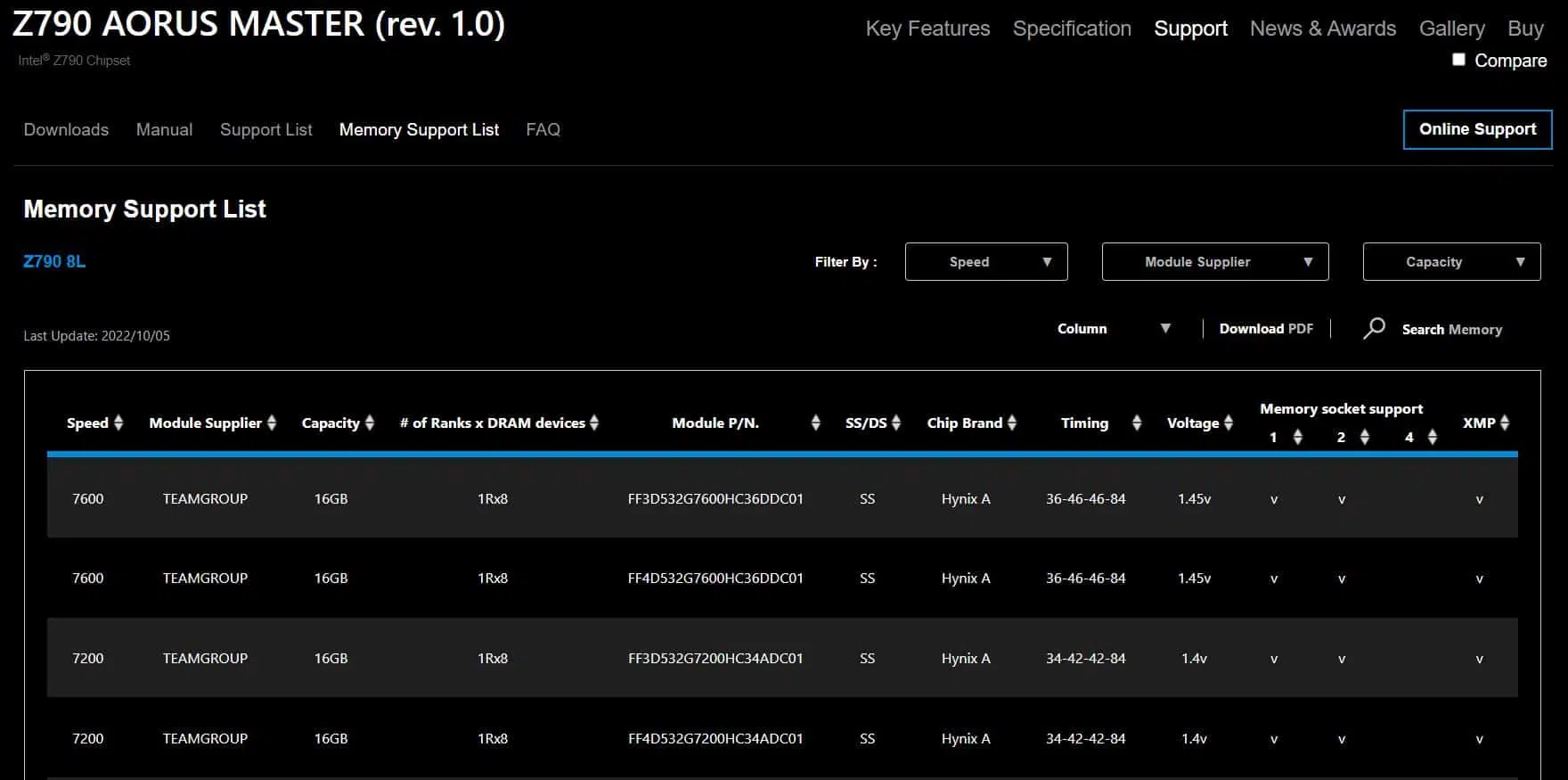
To unleash the ultimate DDR5 performance, GIGABYTE Z790 AORUS XTREME and MASTER implement new generation Shielded Memory Routing design. By optimizing memory trace width, length, and style from HPC simulation to actual implementation, overall impedance is lowered between CPU memory controller and memory modules. Further with low signal-loss PCB, signal loss inside PCB and external interference are greatly reduced which can maintain high-speed DDR5 signal transmission to achieve higher DDR5 speed. In addition, the abundant BIOS setting of DDR5 Memory Upgrade and XMP 3.0 User Profile lead to the breakthrough performance of XMP DDR5-7600 and DDR5-7950 O.C. under fan cooling with T-FORCE DELTA RGB DDR5 7200 memory. The detailed memory information is listed in the memory support list of the motherboard.
https://www.gigabyte.com/Motherboard/Z790-AORUS-MASTER-rev-10/support#support-memsup
This remarkable memory performance on Z790 AORUS XTREME and MASTER with T-FORCE DELTA RGB DDR5 7200 memory is only the beginning of GIGABYTE’s supreme-performance motherboards.
Source: GIGABYTE
Discussion (9 replies)
Join Discussion →If I were to go with a Z790 board (which seems unlikely), I would have a hard time going back to Gigabyte after many years of using them. Glad they accomplished this overclock, but I had many issues with stability with a few of the their Z690 boards. I'd be happy with a stable board which overclocked slightly.
It's mostly down to the memory die in this case. That particular Teamgroup memory is the newer SK Hynix A-die DDR5 - the kits have been trickling out for the last month or two, in low quantities. There are a few folks over at the Overclock.net forums who have been pushing these sticks into the high 7k range already, and in fact it's pretty likely that there are users posting there with higher stable clocks achieved than the one in the press release.
Prior generation M-die was good to the upper 6ks, maybe low 7k if you got lucky, so these new kits look to push things further by about another 1000MT/s. Sounds good to me!
It's down to the memory controller on the CPU and the motherboard as well. For Alder Lake on Z690, there was basically one combination of board, CPU, and memory that would push >7200MT/s - and that was 2022 builds of ASUS' Z690 Apex,* a golden 12900K or 12900KS, and memory with Hynix M-die ICs. Those with A-die ICs are pushing north of 8000MT/s already as you note with that same combination.
*[Many / most Z690 Apex boards produced in 2021 had bum memory slots and were limited to ~6000MT/s or slightly faster]
I admit that I'm continually fascinated by the handoffs between CPU and MB as well as the tradeoffs for the same with different boards. It has made picking boards a bit more tricky with the extra research needed to make sure I'm getting the most for the features I'm focused on, whether drive/lanes or memory related.
There is exactly one Z690 board that has nearly all of the features I looked for - ASRock's Z690 Aqua OC, currently selling for US$890.
My list:
What I find frustrating is that board makers seem to dance around this list. Instead, there's a focus on bling, ludicrous power delivery, and weird PCIe lane and slot configurations. And this regardless of how much you're willing to spend on a board.
Ouch.
Is there a reason for 4 NVMe slots on the motherboard? Could you add more slots on a PCI riser instead?
Same could be asked of 10Gb.
I don't know if that significantly impacts your options or not, but that's a very narrow search result for your parameters.
What I've done up to this point is use a PCIe 10Gbit controller. Could also do the opposite if a board meeting the other qualifications was available, but in general, there are three 'premium' features that are hard to get together - Thunderbolt on the rear I/O, 10Gbit LAN, and overclocking features like a post-code display.
Such is life!
Is your fourth bullet point supposed to read "only two DIMM slots ..."?
Yes; here's a lineup of memory overclocking boards from each major manufacturer:
You'll find these boards released with various chipsets, some with multiple versions per CPU generation, some entirely missing (see X670E for example).