
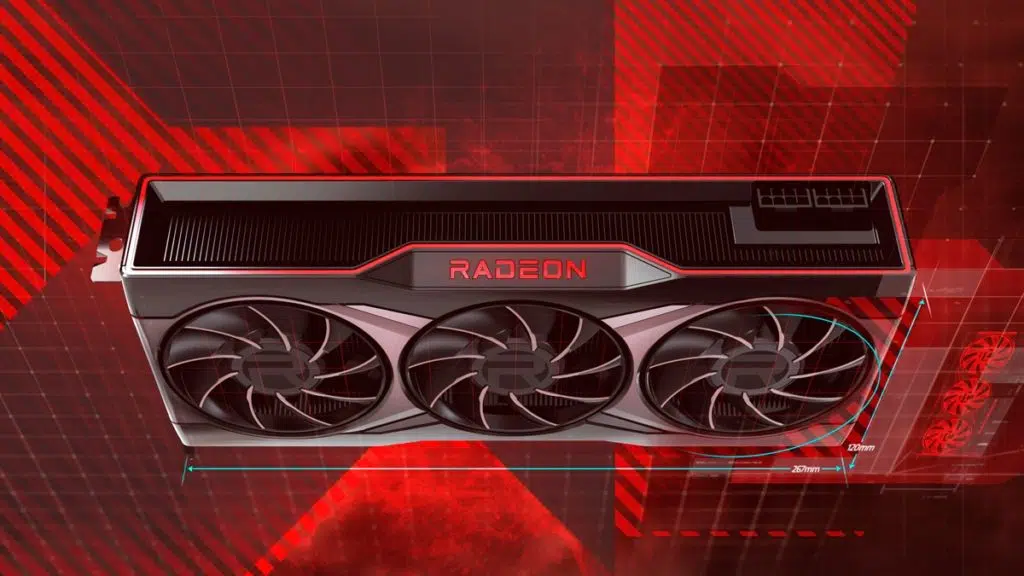
AMD’s next-generation Navi 31 GPUs, which are expected to power the Radeon RX 7950 XT and other high-end Radeon RX 7000 Series graphics cards, will feature support for the unannounced DisplayPort 2.1 specification, according to HardOCP’s Kyle Bennett. “Verification from multiple sources that @Radeon Navi 31 will support upcoming DisplayPort 2.1 specification,” Bennett tweeted, before going on to point out that NVIDIA’s new flagship GeForce RTX 4090, which starts at $1,599, only supports DisplayPort 1.4a. NVIDIA claimed that DisplayPort 2.0 is still “a ways away in the future” in a GeForce RTX 40 Series Community Q&A that was posted in September 2022.
- Q: Why isn’t DisplayPort 2.0 listed on the spec sheet?
- A: The current DisplayPort 1.4 standard already supports 8K at 60Hz. Support for DisplayPort 2.0 in consumer gaming displays are still a ways away in the future.
Verification from multiple sources that @Radeon Navi 31 will support upcoming DisplayPort 2.1 specification. I am tremendously surprised that @NVIDIAGeForce 4090 only supports DP 1.4a. Props to @LinusTech for calling out the DP1.4/4090 shortcomings! https://t.co/eW84VicAZr pic.twitter.com/4fmOtcnlth
— Kyle Bennett (@KyleBennett) October 12, 2022
From Linus Tech Tips, which called NVIDIA out for omitting DisplayPort 2.0:
[…] NVIDIA doesn’t think you need them on a $1,600 graphics card. The official line is,
“DisplayPort 1.0 already supports 8K at 60 hertz, and the consumer displays won’t need more for while,” which might sound fair until you realize that you are also limited to 120 hertz at 4K, a performance level the RTX 4090 can exceed, as we’ve seen.The only way to get higher refresh rates at DisplayPort 1.4 is to use Chroma subsampling, which is, to put it mildly, a suboptimal experience on such premium hardware. 240 hertz 4K displays exist today and will have DisplayPort 2.0 support soon. Arc already supports it, and RDNA 3 has been confirmed to support DisplayPort 2.0 since May. NVIDIA is clearly trying to save a buck again.
DisplayPort 2.0 offers a usable bandwidth of 77.4 Gbps, enabling up to a 3X increase in video bandwidth performance versus DisplayPort 1.4. It is the first standard to support 8K resolution (7680 x 4320) at 60 Hz refresh rate with full-color 4:4:4 resolution, including with 30 bits per pixel (bpp) for HDR-10 support, according to VESA’s official FAQ.
Discussion (4 replies)
Join Discussion →That's really nice. Something to bust nvidia about.
But where are the 8K displays?......oh, there aren't any......are there? Well one...a Dell for 3700 dollars.
nVidia only supporting 1.4 is ... crap. Their rationalewas that 1.4 can already support 8k at 60Hz ... which is true.
But it needs lossy compression (DSC) or lower color depth to support 4K HDR beyond 120Hz. And we do have displays today that can exceed this being sold very commonly.
You can argue that the color depth only matters to pros, or that HDR is a mess on PC and doesn't matter anyway, or that DSC is virtually indistinguishable from the source video... but DP 2.0 eliminates all of those arguments entirely, is a published standard today, and is ~3x the bandwidth of 1.4 - you can drive 2 displays at 4k > 120Hz HDR without compression at all.
I suppose you can also argue that today's cards aren't fast enough to drive two 4k displays at high refresh rates - maybe that's true... not a great thing for nVidia to admit with it's brand new Ada chipset and DLSS 3 though, if you wanted to hang your hat on that particular rationale.
Reality - either it was just an oversite... possible. Or they couldn't make it work... I kinda doubt this one. Or nVidia just doesn't want to eat into their margin to provide it to you, because "you can already use 8k 60Hz". I would say they don't want to overprice their cards, but ... who could possibly say that with a straight face today?
I'm planning my November bonus for a rx7900.
Some people buy the fastest card available, every 5 years or so. There's really no excuse for a $1600 card to not have the latest DP spec.