
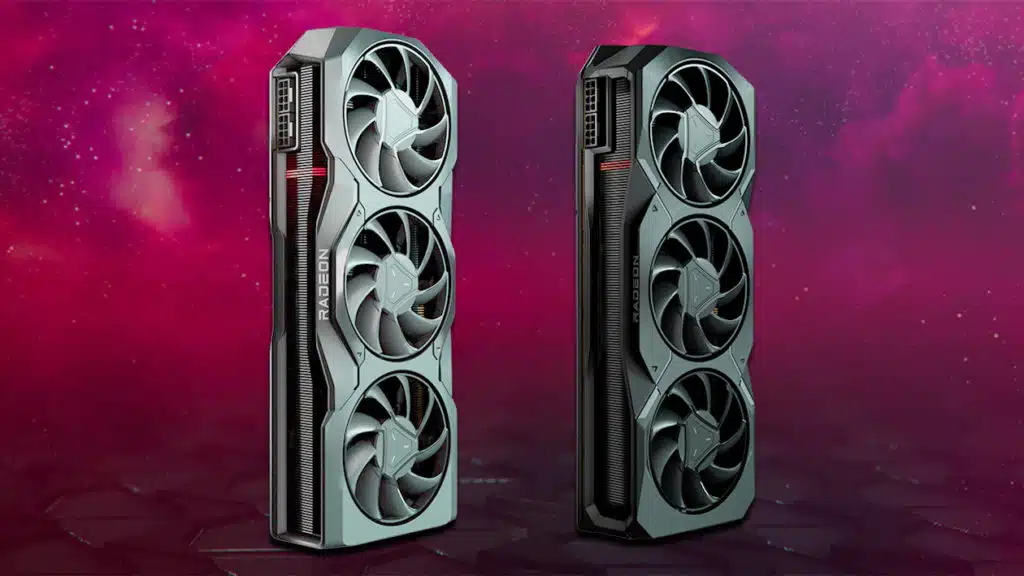
AMD has announced the Radeon RX 7900 XT (20 GB) and Radeon RX 7900 XTX (24 GB), its first next-generation gaming graphics cards built on the new RDNA 3 architecture.
As noted by AMD CEO Dr. Lisa Su and other executives during this evening’s “together we advance_gaming” event, these are the first graphics cards to leverage the world’s first chiplet gaming GPU, enabling what some of red team’s marketing materials have suggested is enough performance to run some of today’s most popular games in 4K at up to 139 FPS, assisted by forthcoming technologies that include FSR 3.0, a new iteration of its upscaling technology.
Users can also expect support for DisplayPort 2.1, 2x 8-pin power connectors, improved ray tracing performance, and TBPs of up to 355 watts. The Radeon RX 7900 XT (20 GB) and Radeon RX 7900 XTX (24 GB) will be released on December 13, 2022 for $899 and $999, respectively.
“These new graphics cards are designed by gamers for gamers. As we were developing the new cards, we not only incorporated feedback from our customers, but we built in the features and capabilities we wanted to use,” said Scott Herkelman, senior vice president & general manager, Graphics Business Unit at AMD.
“We also realized that we needed to do something different to continue pushing the envelope of the technology, and I’m proud of what the team has accomplished with AMD RDNA 3 and the Radeon RX 7900 Series graphics cards. I can’t wait for gamers to experience the powerhouse performance, incredibly vivid visuals and amazing new features these new graphics cards offer.”
AMD Radeon RX 7900 XTX @ 4K Max Settings
- Call of Duty: Modern Warfare 2: 139 FPS
- Resident Evil Village (Ray Tracing): 138 FPS
- DOOM Eternal (Ray Tracing): 135 FPS
- Assassin’s Creed Valhalla: 109 FPS
- God of War: 98 FPS
- Red Dead Redemption 2: 93 FPS
AMD Radeon RX 7900 Series Product Specifications
| Model | Compute Units | GDDR6 | Game Clock (GHz) | Boost Clock (GHz) | Memory Interface | Infinity Cache | TBP | Price(USD SEP) |
|---|---|---|---|---|---|---|---|---|
| AMD Radeon RX 7900 XTX | 96 | 24 GB | 2.3 | Up to 2.5 | 384-bit | 96 MB | 355W | $999 |
| AMD Radeon RX 7900 XT | 84 | 20 GB | 2.0 | Up to 2.4 | 320-bit | 80 MB | 300W | $899 |
From an AMD press release:
AMD today unveiled new graphics cards built on the next-generation high-performance, energy-efficient AMD RDNA 3 architecture – the AMD Radeon RX 7900 XTX and Radeon RX 7900 XT graphics cards. Following on the highly successful AMD “Zen”-based AMD Ryzen chiplet processors, the new graphics cards are the world’s first gaming graphics cards to feature an advanced AMD chiplet design. They deliver exceptional performance and superb energy efficiency to power high-framerate 4K and higher resolution gaming in the most demanding titles.
The AMD RDNA 3 architecture’s chiplet design combines 5nm and 6nm process nodes, each optimized for specific jobs. The breakthrough architecture delivers up to 54% more performance per watt than AMD RDNA 2 architecture, and features the world’s fastest interconnect linking the graphics and memory system chiplets at up to 5.3 TB/s. It also offers up to 96 new unified compute units, second-generation AMD Infinity Cache technology, and up to 24 GB of high-speed GDDR6 memory with up to a 384-bit memory interface. It also includes increased AI throughput that delivers up to 2.7X higher AI performance, and second-generation raytracing technology that provides up to 1.8X higher raytracing performance than AMD RDNA 2 architecture.
Altogether, these features and advancements deliver up to a 1.7X performance uplift in select titles at 4K compared to AMD RDNA 2 architecture. The new graphics cards also support DisplayPort 2.1 displays capable of delivering ultra-high framerates and stunning visuals at up to 4K 480Hz and 8K 165Hz refresh rates.
Radeon RX 7900 Series Graphics Cards
The Radeon RX 7900 Series are the industry’s most advanced gaming graphics cards, unlocking new levels of performance and efficiency and delivering a host of new and enhanced features that supercharge the gaming experience. The AMD Radeon RX 7900 XTX graphics card delivers up to 1.7X higher native 4K performance than the Radeon RX 6950 XT graphics card in select titles, while the Radeon RX 7900 XT provides up to 1.5X higher performance than the Radeon RX 6900 XT graphics card in select titles. Key features include:
- AMD RDNA 3 Architecture – Featuring an advanced chiplet design, new compute units and second-generation AMD Infinity Cache technology, AMD RDNA 3 architecture delivers up to 54% more performance per watt than the previous-generation AMD RDNA 2 architecture. New compute units share resources between rendering, AI and raytracing to make the most effective use of each transistor for faster, more efficient performance than the previous generation.
- Chiplet Design – The world’s first gaming GPU with a chiplet design delivers up to 15% higher frequencies at up to 54% better power efficiency. It includes the new 5nm 306mm2 Graphics Compute Die (GCD) with up to 96 compute units that provide the core GPU functionality. It also includes six of the new 6nm Memory Cache Die (MCD) at 37.5mm2, each with up to 16MB of second-generation AMD Infinity Cache technology.
- Ultra-Fast Chiplet Interconnect – Unleashing the benefits of second-generation AMD Infinity Cache technology, the new chiplets leverage AMD Infinity Links and high-performance fanout packaging to deliver up to 5.3TB/s of bandwidth.
- Expanded Memory and Wider Memory Bus – To meet the growing requirements of today’s demanding titles, the new graphics cards feature up to 24GB of high-speed GDDR6 memory running at 20Gbps over a 384-bit memory bus.
- Dedicated AI Acceleration and Second-Generation Raytracing – New AI instructions and increased AI throughput deliver up to 2.7X more performance than the previous AMD RDNA 2 architecture, while second-generation raytracing technology delivers up to 1.8X more performance than the previous generation.
- DisplayPort 2.1 Support – The industry’s only high-end gaming graphics cards to support DisplayPort 2.1 technology with UHBR 13.5, offering up to 54Gbps of display link bandwidth and enabling high-refresh 4K (up to 480Hz) or 8K (up to 165Hz) gaming on next-gen displays.
- New AMD Radiance Display Engine – Provides 12 bit-per-channel color for up to 68 billion colors and higher refresh rate displays compared to AMD RDNA 2 architecture and includes support for DisplayPort 2.1 and HDMI 2.1a.
- High-Refresh Gaming – DisplayPort 2.1 provides increased display bandwidth compared to DisplayPort 1.4, with the ability to support up to 900Hz, 480Hz and 165Hz refresh rates for 1440p, 4K and 8K displays, respectively.
- Dual Media Engine – Supports simultaneous encode or decode streams up to 8K60 for HEVC and supports AV1 encode, delivering up to 1.8X higher engine frequency than AMD RDNA 2 architecture.
AMD FidelityFX Super Resolution 2.2 and AMD Software: Adrenalin Edition Technology
To support the new graphics cards, AMD is also announcing several updates to its software suite, including:
- AMD FidelityFX Super Resolution (FSR) 2.2 – FSR is now available and upcoming in 216 games, and the next iteration of the popular FSR temporal upscaling technology, FSR 2.2, features enhancements that are designed to improve visual quality. It is expected to be available in the first title on November 8, 2022, Forza Horizon 5. It will also be available to game developers soon at GPUOpen.com.
- AMD FSR 3 – AMD plans to release a new version of AMD FSR featuring AMD Fluid Motion Frames technology in 2023, expected to deliver up to 2X more FPS compared to AMD FSR 2 in select games.
- AMD HYPR-RX – Targeted in the first half of 2023, a one-click preset which enables various AMD Software features – including AMD Radeon Anti-Lag, AMD Radeon Boost and AMD Radeon Super Resolution technologies – to work together at the same time, reducing latency and delivering up to 85% higher FPS in Dying Light 2 Stay Human with the Radeon RX 7900 XTX graphics card and AMD Software: Adrenalin Edition 22.40.00.24, than stock settings.
- New AMD RDNA 3 Media Engine – Features AV1 hardware encoding enabling up to 7X faster video encoding at 8K compared to a software-only solution, and integrates Xilinx Content Adaptive Machine Learning technology to enhance text quality for lower resolutions and bitrate streams.
- Improved Video Recording and Streaming – AMD collaborated with OBS to improve video streaming quality on AMD Radeon RX 6000 and Radeon RX 7000 Series graphics cards. In addition, the AMD RDNA 3 Media Engine includes AV1 hardware encoding to help improve quality and transform live streaming.
AMD Advantage for Desktop PCs
Building on the success of AMD Advantage laptops, AMD is bringing the AMD Advantage framework to desktops, fusing together the top-of-the-line AMD Ryzen 7950x processors and AMD Radeon RX 7900 XTX graphics cards with AMD Software: Adrenalin Edition technology and AMD’s smart technologies to deliver the ultimate platform for gamers and creators. AMD Advantage certified desktops will feature select AMD smart technologies that amplify performance, including AMD Smart Access Memory technology and the new AMD SmartAccess Video technology that intelligently divides the decoding and encoding workloads across AMD Ryzen processors and AMD Radeon graphics cards, delivering up to 30% uplift in 4K multi-stream encoding.
AMD Advantage desktops feature world-class performance, stunning graphics with the AMD Radiance Display Engine and supported AMD FreeSync Premium technology-enabled monitors. They are built to game with high-quality chassis, CPU liquid cooling, a minimum of 2TB of NVMe SSD storage, 32GB or more of DDR5 AMD EXPO memory, 80 plus gold power supplies, and optimized acoustics, and are designed to be easily customizable.
New AMD Advantage desktop systems are expected to be available soon from leading SI partners, including CSL, Cyberpower, eBuyer, Falcon Northwest, Maingear, Origin PC, and XIdax.
Discussion (19 replies)
Join Discussion →Prices at least seem better then Nvidia if they hold true in Europe and if performance is there, I may got AMD
while RDNA3 is technically a chiplet design, people expecting multiple gpus on a single package are going to be dissapointed.
I don't think it will go head to head with the RTX4090, but I can see even the 7900XT beating the RTX4080.
Hmm, will be interesting to see benchmarks.
7900XTX, is 100W less than a 4090 - so no, I don't expect it will take performance crown, particularly in RT, but I am curious to see how close it comes - particularly to the 3080, where it comes closer to price parity.
I am kinda glad to see AI and RT delegated to a lower-tier marketing bulletpoint, instead of a mainline attraction. I've felt they are overhyped buzzword marketing since RTX.
My PCIe slot is ready.
Yea waiting for these reviews. If these are performance comparative with Nvidias top of the line for almost 600 less... that will be a freaking mazing.
What are you talking about? RT and AI are being pushed hard by nvidia and most newer titles support them.
AMD can't tout any of those simply because it still kind of sucks on them, sucks less yes, but still...
I was talking about AMDs marketing with these cards — of course they are downplaying it. nVidia is the only one pushing it - everyone else is just including some token ability so they can check a box. Go look up RT and Ai in the latest AMD press release. Hint: It’s not in bold letters at the top.
So I think we are saying the same thing, from different angles.
And I agree - it’s just nVidia trying to create a market. But nVidia is very good at that.
Any word on when embargo day is?
I couldn't care less about ray tracing. Raster performance of the 7900XTX should be pretty dang close to the 4090. It should also be a pretty good card for streaming and content creation. At $1000 it'll be a bargain.
Now, the real question, will they actually exist and be in stock? Or are we going to have a repeat of the 6000 series launch where Linus, J2C and GN get a dozen cards between them and about 10 cards actually make it to retail chains.
That's a bit of an exaggeration. I got mine in Febuary after release. It wasn't EASY per say... but there you have it.
You just proved my point. 6000 series was released Dec 8. Might as well have been a paper launch as they were nowhere to be found. Months later they started trickling in, and you had to watch discord and youtube channels for stock notification. Even then barely any were hitting the market. Wasn't until mid to late 2021 that they started to become readily available.
At 4K the 4090 is beating the 7900XTX in Watch Dogs Legion without RT according to the numbers AMD provided and that is a pretty AMD favored title
Also the 4090 appears to match the 7900XTX in CoD MW2 and that is heavily AMD favored
This is a disappointing generation for top end performance for AMD. Hopefully they price their entire lineup well.
This of course isn't considering how close the 4080 16G is to the 4090 in raster as we don't have independent reviews yet.
The 7900XT(X) may both beat the 4080 in raster by a lot but the 4090 appears to be in a league of it's own
I think its december 13th
It depends on the price, if the 7900XTX sells for less then 1500€ that would be between 800 to 1000€ less then the 4090, I'm willing to take a bit less performance in that case as long as it beats my 3080 by a decent margin.
Finding one in stock may be the hard part.
One other note. Amd has historically lagged behind Nvidia at launch yet catches up over time with driver updates.