
Power and Temperature
To test the power and temperature we perform a manual run-through in Cyberpunk 2077 at “Ultra” settings for real-world in-game data. We use GPU-Z sensor data to record the results. We report on the GPU-Z sensor data for “Board Power” and “GPU Chip Power” when available for our Wattage data. For temperature data, we report the GPU (Edge Temp of the GPU or Package Temp) as well as Hot Spot (Junction Temperature) when available for our temperature data.
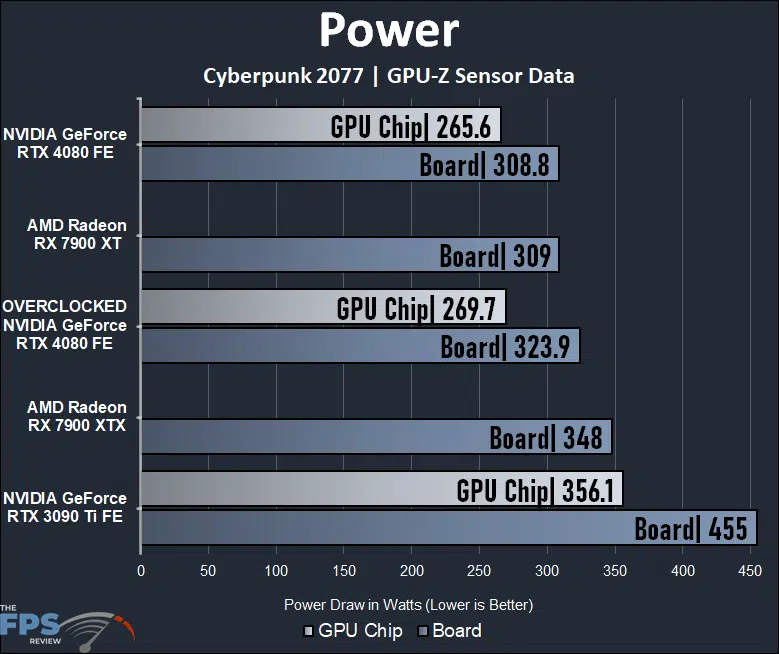
By default, the NVIDIA GeForce RTX 4080 Founders Edition pulled 308.8W board power, and 265.6W GPU chip power. This puts it as the most power-efficient video card on this graph, well under the Radeon RX 7900 XTX, and GeForce RTX 3090 Ti FE. In fact, it’s on par with the power draw from the Radeon RX 7900 XT, and yet much much faster in performance. It uses almost 150W less power than the GeForce RTX 3090 Ti FE, yet is much faster.
When we overclocked the GeForce RTX 4080 FE board power rose to 323.9W, an increase of 5% board power or only 15W of board power. At this level, it still uses less power than the Radeon RX 7900 XTX. This is exactly in line with the performance increase we received, so the power increase vs performance increase is nearly a 1:1 ratio.
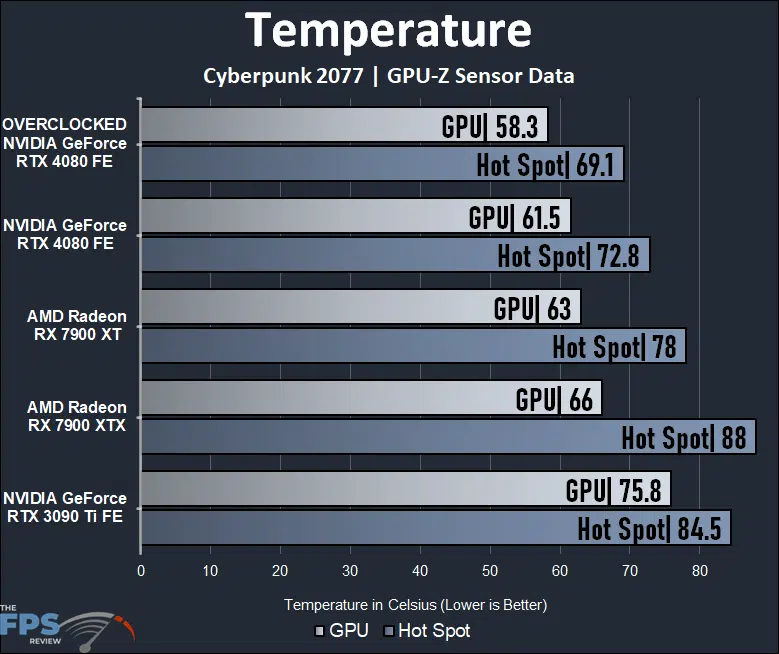
At stock settings, the GeForce RTX 4080 FE has a GPU temp of 61.5c and a Hot Spot of 72.8c. This again runs cooler than the GeForce RTX 3090 Ti which is at 75.8c GPU and 84.5c GPU. The Radeon RX 7900 XTX and XT actually run warmer than the GeForce RTX 4080 Founders Edition.
Granted, the fans are running at 100%, but when overclocked the GeForce RTX 4080 FE is running at 58.3c GPU and 69.1c Hot Spot. These temperatures are the lowest on the graph, so we can see that the cooler configuration is not holding back overclocking potential.
GPU-Z Sensor Data
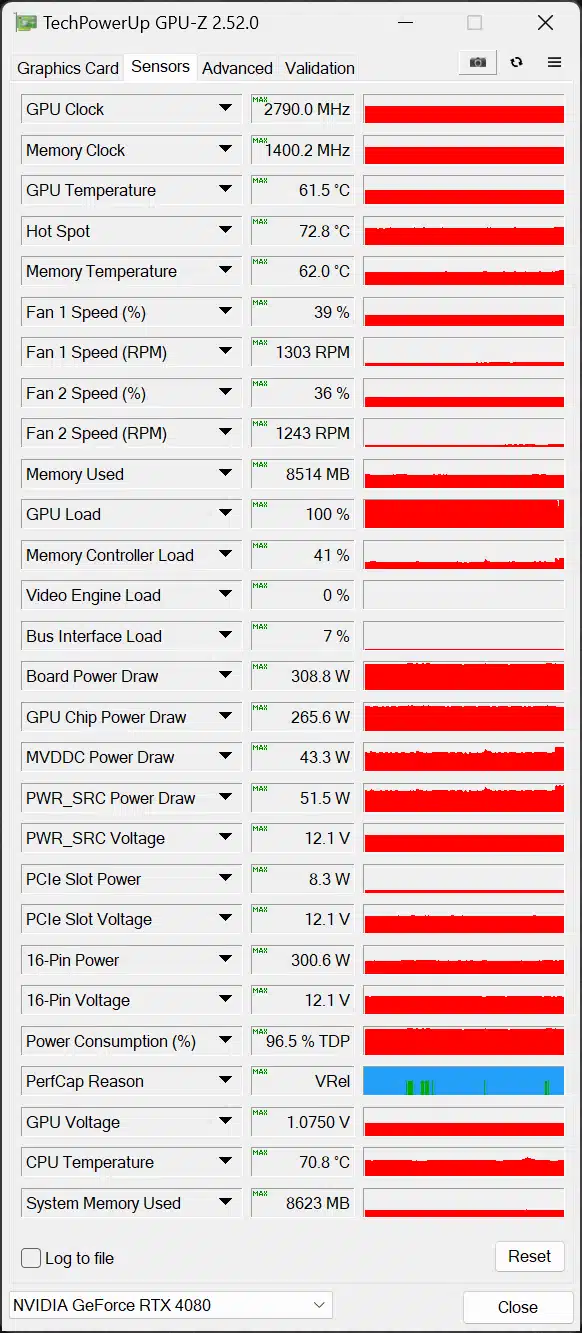
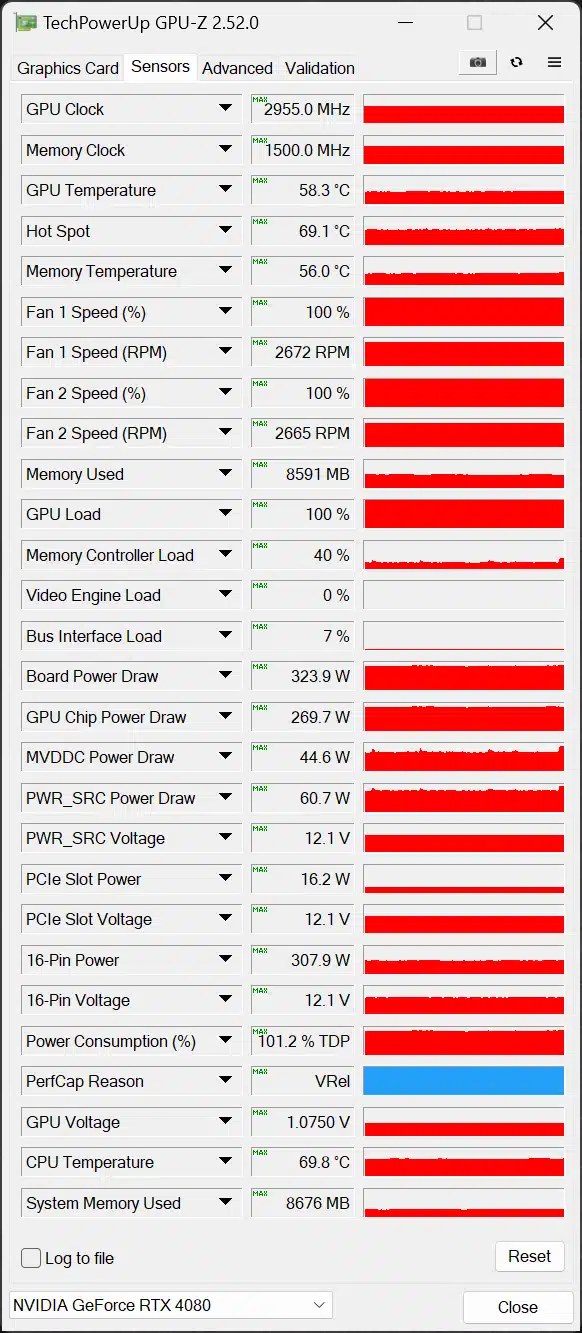
The first screenshot of GPU-Z above is at Default, and the second screenshot of GPU-Z is at Overclocked.
Discussion (9 replies)
Join Discussion →Nice read, thank you. :)
I can't remember where I read it but I do remember someone saying sometime before the 40 series launch that NVIDIA's dynamic boost had reached a point where OC gains would be at a minimum for this gen. It was something to the effect that there's not even much for board partners to squeeze out with custom models. This card is definitely an example of that. Granted, it's been getting that way for a while now but this might be the least we've seen in around 10 years. Even with my 4090 I usually keep it just under 2900 and that's only ~100 more than the out-of-the-box settings. Still a fun ride though. I'd say the other big take away is the power efficiency of these GPUs in comparison to Ampere. It's almost like night and day.
CPUs and GPUs are coming factory maxed now; there's still value in tuning, and still some performance on the table, but it comes with significant exploratory testing.
Which is why we give them to Brent to test :D
I remember the time when my Geforce3 TI200 overclocked and performed better than my friends Geforce 3 Ti500.
IMO OC has been dead for years, you don't get much more performance since GPUs are already maxxed out to begin with.
Its really not worth the higher temps and powerdraw.
And that applies to CPUs too.
Man I remember those candy bar celerons... overclocked like a BEAST.
I had the legendary celeron 300 that could easily OC to 450mhz and a duron 600 that reached 1.1ghz.
...but did you have a Golden Orb on it?
:D
The golden orb....
Overclocking is dead unless you are using exotic cooling methods. DI or LN2. Even on high end custom water the gains are minimal. OEM's aren't leaving anything on the table anymore. And people aren't so quick to apply a custom firmware to remove the power, voltage and temp limits on the $1000+ GPU's.