
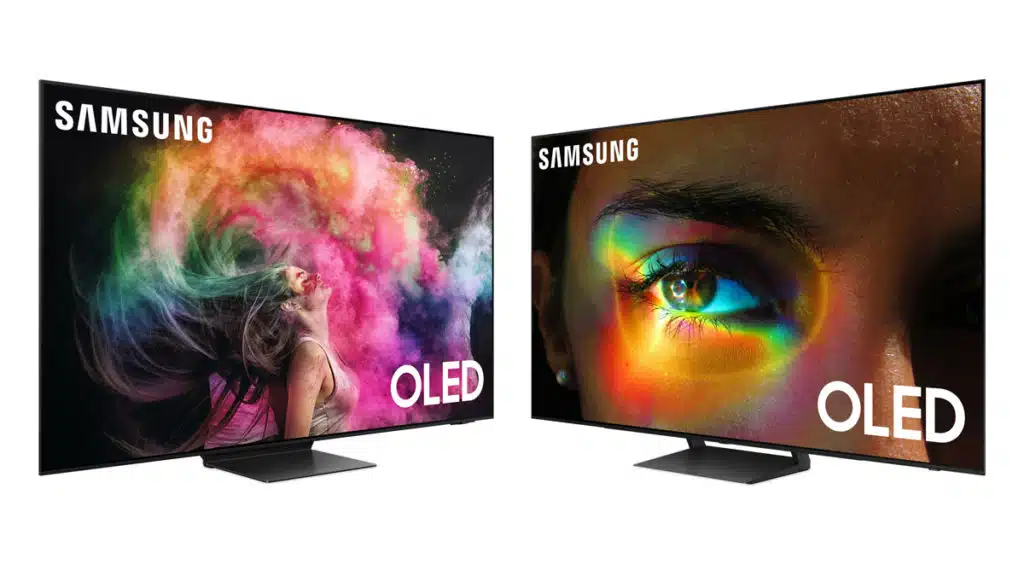
The competition between Samsung’s QD-OLED TVs and LG’s OLED TVs appears to be heating up. Samsung Electronics America today announced the expansion of its OLED 4K TV line with two new series, the S95C and S90C, and the latter happens to start at $1,899, a price that matches the 55-inch C3, one of LG’s key OLED offerings for the year. According to a press release from Samsung, these new QD-OLED TVs are capable of delivering up to a 30% brighter picture, with more vibrant colors and contrast thanks to the company’s Neural Quantum processor technology. Both series begin rolling out at retailers nationwide today and are available in 55-, 65-, and 77-inch screen sizes.
From a Samsung press release:
The 2023 Samsung OLED 4K TV portfolio is more dynamic than ever with vibrant colors boosted the AI powered Neural Quantum processor. The lineup delivers content in dramatic detail with the deepest blacks, a billion shades of lifelike color – including vivid color palettes validated by Pantone, the industry-leading color experts – along with 8.3 million self-illuminating pixels that create a truly stunning picture.
With powerful processing and 4K upscaling, everything displayed on screen is instantly transformed to incredibly sharp 4K resolution to bring out incredible detail no matter what the original source resolution. Exceptional motion enhancements are included in both series to ensure high speed games and movies appear in consistently crisp 4K at blazing-fast speeds up to 120hz and Game Motion Plus goes up to 144hz with compatible PC-connected content. To further captivate viewers with the total sound, both the S95C and S90C have powerful Dolby Atmos sound built in.
Bring the movie experience home: Samsung OLED 4K flagship S95C
The flagship S95C series is offered in 77”, 65” and 55” screen sizes with anti-reflective coating. This series offers Quantum HDR OLED+ that delivers bright whites and pure blacks thanks to the powerful processor that dynamically brings to life every scene for Hollywood content leaps off the screen. Viewers can feel like they’re part of the action with enhanced Dolby Atmos built-in and Object Tracking Sound+ that uses AI to track the on-screen action and follows the movement with pinpoint accuracy.
The S95C series stands out with dramatic visuals, bold sound and convenient connectivity all housed in a strikingly slender Infinity One Design boasting modern lines at just 4mm thin. It’s virtually bezel-free and offers a choice of a near flush-fit wall mount or a streamlined blade stand. The attachable Slim One Connect solution neatly tucks away cords and cables so viewers can focus on what’s on the screen, rather than around it.
- 77S95C: MSRP $4,499
- 65S95C: MSRP $3,299
- 55S95C: MSRP $2,499
Prepare to be captivated with the Samsung OLED 4K S90C
The Samsung S90C brings the benefits of OLED at a lower price point in 77”, 65,” and 55” screen sizes with anti-reflective coating. With fine-tuned brightness and optimized contrast made possible by self-illuminating pixels, picture quality is instantly enhanced as Quantum HDR OLED uses AI deep learning to analyze each scene, detecting areas that should be brighter and areas that should be darker ensuring rich, accurate colors.
Its slender LaserSlim design showcases a virtually bezel-free cinematic experience. Viewers will experience pure blacks, bright whites, and dramatic color and audio that keeps them in the action with Dolby Atmos and Object Tracking Sound Lite that reacts dynamically to deliver realistic, 3D audio.
- 77S90C: MSRP $3,599
- 65S90C: coming soon
- 55S90C: MSRP $1,899
Endless, easy entertainment
Users can personalize their viewing experience with easy access to the latest Smart TV apps and top streaming providers.3 The Tizen OS-powered entertainment hub delivers access to Samsung TV Plus, Samsung’s free ad-supported TV (FAST) and video-on-demand service which offers nearly 250 channels in the US and 1,900 channels globally, as well as thousands of shows and movies on-demand. With Samsung Gaming Hub, gamers can instantly play thousands of games from top streaming services like Xbox, NVIDIA GeForce NOW, Amazon Luna, Utomik and more coming soon with no console required.
Better together with Samsung audio
For sound that is off the charts, Samsung TVs pair effortlessly with Samsung soundbars. With Q-Symphony, TV speakers paired with Q-Series and S-Series soundbar operate as one for optimized channels that deliver a masterfully orchestrated sound experience.
Everyday sustainability
Samsung OLED 4K TVs help users turn up the volume on sustainability with the innovative SolarCell Remote featuring a solar panel for charging that eliminates the need for disposable batteries, as well as other smart features including a built-in microphone to use with compatible voice assistants.
In addition to more efficient manufacturing, reduced packaging and more recycled materials in its products, Samsung offers energy efficient products to help users save on energy bills without sacrificing performance comfort.
Discussion (19 replies)
Join Discussion →What is "QD-OLED" again? Is that just Samsung's marketing name for their OLED?
They just had to be different?
Ugh... has to be a full Sa... ugh... Nope! I refuse... I mean... seriously... why does this panel... UGH!
Just... No!!
QD is Quantum Dot. Instead of using color filters it uses quantum dots to bend light to the desired color.
Samsung S95C and LG G3 are both going to be bright panels, it's how they produce their colors and brightness that's different. Both have their pro's and con's. The Samsung panels were brighter in 2022, but they suffered from light bleed a bit and low bitrate image processing. The LG panels were not as bright and suffered from color accuracy issues. Supposedly these 2023 displays from Samsung and LG have corrected those issues. We'll just have to wait for a side by side comparison once people get them for review.
I thought the whole point of OLED was that threre was no filter or backlight? That it is all three color (RGB) mini-LED's per pixel that are responsible for both lighting and color?
Taken from TechRadar.com
So to answer your question. Straight OLED TV's are exactly as we thought. Each pixel is it's own source of light. But it struggles with very bright scenes and colors. LG has WOLED to help with a white subpixel to increase brightness but struggles with color reproduction. Samsung's answer is QD OLED which is a blue or different colored light that is spectrum bent via a Quantum Dot Screen of sorts that bends the light to be both brighter and more in line with the color the pixel is trying to display... I think??
Depends on the screen type.
Small AMOLED screens - the OLED is just white, and it uses color filters much like a LCD does. That isn't what's in these big TV sets though.
QD are a method to boost brightness. LG is using a micro lens array in the G-series to help boost the brightness, as well as new polarizer on the screen ("Vanta Black") to help reduce glare.
Well, I'm not sold on the idea of QD led. I liked the concept of the LED being the pixel (or at least the subpixel) without backlights or filters.
That said, it's good to have alternatives.
The smallest of these seem to be 55" though, which means they are a no-go as desktop monitors.
We're still a ways off from micro-LED displays being in the realm of affordable. Their smallest one is 89" and is like $60,000.
I'd say another 5 years and the tech will mature. OLED has always been a stop gap between LCD and micro LED.
I swear, is it really so hard for them to make a 31-ish UW 21:9 1440p Fanless-OLED 144Hz G-Sync? If it was even close to $1K I might order in a heartbeat. This extreme of 27 that skips to 49 and over is insane and putting two of these side-by-side is just as bad or worse.
Are you telling me there are screens with fans? :LOL:
pretty loud ones too
I had no idea this was a thing to be on the lookout for. I would be pissed if I bought a screen and it was loud.
https://www.guru3d.com/articles-pages/asus-rog-swift-pg27uq-monitor-review,7.html is one of them
If this were me, the minute that fan turned on, it would be packed up and returned as unsuitable for its purpose.
and I would not blame you one bit.
Think it was one of thee monitors I was looking into back then but decided against it. I know there are more around from back then, not sure they still have ones with fans these days, not looked much into monitors recently.