
Rendering Performance
We will now take a look at how rendering performance compares.
Cinebench R23
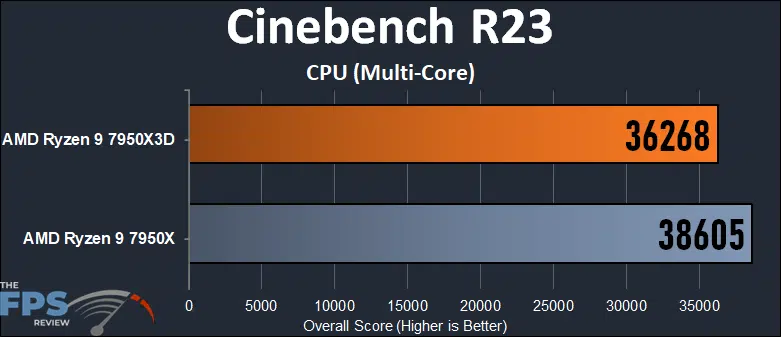
In Cinebench R23, the rendering performance backs up the system testing in 3DMark and Geekbench as it relates to multi-core performance. The Ryzen 9 7950X3D scores 36268, which is 6% slower than the Ryzen 9 7950X at 38605. The Ryzen 9 7950X is 6% faster than the Ryzen 9 7950X3D when all the cores are maxed out in performance, meaning the 7950X is faster.
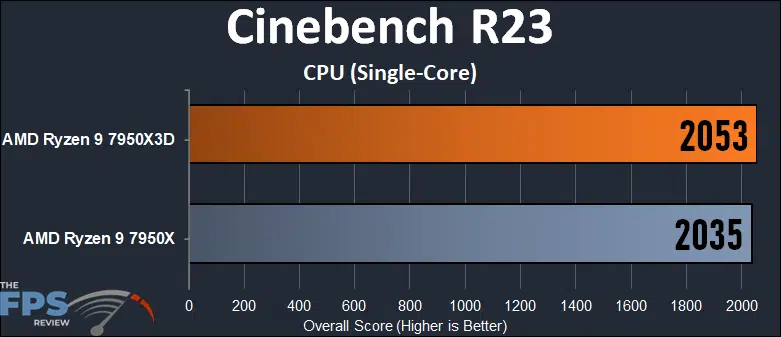
But, in single-thread performance the tables even out between the CPUs. Here the Ryzen 9 7950X3D is 1% faster than the Ryzen 9 7950X, or basically the same performance. This backups the 3DMark and Geekbench testing as well were both CPUs are the same in single-thread performance.
Blender Open Data Benchmark
Take note, the Blender Open Data Benchmark has changed, it now runs 3 scenes and spits out a “Samples per Minute” number, where higher samples are better.
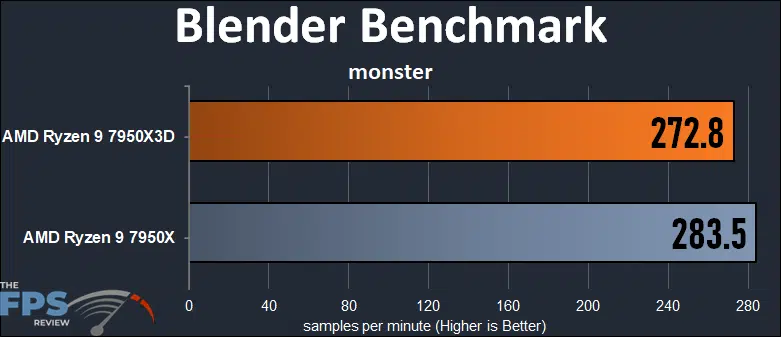
Blender utilizes all the cores to render 3D models, and this once again shows that the Ryzen 9 7950X3D is slower than the Ryzen 9 7950X. The Ryzen 9 7950X3D scores 272.8 samples per minute, which is 4% slower than the Ryzen 9 7590X. The 7950X is 4% faster than the Ryzen 9 7590X3D for modeling the monster scene in Blender.
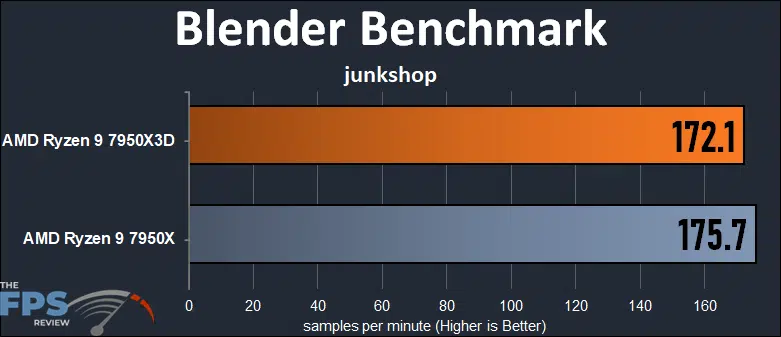
In junkshop, we see the same, the Ryzen 9 7950X3D is 2% slower than the Ryzen 9 7950X.
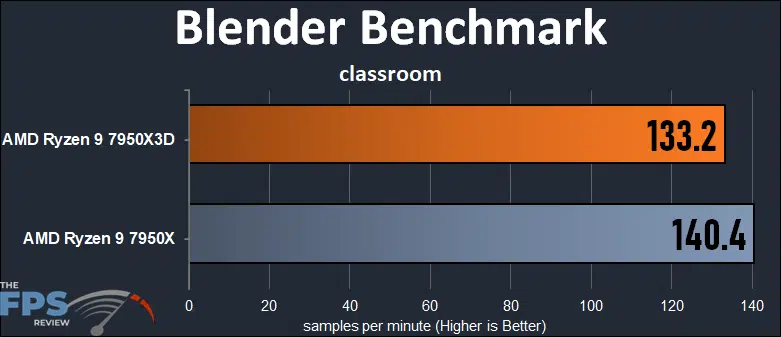
In classroom, we also see the Ryzen 9 7950X3D at 5% slower than the Ryzen 9 7950X for 3D modeling.
V-RAY 5 Benchmark
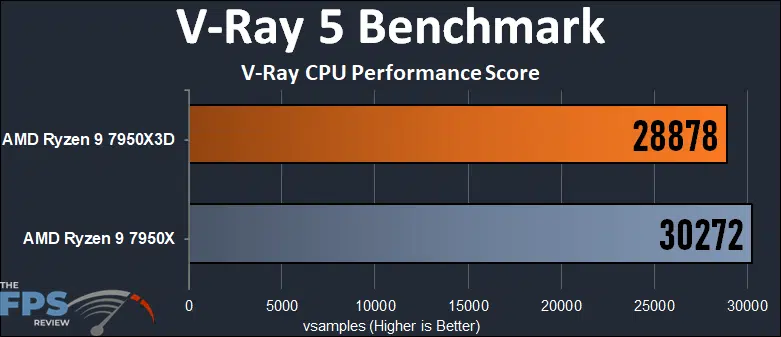
V-Ray 5 is another benchmark testing 3D performance in vsamples. Following all the other benchmarks, this very multi-threaded benchmark shows the Ryzen 9 7950X3D falling behind the Ryzen 9 7950X by 5% in performance.
HandBrake
We are going to test HandBrake performance encoding a 10-minute video using two different media formats, H.264 and AV1 on the CPU only. Remember, we are looking for the lowest time to encode here, the lowest result is the better one.
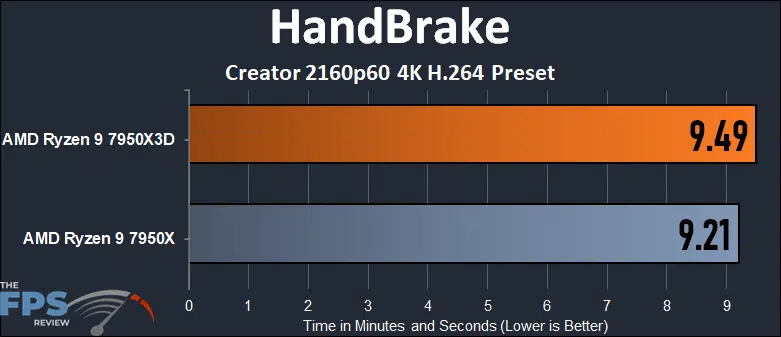
In this first test, we are rendering using the Creator preset at 2160p60 4K H.264 preset on a 10-minute video which was recorded at 1440p, therefore it is upscaling the video. Our tests show that the fastest CPU is the Ryzen 9 7950X, not the Ryzen 9 7950X3D. The Ryzen 9 7950X3D rendered the video in 9 minutes and 49 seconds, while the Ryzen 9 7950X rendered it in 9 minutes and 21 seconds, an almost 30-second difference. This isn’t large, but consider if your video took hours to render, the difference would add up and matter more then.
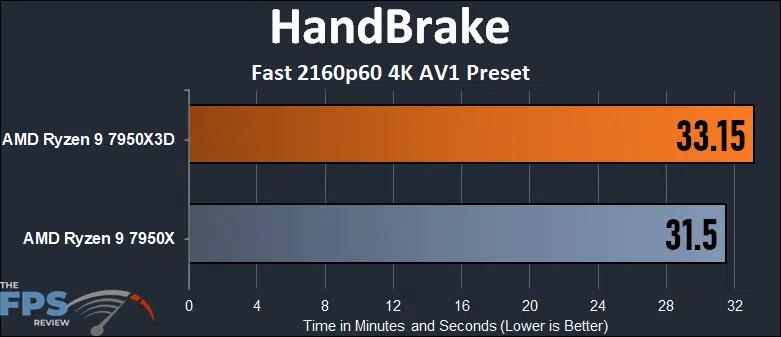
In this test, we are testing the new AV1 codec in the Fast 2160p60 4K AV1 preset, which is upscaling the video to 4K. As the time to render is longer, the difference widens between the CPUs. The Ryzen 9 7950X3D took 33 minutes and 15 seconds, while the Ryzen 9 7950X took 31 minutes and 50 seconds, a difference of close to 2 minutes. That again can make a pretty big difference if you are rendering hours of video.
Discussion (5 replies)
Join Discussion →So, question.
Here is a head to head comparison of two different items. The writeup is great and I think it's a very good article. But you have those Review Overview graphs at the bottom that list Performance/efficiency/features/value. So which of these two items in a head to head comparison does that graph pertain to? You may want to revisit that graph layout for head to head comparison type reviews.
It pertains to the 7950X3D. The first CPU in the title, is always the one that is the main focus, or the one being reviewed. I think from the tone of the review, as you read it, starting with the Introduction, I made it quite clear the 7950X3D is the focus of the review and the CPU that is being "reviewed". IMO, the text is very clear about which CPU is in question here. The conclusion also concludes with that comparison and focus. In addition, the "Summary" in the ranking system starts off with the very first line telling the reader what we did in the review: "In this application-focused review, we find out the overall big picture of the Ryzen 9 7950X3D when it comes to application performance." and the rest of it goes into explaining the ratings we chose, and why, for that CPU that it calls out. IMO, the intention is very clear.
I see what you're saying here. When doing a head to head include the overall score and short breakdown for each.... makes sense. Also makes sense to only do the title card.
Oh I also wanted to add, good review enjoyed reading it and feel more informed. I'll be waiting for the next generation CPU's from AMD before I talk upgrade. Or maybe skip two depending on motherboard, ram and storage costs.
That is what the "Summary" section does at the bottom of every page, to explain the rankings.