
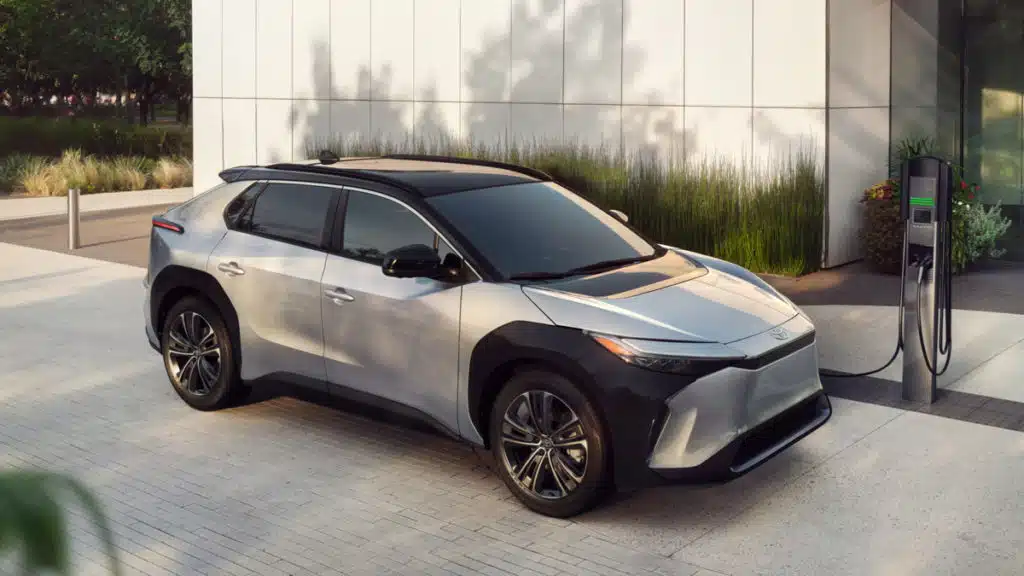
Toyota claims that it has made a “technological breakthrough” that will enable the development of solid-state batteries that not only feature a range of 745 miles, but can be charged in as little as 10 minutes. As a point of comparison, Tesla’s longest-range EV, the $88,490 Model S, offers a range of up to 405 miles, with Li-ion battery charging times ranging anywhere from under an hour to days depending on the hardware involved. Toyota thinks it’ll be able to launch these solid-state batteries for use in EVs as soon as 2027.
“For both our liquid and solid-state batteries, we are aiming to drastically change the situation where current batteries are too big, heavy and expensive,” said Keiji Kaita, president of Toyota’s research and development centre for carbon neutrality, teasing a simplified production process. “In terms of potential, we will aim to halve all of these factors.”
“All of our members are highly motivated and are working with the intention to definitely launch” he added.
The comments come after the world’s largest carmaker by sales surprised investors last month with plans to commercialise its solid-state battery technology in an electric vehicle by 2027 at the earliest. Toyota is also working on the technology with Panasonic through their joint battery venture.
Solid-state batteries have long been heralded by industry experts as the most promising technology to solve EV battery problems such as charging time, capacity and the risk of catching fire. They replace a liquid electrolyte with a solid one and use lithium metal at the anode instead of graphite, the current standard in lithium-ion batteries.
Discussion (7 replies)
Join Discussion →That's actually VERY good news for the EV market. Especially if they can do it at price. I'm going to laugh though if they are the Egyptian batteries in a newer modern case. ;)
We shall see, come 2027
745 miles in what? A Yaris? You can go 2000 miles with a Tesla battery ...... in a golf cart.
I'd have to find it, but a bunch of scientists with MIT or somewhere did a video on energy density in batteries. And said we were pretty much at the limit as far as how dense we can store energy in a solid or liquid medium. Any more and you basically have a bomb when using alkali metals due to the heat dissipation that would need to be addressed. To where what would be needed to control the heat grows exponentially higher the more dense you try to make the battery. Something like an extra 25% in stored power would require an additional 150-200% cooling capacity, where the weight of that cooling negates the extra stored power.
While I too am skeptical I'm also hopeful. As a Texas resident the likelihood of me needing to go on a drive over 200 miles is more than 5%. Given that even if the range for a regular car is around 300 miles but stopping for a recharge is 10 minutes .. it seems worth while.
Less important than all this, cheap, less or non toxic materials reign supreme. Sodium Ion is likely they way to go, and the Chinese solved that problem already and are moving forward.
There's a threshold of reasonably good , usefulness for personal transport. At 200 miles ( way less for dense cities) you are well into it, even if it takes 1 hour to charge. No one is going to die from waiting 1 hour every 200 miles or so, 180 whatever.
This toyota thing is pure bs unless its made from cheap, less toxic, less dangerous metals.
At some point perhaps cars should have a small battery pack, like 50 miles or so, with the ability to plug in standarized large packs, for fast change and range expansion. You would not own that battery but pay for the power, rent it for a fee and such. Could be a modular pack, which you can buy the car with just one module something like this. The time is coming to make these logical decisions. China is absolutely number one in EVs, perhaps they should come up with the model of this. Well they can always modify things for export in countries that do not want logic.
Having most of the capacity of the battery being an empty spot, will also allow battery improvement to be separated from the car themselves.
That quick of a charge time for that size battery just makes me think of excessive heat.
Ding Ding Ding!
How do you deal with the heat?