

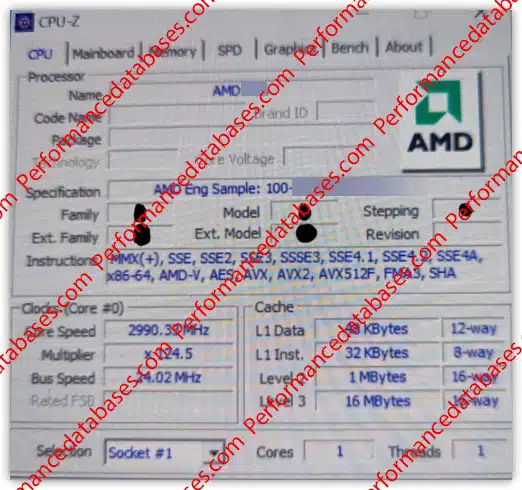
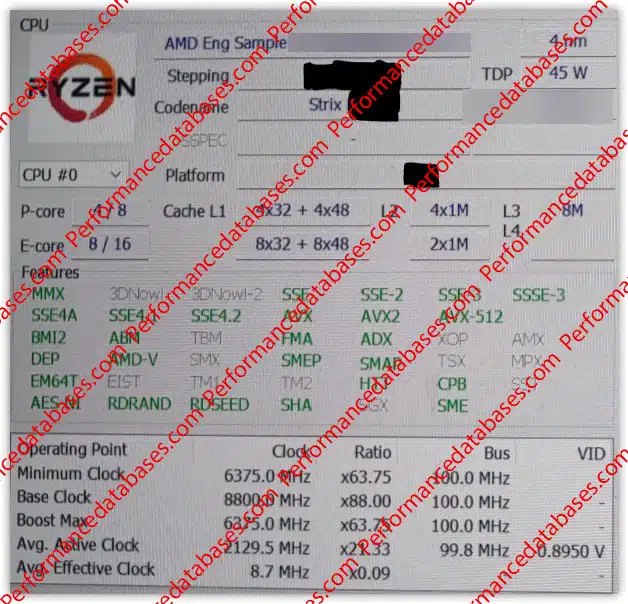
AMD appears to be taking a page out of Intel’s playbook with “Strix,” a new Zen 5 APU that’s apparently in development. According to CPU-Z screenshots shared by performancedatabases.com, this CPU will feature a mix of Performance and Efficiency cores, echoing a design that Intel introduced for its more recent Core processors. AMD had suggested in the past that it didn’t really care for Intel’s hybrid core approach.
The next-gen APU, codenamed “Strix,” is built on a 4nm Process and features the Big.Little CPU architecture with 4 Performance Cores and 8 Efficiency Cores. Both the P and E cores support hyper-threading. On the P Core and E Core, the L1 Data cache is 48 kb, while the L1 instruction cache is 32kb. Each P Core boasts 1Mb of cache, and with E cores, it looks like there are 4 in a group, sharing 1mb of L2 Cache. This setup is quite similar to Intel’s design. Keep in mind, it’s still in the ES stage, so there’s more to come. We’ll keep you posted on any further updates!
Discussion (8 replies)
Join Discussion →The rumor mill suggests this is not like Intel's P and E cores in many ways.
Rumors I have seen suggest that both cores support the same ISA (Intels don't) and as you mentioned both cores support hyper threading.
The support of the same ISA is a non-trivial part of the performance challenges that are seen with Intel's P/E strategy.
AMD said they wouldn't do a hybrid strategy like Intel's but they would have a hybrid strategy.
A 16 core system where 6 of my cores are lower performant cores for background tasks, and the other 10 are full fat high bandwidth/speed cores makes sense. With AMD's chiplet designs the lower performance cores could literally just be an older generation CPU. Interesting....
AMD makes standard and dense versions of their chiplets for cpu cores, the rumors are that they may make hybrids with mixed chiplets that combine standard, dense, and GPU chiplets on a single substrate (possibly other things as wells like FPGA and AI accelerators).
Sounds like a direct competitor to apples SOC design. Ok for a laptop I think as long as storage isn't integrated.
I would rather 32 full fat bandwidth/speed cores.
I want all CPU cores to be equal in my CPUs.
I'm on board with efficiency vs performance cores - I don't have an issue with a split setup at all. I'm all for an efficient setup when I'm not using it, or using it only lightly, but yeah, when I need the performance I want it there without having to hassle with it. I would ~love~ it if my desktop could ramp all the way down to no fans at all and be totally silent if it's idle or lightly used, but throttle up to the same performance I have now. I'm sure I could probably do that now with very careful component selection, but it's not "standard" and you have to build around that idea with very specific parts throughout.
But it doesn't work unless it's seamless - the scheduler and programs need to be smart enough to know when and where they should be running. If that part doesn't work, you may as well have a slow computer and a fast computer and just use whichever you need at the time.
It works very very well on my MBP - but that's a case where the hardware and software are pretty intertwined. I love getting almost a week out of a battery charge, absolutely no fan noise (or rotating parts period for that matter), and it ramps up when I need performance without me having to do anything special.
Only problem I have with integrated storage (which I like given the potential performance benefits) is when the integrated storage is exclusive.
If I can shove another 4TB of NVMe in there alongside and have that run at full speed, I'm good to go.
Looking at you, Apple.