
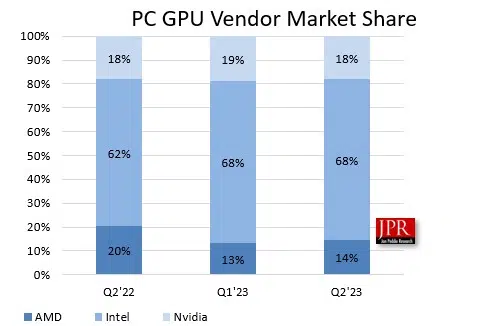
Jon Peddie Research has delivered a fresh report regarding the state of the GPU market, revealing that AMD’s overall market share has increased 1.2% from the previous quarter. NVIDIA and Intel, on the other hand, saw a decrease in market share at -0.8% and -0.4%, respectively. And as for GPU shipments, AMD’s increased by 22.9%, Intel’s increased by 11.7%, and NVIDIA’s increased by 7.5%.
“Q2 was surprisingly up, significantly up, led by AMD in growth and by NVIDIA in total shipments,” Jon Peddie, president of JPR, said. “NVIDIA had their best results in notebooks, AMD did well in desktops, and Intel had year-to-year overall growth. The suppliers are bullish and expecting a strong third quarter, which is normal—if things will ever be normal again.”
“Whereas the increased shipments are welcome good news, the overall PC market and, therefore, the GPU market, has been on a steady decline since 2010. And so, if the market has indeed turned around, it’s not going to get to the levels it was 10 years ago.”
JPR Q2 23 Market Highlights
- The GPU’s overall attach rate (which includes integrated and discrete GPUs, desktops, notebooks, and workstations) to PCs for the quarter was 115%, down -2.6% from last quarter.
- The overall PC CPU market increased by 15.0% quarter to quarter and decreased -23.0% year to year.
- Desktop graphics add-in boards (AIBs that use discrete GPUs) increased by 2.9% from the last quarter.
- This quarter saw -31.9% change in tablet shipments from last quarter.
AMD’s overall market share increased 1.2% from the last quarter, Intel’s market share decreased by -0.4%, and Nvidia’s market share decreased by -0.8%, as indicated in the following chart.
Discussion (5 replies)
Join Discussion →I wouldn't call those numbers... staggering. Especially considering they still represent a .6% Year over year decline for AMD. But it's moving in the right direction for them.
There's also a little more to unpack here. Sure AMD could be shipping more but at what price points and does that equate to larger profits vs. NV? It's well known AMD tends to dominate more at the low-mid tiers but that's also a much lower pricepoint segment.
I'd call this noise in the waning days of the current generation.
I have a hard time believing this at all. I'd question methodology tbh.
I'd say it wouldn't surprise me. Nothing terribly exciting has come out in GPUs in a while. We've seen the mid-tiers flesh out a bit, but mostly at non-exciting price points that aren't exactly going to lead to a flood of gamers going out clamoring for upgrades.
Combine that with the fact that nVidia is focusing on manufacturing AI parts over GPUs (so mid-generational discounts we normally would see just haven't really appeared, they are not being aggressive on GPUs right now), and AMD has basically changed nothing, and just the slight bit of change in manufacturing from nVidia leads to the tetter-totter starting to lean in the other direction.
So yeah, I could totally believe it, but I don't think it's significant in any way. It's hardly a harbinger to nVidia exiting the consumer space all together, and they had already signaled strongly that they were going to command a higher margin on consumer parts - everyone else in the GPU space is just along for the ride with nVidia firmly in the driver's seat.