
Ray Tracing Performance
We are going to focus on Ray Tracing 1440p gameplay performance with the ASUS TUF Gaming Radeon RX 7800 XT OC Edition Video Card. We will include DLSS and FSR performance on the same graph in the games that are supported. We will use DLSS on NVIDIA GPUs and FSR on AMD GPUs.
When comparing video cards in this review, we are using an NVIDIA GeForce RTX 4070 Founders Edition. Keep in mind launch prices by MSRP for comparison, the GeForce RTX 4070 FE launched at $599. The Radeon RX 7800 XT has a launch MSRP of $499. The ASUS TUF Gaming Radeon RX 7800 XT OC Edition has an MSRP of $529.
Returnal
Returnal was launched on the PC in February of 2023 and is based on Unreal Engine 4. The game supports real-time ray tracing effects, particle systems, and volumetric rendering. We utilize the graphics preset to set EPIC graphics settings with an unlocked framerate, and everything is enabled. For ray tracing tests we have enabled Ray Traced Shadows and Reflections at EPIC settings. We use the built-in benchmark.
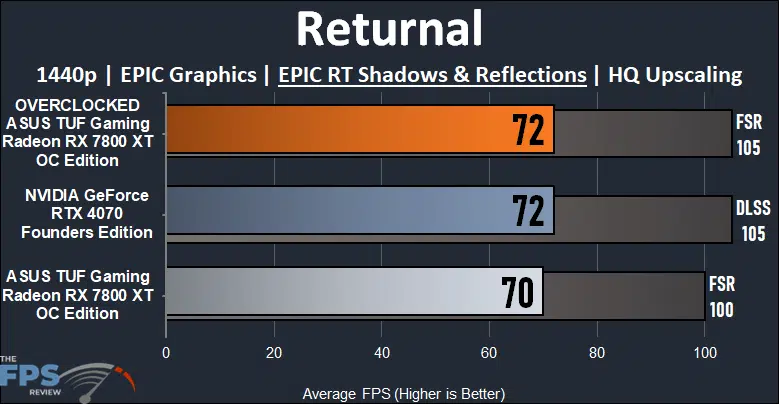
Now we are really pushing these cards by enabling Ray Tracing at maximum settings in games at 1440p. The ASUS TUF Gaming Radeon RX 7800 XT OC Edition is still playable in this game at 70 FPS with Ray Tracing with smooth and enjoyable gameplay. In fact, it’s almost as fast, practically on par, with the GeForce RTX 4070 performance with Ray Tracing. The GeForce RTX 4070 is only 3% faster. When we overclock the ASUS TUF Gaming Radeon RX 7800 XT OC Edition it matches the GeForce RTX 4070 exactly on performance, for a 3% performance improvement. With FSR enabled, it also matches the RTX 4070 with DLSS.
Forspoken
Forspoken was released on January 24th, 2023, on the PC and uses the Luminous Engine. The game supports all upscaling methods and Ray Tracing. We are going to customize the settings and enable the highest graphics settings, including Ultra High Texture Memory. We are going to enable both Ray Tracing options, Shadows, and Ambient Occlusion. We use the built-in benchmark.
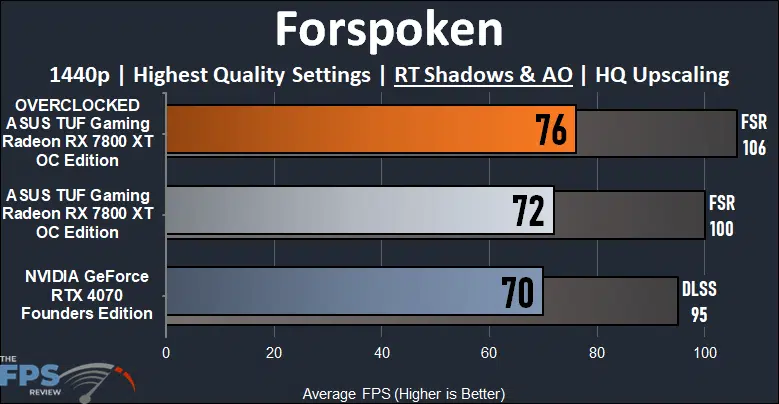
In Forspoken with Ray Tracing ASUS TUF Gaming Radeon RX 7800 XT OC Edition is very playable at 72 FPS with Ray Tracing enabled. In this game, it is actually 3% faster than the GeForce RTX 4070 with Ray Tracing. When we overclock the ASUS TUF Gaming Radeon RX 7800 XT OC Edition performance increases by 6% to 76 FPS. When overclocked it is 9% faster than the GeForce RTX 4070.
The Callisto Protocol
The Callisto Protocol was released in December of 2022 on the PC and is based on Unreal Engine 4. We run the game in DX12 mode with unlimited framerate, and all graphics settings enabled and at the highest graphics settings. This game supports ray tracing, and FSR upscaling only, we use FSR2 for testing. For Ray Tracing we enable Ray Traced Shadows, Ray Traced Transmission, and Ray Traced Reflections to High. We use the built-in benchmark.
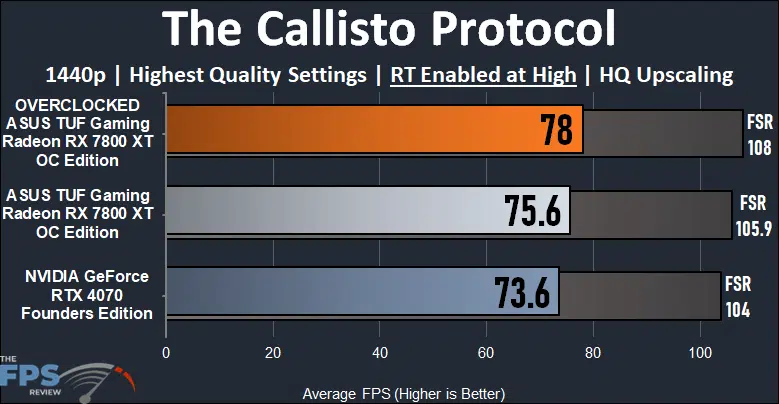
In The Callisto Protocol, the ASUS TUF Gaming Radeon RX 7800 XT OC Edition is very playable at 75.6 FPS with Ray Tracing enabled providing a smooth gameplay experience. It is actually 3% faster than the GeForce RTX 4070 with Ray Tracing. When we overclock the ASUS TUF Gaming Radeon RX 7800 XT OC Edition performance increases by 3% to 78 FPS.
Chernobylite Enhanced Edition
Chernobylite was released on the PC in 2021, but the free Enhanced Edition update for the game was released in April 2022. The Enhanced Edition provides a visual overhaul of the game with better textures, plus introduces tessellation and ray tracing features. It features raytraced reflections, raytraced translucency, raytraced caustics, and raytraced dynamic diffuse global illumination. The game is based on Unreal Engine 4. For our Ray Tracing test, we have enabled the Ultra Ray Tracing option.
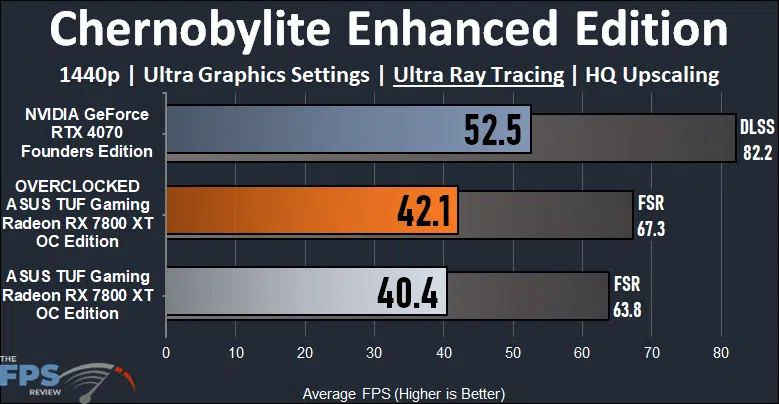
Chernobylite Enhanced Edition is pretty hard on performance with Ultra Ray Tracing due to Global Illumination. Here the GeForce RTX 4070 is faster than the ASUS TUF Gaming Radeon RX 7800 XT OC Edition by 30%, but neither card is playable without upscaling. Once we enable DLSS or FSR on these cards, performance is playable and above 60 FPS. When we overclock the ASUS TUF Gaming Radeon RX 7800 XT OC Edition performance increases by 4%. However, when we use FSR performance is playable in the 60 FPS range with Ultra Ray Tracing on the ASUS TUF Gaming Radeon RX 7800 XT OC Edition.
Dying Light 2
Dying Light 2 was released in February 2022 on the PC and uses Techland’s C-Engine. The game supports Ray Tracing, DLSS, and FSR2. This game supports Ray Tracing environmental effects including Ray Traced Soft Shadows, Ray Traced Ambient Occlusion, Ray Traced Global Illumination, and Ray Traced Reflections. We utilize the built-in preset option to set “HIGH-QUALITY RAYTRACING” which enables the game’s highest graphics settings plus the environmental effects explained above at the highest values. The game is run in DX12 Ultimate mode with ASYNC Compute turned on. We use the built-in benchmark.
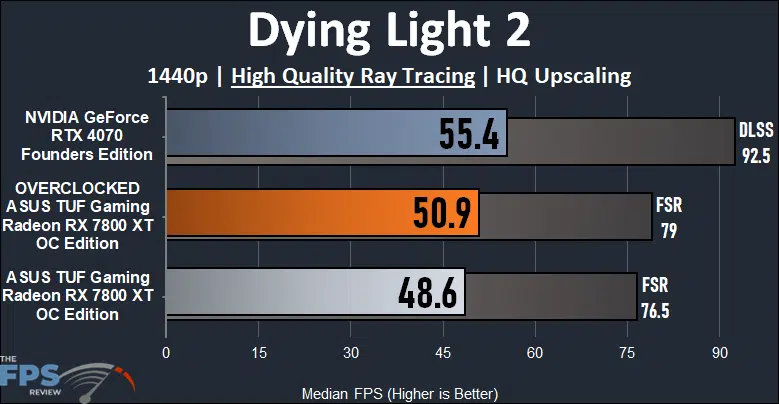
In Dying Light 2 the GeForce RTX 4070 is also faster than the ASUS TUF Gaming Radeon RX 7800 XT OC Edition by 14%. When we overclock the ASUS TUF Gaming Radeon RX 7800 XT OC Edition performance increases by 5%. However, we still need upscaling in this game with Ray Tracing at 1440p on both video cards. With FSR enabled the ASUS TUF Gaming Radeon RX 7800 XT OC Edition is very playable in the 70 FPS range.
Cyberpunk 2077
Cyberpunk 2077 was released in December 2020 and uses the REDengine 4. We have the game patched to version 2.0 and use the built-in benchmark. We test using the Graphics Preset option to set graphics settings. We use the Ray Tracing Graphics Preset of either: “Ray Tracing: Low”, or “Ray Tracing: Medium” or “Ray Tracing: Ultra” as indicated. This game supports DLSS and FSR2.
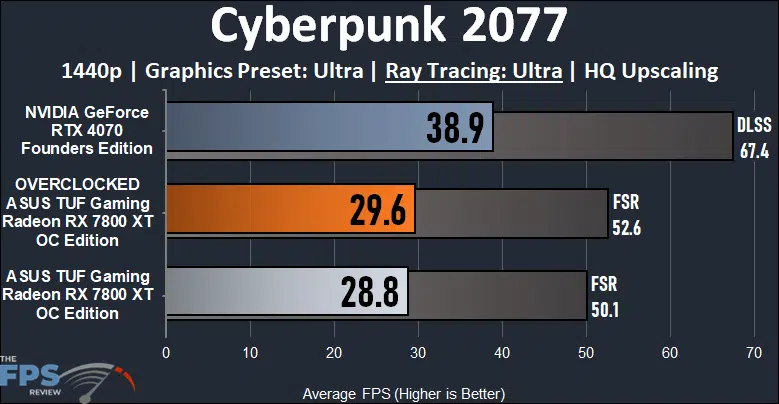
In Cyberpunk 2077 2.0, none of the video cards are playable at 1440p with Ultra Ray Tracing until we enable upscaling, even then, only the GeForce RTX 4070 is playable. The GeForce RTX 4070 is 35% faster than the ASUS TUF Gaming Radeon RX 7800 XT OC Edition. When we overclock the ASUS TUF Gaming Radeon RX 7800 XT OC Edition performance increases by 3%. When we enable FSR the ASUS TUF Gaming Radeon RX 7800 XT OC Edition is in the 50 FPS range with Ultra Ray Tracing.
Discussion (7 replies)
Join Discussion →I get comparing to it's closest competitor. But I feel like I must be remembering reviews with rose colored glasses. Didn't reviews compare new cards to one step up and one step down as well to see how they fit in the stack and if they were worth while?
I mean if you're constantly reading/watching reviews and ingesting data I suppose having just an review against the other teams price parity (or closest) makes sense. But as a consumer I would love to see if the 78000 XT card stacks well against another brands work with an same model, a 7900xt, and a 7600xt, as well as a 4080, and 4070ti/non ti.
Nice review, Brent.
Man I just about had my mind set on a 4070... this is $30 cheaper (than the $550 4070 Gigabyte I was looking at) and seems to be better in most cases. HMMMMMM.
You can look at what we've already reviewed and get a good idea of just that. We have already reviewed the XFX, Sapphire Nitro and reference AMD 7800XT cards. Thats real apples to apples. If you throw in a lesser or higher tier card, then you really don't get fair comparisons. What we try to do is show what is out there in the same price bracket or aimed at the same or similar gaming experience. TBH, right now the prices are all over the place, so that can be hard to do. That said, these reviews have always been pretty much about comparing cards that are closest in price and performance. We do throw in prior generation cards when a new gen is released. Also you have to consider the time it takes to run the data, graph it all out, compile the stats and then publish it. It takes about 4 or 5 days to knock out a polished review using an overclocked card, the out of box card and then the comparison card. If we did any more this stuff would be ancient history by the time you read it.
So why not include those in the chart? Or are we dealing with a like for like hardware issue between reviews. Since recreating the data doesn't make sense. Oh.. I get it with how intrisic driver versions are to performance improvements that wouldn't make sense.
Either you bench everything with an older driver, or you bench everything again with a newer one - and if you're doing it correctly and not over-automating reviews such that you miss things like artifacting and such, or using built-in benchmarks that do not represent gameplay (and perhaps favor one vendor over another, and that is different than gameplay) so that you wind up with results that are correct. At a minimum, really.
Benchmarking well is really a throughput problem that isn't easy to solve, unfortunately.
That has alot to do with it. Everything is tested on that day, using the latest most up to date everything.
Game updates can also make a difference - some games like Cyberpunk on GOG are easy enough to time machine into a specific version, but the more connected ones can force upgrade you.
There's a lot of variables to control for that we have a stack of internal documentation on to get things set up the same way every time. When looking at a single card, it's focused on 1-2 comparison options at that point in time. For a GPU level review, you'll see we run a much larger comparison dataset (usually limited by time before launch and who has what to ship to whom).