
AMD could be losing an important board partner after MSI has quietly stepped back its production of Team Red’s graphics cards. It’s true that AMD doesn’t offer as many variants per generation as NVIDIA does but it is unusual for a company as large as MSI to not produce all that it can but apparently this is not happening with GPUs on both sides of the fence. Hardware Unboxed took notice of the lack of MSI AMD GPU offerings, in particular noticing the abscence of Radeon RX 7700XT and Radeon RX 7800 XT models.
Did I miss this story? MSI has been completely removed from AMD's Radeon 7000 series, all existing products have been discontinued and they never released a 7700 XT/7800 XT. This all seems to have happened very quietly.
— Hardware Unboxed (@HardwareUnboxed) April 26, 2024
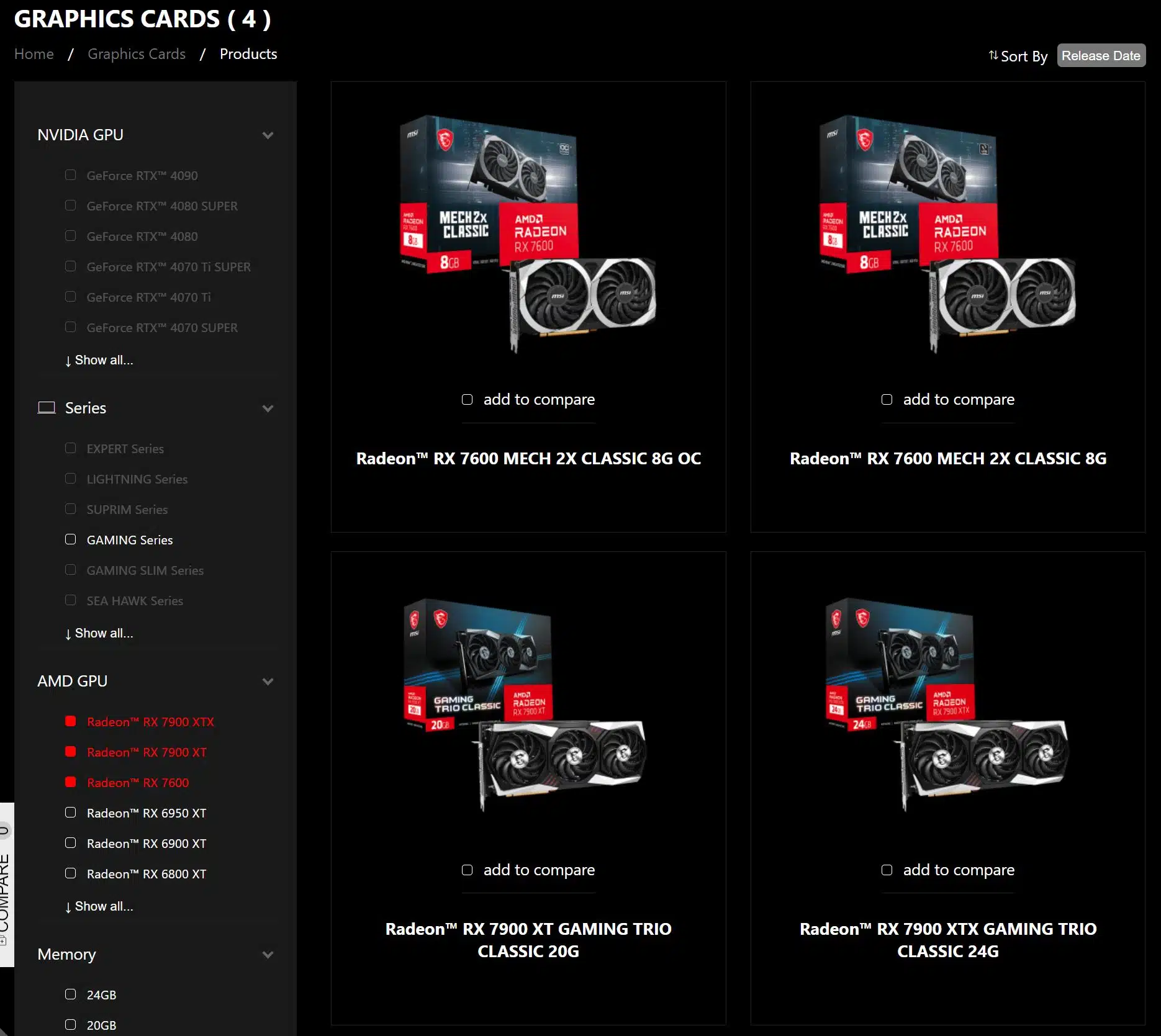
A quick visit to MSI’s official graphics card product page confirms the missing two models from AMD’s current RDNA3 lineup. AMD’s flagship cards, the Radeon RX 7900 XTX and RX 7900 XT, are present and accounted for as are two budget oriented Radeon RX 7600 models but that is all there is to be found.
Hardwareluxx confirmed the same and reached out to MSI for comment on the lack of AMD offerings. Surprisingly MSI explained that while it considers AMD’s motherboard lineup very important to them it has chosen to focus on NVIDIA’s RTX graphics cards.
Per AMD (via Hardwareluxx):
“When it comes to graphics cards, our focus at the moment is actually more on RTX cards. Nevertheless, the collaboration with AMD is essential and extremely relevant for us. We see a very positive development, particularly in the area of mainboards.”
Andreas Schilling also notes how MSI’s handling of the current Radeon series has differed from other board partners. MSI didn’t offer its own version of the Radeon RX 7900 series at launch alongside other partners and instead released custom versions at a later date. MSI repeated that strategy again when the now absent RX 7800 XT and Radeon RX 7700 XT cards launched.
A tale of two colors
VideoCardz has compiled its own tally of AIB partners inventory. While ASUS tops the list for the RX 7000 series with 19 cards, GIGABYTE at 12 cards, MSI only produced 4 cards. Things change a bit when looking at the RTX 40 series offerings from the same three board partners. MSI takes the top position for RTX models with 147 cards, ASUS drops to 2nd place with 100 cards, and GIGABYTE at the tail end with 86 cards. So with little to say, MSI has quietly stepped back its production of AMD graphics cards.