
Conclusion
In today’s overclocking gaming performance review, we compared the GeForce RTX 4070 SUPER and Radeon RX 7900 GRE when overclocked to their potential. This review today was particularly prudent as it came to light that the Radeon RX 7900 GRE’s driver software had a bug in its initial launch that would not allow us to overclock the memory from its default 18Gbps to anything higher than 18.5Gbps. Thankfully, AMD released driver updates which unlocked its potential and so we really wanted to hone in on its performance potential.
With the GeForce RTX 4070 SUPER and Radeon RX 7900 GRE competing against each other in performance and price segments, we wanted to find out how they compare when that potential for performance is met between both GPUs. We recently overclocked the GeForce RTX 4070 SUPER and refreshed all our data in May of 2024 with it and the PowerColor Hellhound Radeon RX 7900 GRE video card. This afforded us a great opportunity to also overclock the PowerColor Hellhound Radeon RX 7900 GRE with unlocked frequency sliders, and find out how the two video cards really match.
The performance results were actually quite shocking as to how close the Overclocked GeForce RTX 4070 SUPER and Overclocked PowerColor Hellhound Radeon RX 7900 GRE performed in games at 1440p. In more than a few games, performance was equal or very similar. For example Horizon Fordibben West resulted in the same performance, Alan Wake 2 was close, Assassins Creed Mirage wasn’t far off, Starfield was close, Forspoken was the same, and Dying Light 2 wasn’t far off.
Sure, one card edges out the other here or there, but the experience, the playability, was similar. There were some standout games, however, that did lean toward one or the other, such as Cyberpunk 2077 toward the Overclocked PowerColor Hellhound Radeon RX 7900 GRE, or Chernobylite toward the Overclocked RTX 4070 SUPER, or Avatar toward the Overclocked RTX 4070 SUPER due to Ray Tracing.
Sure enough, in games with Ray Tracing enabled the Overclocked GeForce RTX 4070 SUPER was always the faster video card. Even though the PowerColor Hellhound Radeon RX 7900 GRE was overclocked, it could never catch up to the GeForce RTX 4070 SUPER in Ray Tracing performance. Most games were playable with Ray Tracing on the Overclocked GeForce RTX 4070 SUPER, and the ones that weren’t were when DLSS Upscaling was enabled. There were some games though, where the Overclocked PowerColor Hellhound Radeon RX 7900 GRE was indeed playable with Ray Tracing at 1440p when FSR Upscaling was enabled.
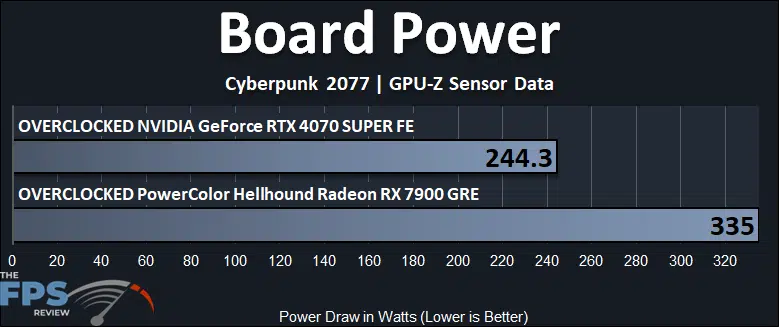
There is, however, one sore spot we have to bring up with the Overclocked PowerColor Hellhound Radeon RX 7900 GRE and that is the power draw. Overclocking the PowerColor Hellhound Radeon RX 7900 GRE pushed the board power up to 335W, compared to the Overclocked GeForce RTX 4070 SUPER at 244W. That’s a 37% power difference between the two video cards, which can add up over time. The PowerColor Hellhound Radeon RX 7900 GRE had a great cooling solution, which kept the GPU temps well in check, it is just the power draw compared to the RTX 4070 SUPER is quite a lot, and worth a consideration.
Final Points
Overall, we had a fairly easy time overclocking both video cards. Having overclocking features built into AMD Radeon Adrenalin Software was much more convenient and easy to use, versus downloading software to overclock the RTX 4070 SUPER. With both video cards, it was just a matter of trial and error, we could increase the Power Targets on both video cards and could control clock speed, memory speed, and fan speeds. We did have the advantage of being able to increase Voltage on the GeForce RTX 4070 SUPER, whereas we did not on the PowerColor Hellhound Radeon RX 7900 GRE.
Now that memory overclocking is unlocked on the Radeon RX 7900 GRE we are not as constrained by memory bandwidth, and can now exceed the memory frequency of the Radeon RX 7800 XT. We found that overclocking the memory frequency make a big impact on performance gains with the Radeon RX 7900 GRE.
Hopefully, this comparison will give you more information as you choose your next video card in this $549-$599 price range. You will have to weigh features, specifications, and performance, and decide which is more important for your build. Happy Overclocking and Happy Gaming.
Discussion (10 replies)
Join Discussion →Interesting review glad to see the cards trading blows more or less. Only standout is RT.
But... what does it say that a mid tier card is 600 bucks! OOf.
RDNA 4 will comfortably beat the 4070 super. Priced around the same as 7900 GRE hopefully. Not sure when AMD wants to launch it tho
...There'll be a '5070' of some sort coming too. The game of one upping never ends. Hopefully AMD will have their RT up to par with Intel and Nvidia at least.
That people are willing to buy them!
Willing or Have No Choice?? I think the latter..
Will RT continue to be a thing now that AI is the latest “it”?
Seems like RT really only was there for nVidia to have a marketing point over AMD and a potential Intel rivalry, and a good excuse to raise the price up. But even today - nVidias talk is mostly all about DLSS and AI - they have totally shifted gears. Sure they still mention RT because they beat the pants off everyone else with it, but it’s mostly just become a marketing bulletpoint and not the item that gets slides and slides about it
You're not forced to buy GPUs, so, 'willing' :)
Absolutely. 'AI' has almost no practical meaning for desktop users in general (until it does). Whereas we know that AMDs weak RT performance thus far has been holding back RT implementations in games, particularly due to the console effect.
DLSS is still huge, and represents a significant advantage in overall refinement as well as having broad support. I see the level of support evening out over time of course, but it's still something that Nvidia has simply developed further and anything else represents a compromise in either performance (XeSS either not running on an Intel GPU, or in having to run an Intel GPU...), or FSR just being inferior.
For AI... marketing buzzwords and SEO are going to dominate marketing, reason be darned. Local 'AI' hardware is likely to be useful in augmenting LLMs for those that use them but we're still waiting for those 'killer apps' to make a case for general consumer investment. Right now, it seems to me that these tech giants are mostly just capitalizing on fervor and not wanting to be seen as being behind in the new hotness.
I really cannot see local AI hardware today being of the same importance to gaming as RT and smart upscaling and frame generation technologies. Maybe tomorrow?
You're not forced to buy a GPU, but if you want a GPU, and you want a mid-tier card, you're forced to spend $500+ for it. Unless you settle for a much lesser powered card in the $200-$300 range..
You can always make compromises elsewhere, like your monitor and/or resolution, for the same performance on a lower end/cheaper card. But I think you can still play most games at 1440p/60 with high or near maxed settings on a $300-$400 card these days. The numbers on this review on the RT slides are completely maxed out with RT, and that doesn't make sense for most people anyways if you care about optimization where you can get 95% of the IQ with 150% of the performance if you tweak the right settings.
I thought RDNA 4 was to match the RTX4080, anyway that's not what it's going to compete with.
But if its priced right, it will force nvidia to price their cards accordingly, consumer win!!!.
Well, MS is betting big on AI on the desktop, so nvidia will surely try to grab a large chunk of that market.