
Power and Temperature
To test the power and temperature we perform a manual run-through in Cyberpunk 2077 at “Ultra” settings for real-world in-game data. We use GPU-Z sensor data to record the results. We report on the GPU-Z sensor data for “Board Power” and “GPU Chip Power” when available for our Wattage data. For temperature data, we report the GPU (Edge Temp of the GPU or Package Temp) as well as Hot Spot (Junction Temperature) when available for our temperature data.
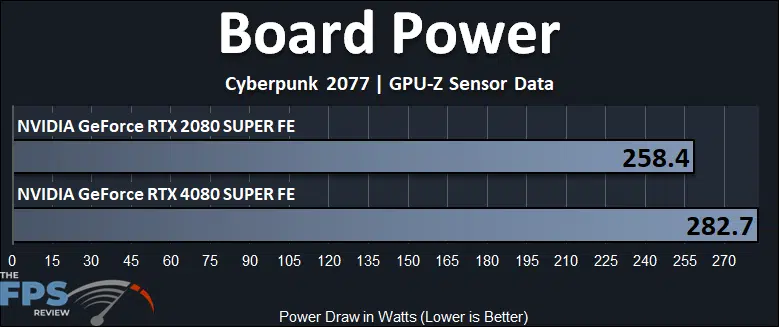
The GeForce RTX 2080 SUPER has a total board power of 250W, while the GeForce RTX 4080 SUPER has a total board power of 320W. In our testing, while playing a game, the GeForce RTX 2080 SUPER hit just above that, while the GeForce RTX 4080 SUPER is actually well under its quoted total board power, according to GPU-Z data while playing a game. In this testing, the GeForce RTX 4080 SUPER uses 9% more power than the GeForce RTX 2080 SUPER. Considering it’s 150%+ faster, that’s a heck of an efficiency result.
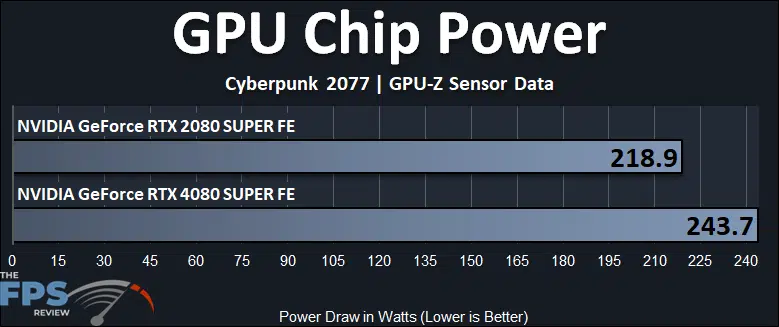
Looking at just GPU Chip Power, the GeForce RTX 4080 SUPER uses 11% more power than the GeForce RTX 2080 SUPER, for the GPU chip.
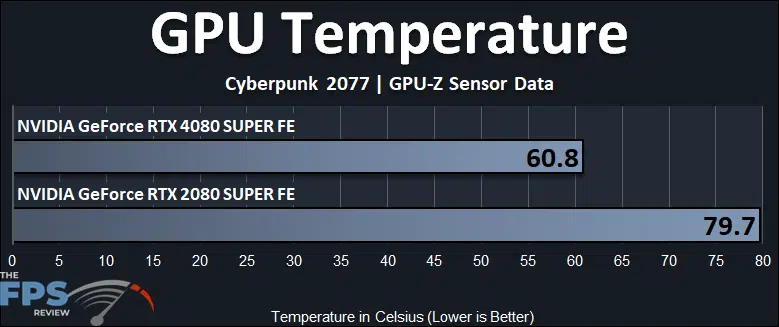
Both video cards are Founders Edition models. What’s interesting is that the GeForce RTX 4080 SUPER actually runs cooler at 60.8c.
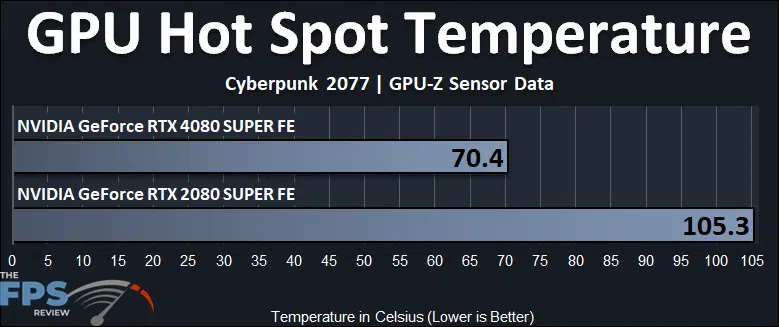
Looking at GPU Hot Spot, the RTX 4080 SUPER is running a lot cooler at 70.4c, while the GeForce RTX 2080 SUPER is allowed to reach 105c.
Discussion (5 replies)
Join Discussion →Interesting . They have made nearly 3 x the core count perform nearly 3x faster. Decreased die size means less power per core needed. So proceed node improvements. And their base work distribution and balancing works well.
What's really amazing is the lack of IPC improvement on these cores. The cores do effectively the same work and performance appears to be almost linear improvement with core count.
All told worth the upgrade if you have the cash to spend. But at least for the main raster cores. Not that much improved if at all. Still a feat of engineering of course.
Seems to be a common theme - gains in power efficiency have a linear increase in computing power. Gains in computational efficiency are less than linear (these tend to be the typical 10-15% improvement generations). And very very rarely do you get an entirely new computational method which presents an entire leap forward, but those tend to be isolated to specific cases and not a general case. Adding RTX cores for ray tracing is a good example of that - it greatly accelerates ray tracing tasks but doesn’t do much for overall performance
I'm not sure I'd jump to a 4080 Super, the 4070TiSuper seems like a better deal, especially @1440p.
I'm really tempted to go from a RTX3070Ti to a RTX4070Ti, but I think I'll wait for Blackwell. I'm afraid it will cost me more though.
That comparison (RTX 2080 SUPER to 4070 Ti SUPER) is planned already. I have the data, need to put the review together.
Don't do this to me
Great, when things are slow these articles are very useful.