
Power and Temperature
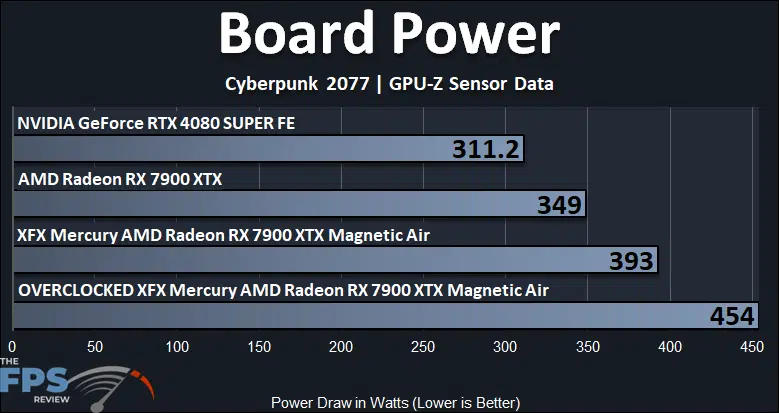
The default board power for the made-by-AMD Radeon RX 7900 XTX is 355W. XFX states that the “TGP” of the XFX Mercury Radeon RX 7900 XTX Magnetic Air is 327W. As we can see from our testing, utilizing GPU-Z for power results, the XFX Mercury Radeon RX 7900 XTX Magnetic Air is pulling 393W while gaming for the total board power. This is higher than the made-by-AMD Radeon RX 7900 XTX which pulled 349W on our system. Therefore, the XFX Mercury Radeon RX 7900 XTX Magnetic Air uses ~44W more power or 13% more.
This makes complete sense, as we saw on the overclocking page the XFX Mercury Radeon RX 7900 XTX Magnetic Air is running at a higher boost clock out-of-the-box by default and sustaining that over a long duration. The XFX Mercury Radeon RX 7900 XTX Magnetic Air is able to utilize more power than the reference AMD Radeon RX 7900 XTX to achieve a higher sustainable clock speed, and that is the takeaway here, it has more headroom in power to allow that higher clock speed.
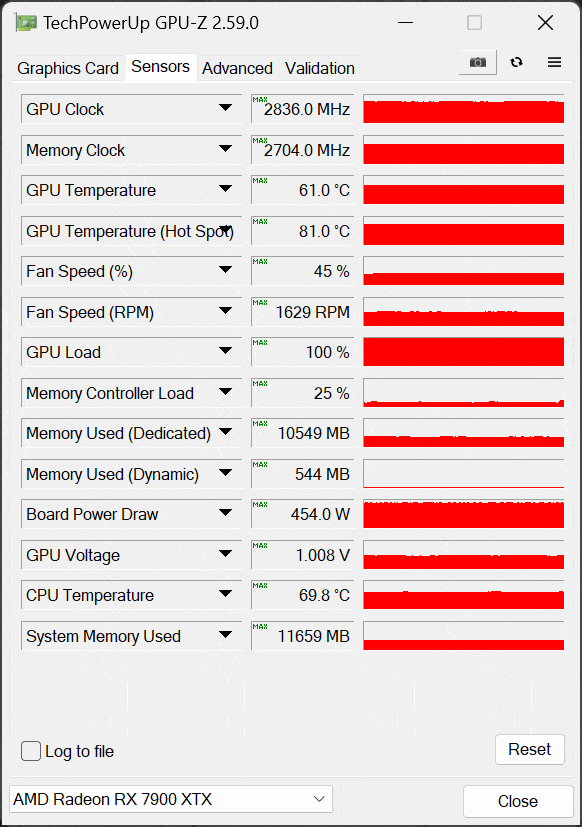
When we overclock the XFX Mercury Radeon RX 7900 XTX Magnetic Air power is able to increase as high as 454W! That is an increase of 61W over the default power draw or 16% more power out of the XFX Mercury Radeon RX 7900 XTX Magnetic Air with the Power Limit increased to 15%, which is right on the money. This shows the incredible power headroom the XFX Mercury Radeon RX 7900 XTX Magnetic Air has for overclocking potential, especially with those 3x 8-pin PCIe power connectors.
Now, compared to the GeForce RTX 4080 SUPER it isn’t very efficient, the GeForce RTX 4080 SUPER FE does utilize 21% less power than the XFX Mercury Radeon RX 7900 XTX Magnetic Air at default.
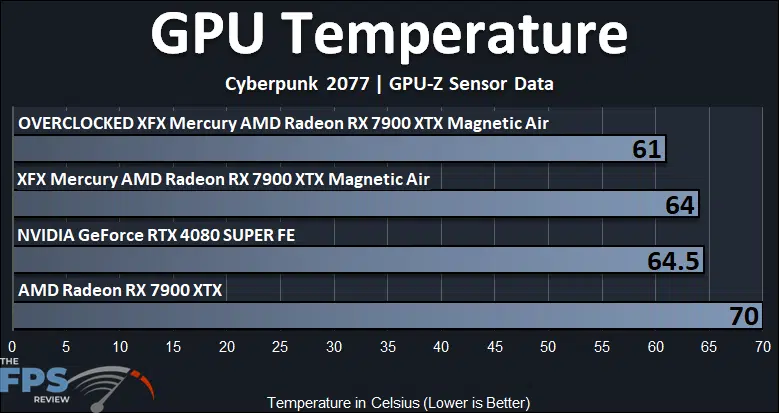
One of the great things about the XFX Mercury Radeon RX 7900 XTX Magnetic Air is its cooler, and its ability to keep all of those 400W+ cool. In our GPU Temperature testing the XFX Mercury Radeon RX 7900 XTX Magnetic Air came in with very impressive GPU temperatures of 64c at default, which runs a lot cooler than the Radeon RX 7900 XTX by 6 degrees, and it’s pulling more power and higher clock speeds! This actually puts it on par with RTX 4080 SUPER FE temps, which was actually pulling less power.
Even when we overclock the XFX Mercury Radeon RX 7900 XTX Magnetic Air temperatures remain sane, as the fans automatically spin up it stays even cooler when overclocked. Thermals are not holding back this video card with the Magnetic Air design.
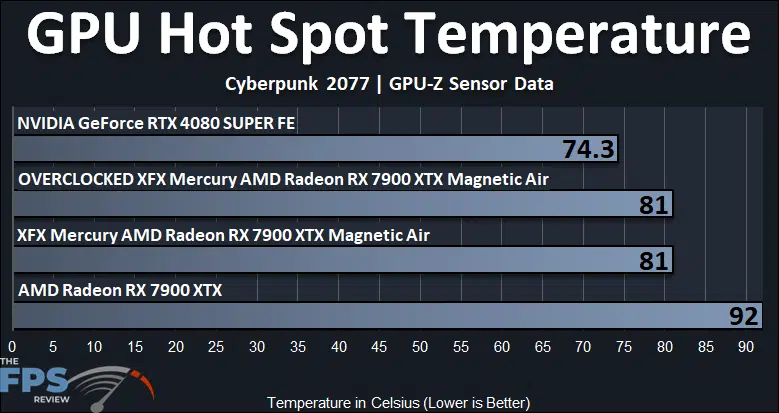
The GPU Hot Spot temperatures were also very exciting on the XFX Mercury Radeon RX 7900 XTX Magnetic Air. Look how hot the made-by-AMD Radeon RX 7900 XTX gets at 92c, now we see the XFX Mercury Radeon RX 7900 XTX Magnetic Air running 11 degrees cooler at 81c default and overclocked! This shows the superior cooling nature of the cooling design on the XFX Mercury Radeon RX 7900 XTX Magnetic Air, those Magnetic Fans are not holding back temps at all.
GPU-Z Sensors Screenshots
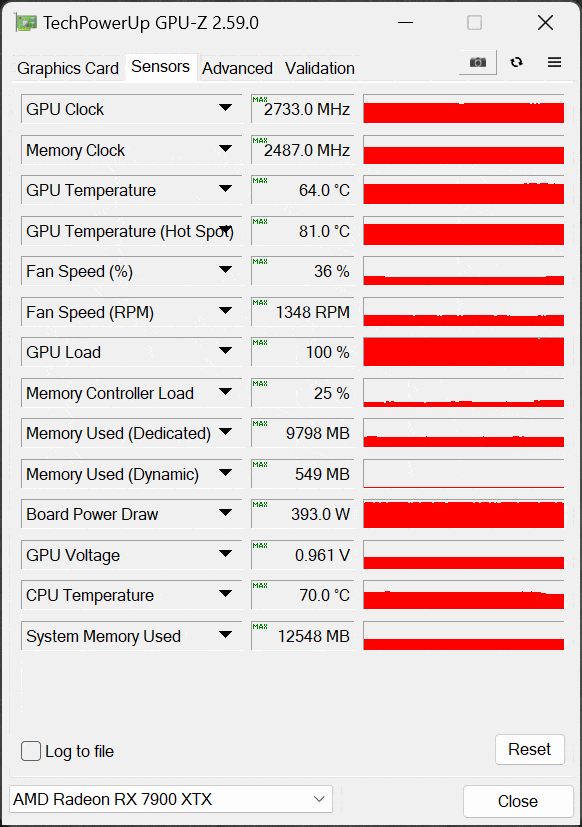
On the left is the XFX Mercury Radeon RX 7900 XTX Magnetic Air at default, and on the right is the XFX Mercury Radeon RX 7900 XTX Magnetic Air overclocked. We can see that when overclocked the fans spin up to 45% from the default of 36%, and they are still quiet. We can also see that indeed the GPU Voltage is automatically being increased with this overclock to 1.008V from the default 0.961V.
Discussion (5 replies)
Join Discussion →Compared to the RX 7900 XTX versions we have already reviewed (AMD RX 7900 XTX and MSI RX 7900 XTX Gaming TRIO Classic) the overclocking and gameplay are nearly identical across the board. Given the time passed and driver improvements I would bet there is little difference. At present, the XFX model reviewed is just a few frames better in most games and could be attributed to a higher power limit setting. The XFX Merc models are exceptionally well made and have excellent cooling, there is no doubt about that. The fit and finish of a Merc is equal to the MSI SUPRIM or the ASUS ROG Strix models.
To me the fan is a gimmick to ressurect a model of video card that is just not selling. Realistically, when was the last time a fan went DOA in any of your video cards? Most of us are going to sell them off and upgrade well before the fans go out. The real advantage or draw to this would be swapping the fan out for aesthetic in a vertical orientation, but there are no alternatives. Cleaning? A little compressed air even with the fan in place is no problem.
Just playing the Devil's advocate here. I'm not sure this video card should get a "10" . Maybe for design and cooling, but if I had $1000 to spend on a video card I'd have to look hard at what this card can do with Ray Tracing compared to the competition.
The last time I owned MSI or Gigabyte GPUs. It's why I don't buy models from them anymore.
LoL, I own almost exclusively MSI gpus and have not had any problems. My only gpu issues ever were both with EVGA products......one fan and one memory issue.
I'm sure I just got unlucky with the ones I owned. I think I had around 5 or 6 of them over the last decade and all of them had fan failures. Gigabyte was about 50/50 in the half a dozen or so I owned around the same time. Mostly AMD cards for MSI, but Gigabyte was Nvidia cards. Most of the Gigabyte boards during that time failed on me as well so I don't buy them anymore either.
Only blemish in my mind on MSI is them changing warranty terms after the sale on some folks that were doing crypto mining with them. Changing the warranty after sale should be illegal.