Now we will look at some specific AIDA64 CPU Benchmarks that test specific parts of the CPUs. The AIDA64 Zlib test is an integer benchmark that measures combined CPU and memory subsystem performance through the public ZLib compression library. The AIDA64 AES benchmark measures CPU performance using AES (Advanced Encryption Standard) data encryption. In cryptography, AES is a symmetric-key encryption standard. AES is used in several compression tools today, like 7z, RAR, and WinZip, and also in disk encryption solutions like BitLocker. Finally, the SHA3 test shows measures CPU performance using the SHA3-512 hashing algorithm defined in the Federal Information Processing Standards.
Memory Bandwidth
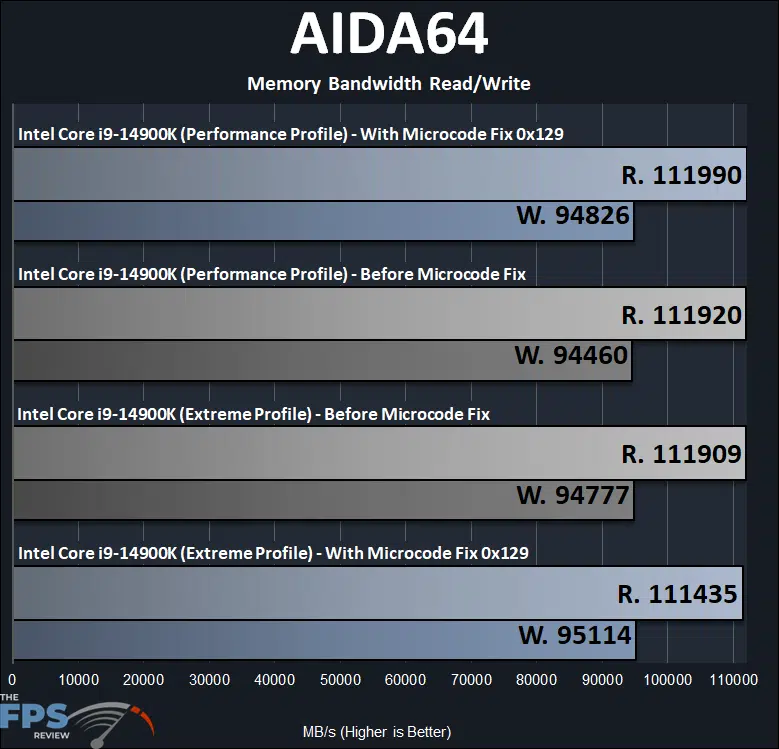
The big takeaway from looking at memory bandwidth is that it is unchanged with the Microcode Fix 0x129 applied on the Intel Core i9-14900K. It shouldn’t affect bandwidth anyway, and it does not in our testing.
CPU Zlib
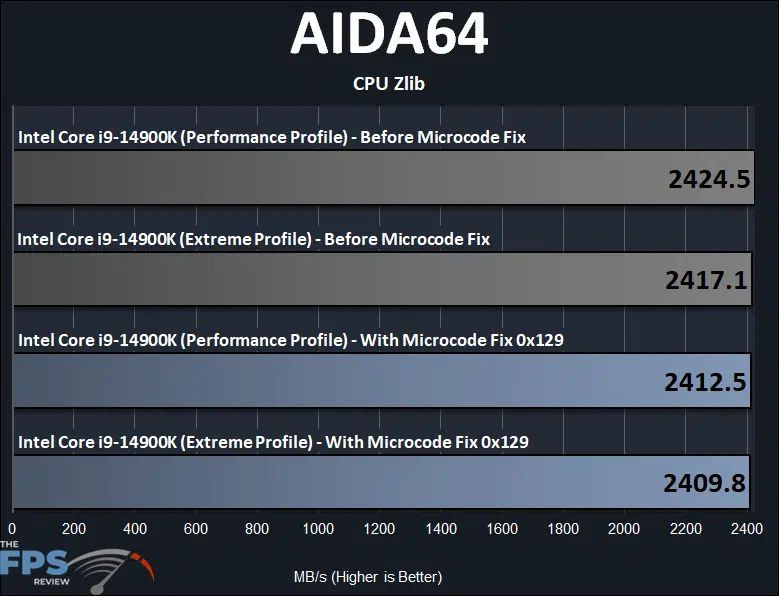
Zlib test is an integer-based test and scales well with performance. The Intel Core i9-14900K in the Extreme Profile loses only 0.3% performance with the Microcode Fix 0x129 applied. In the Performance Profile, it loses a slightly higher 0.5% performance.
CPU AES
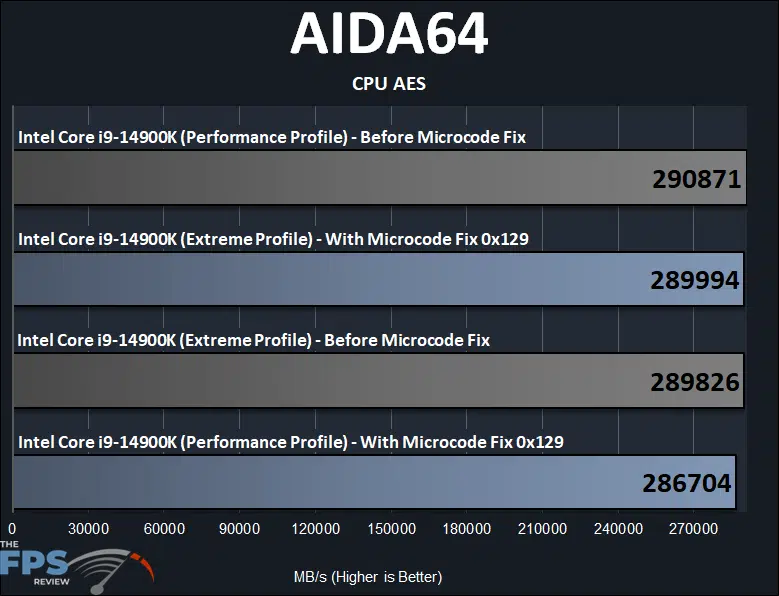
In CPU AES testing, the Intel Core i9-14900K with Microcode Fix 0x129 is pretty much at the same performance as it was before the fix, just a 0.05% difference. In the Performance Profile, the new Microcode Fix 0x129 actually does decrease performance by 1.4%.
SHA3
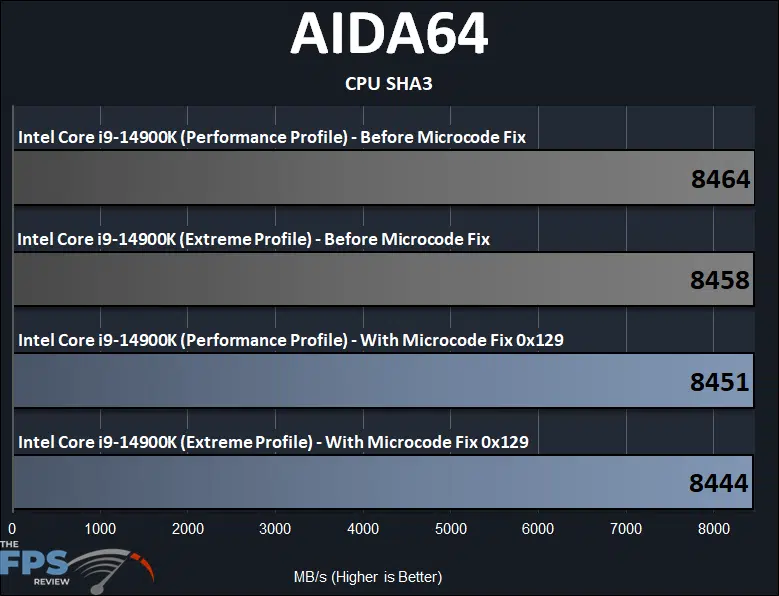
In the AIDA64 SHA3 test, the Intel Core i9-14900K with Microcode Fix 0x129 applied reduces performance by a tiny 0.16%. In the Performance Profile Microcode Fix 0x129 reduces performance by 0.15%.
Great writeup as usual. This is "a time will tell" scenario if this was a placebo or if it indeed worked.
I can't help but wonder if this is akin to putting lipstick on a pig and declaring it is fixed. Slight changes all of a sudden will prevent degradation (if a chip has not been degraded yet)? I don't know. I get the impression that Intel has no idea what is causing this in their 13/14 series, so they put out this microcode to appease the angry mobs with pitchforks banging on their door. Right now, I do not trust anything they say or do.
B
Burticus
👍 1
good article, let's hope it works long term
I
Iron Bars
The uCode update did not change the power draw, nor are the boost clocks much lower. The max voltage was lower however (1.495 V in HWinfo). A few questions: 1) What was the VCore before the update? (In HWinfo) ? Did you see the 1.55V? 2) Does this new limit on VCore have a built in margin for already degraded processors? 3) Does tracking VCore across loads tell us anything about whether a processor has degraded or not? (accounting for the effects of Silicon lottery?)
Niner51
👍 1
Thanks for this article. I didn't see any noticeable difference in my 14700K after the latest bios update other than my voltages going from 1.5XX down into the 1.4XX range.
h
hubaduba
I installed the update for my 13600K system and I'm sure I'll never notice a difference in performance.
I think the real comparison is between the new microcode and the initial version that was used for the day 1 13XXX and 14XXX reviews.
a
arbiter9605
👍 1
"Iron Bars, post: 88787, member: 8397" wrote:
The uCode update did not change the power draw, nor are the boost clocks much lower. The max voltage was lower however (1.495 V in HWinfo). A few questions:
1) What was the VCore before the update? (In HWinfo) ? Did you see the 1.55V?
2) Does this new limit on VCore have a built in margin for already degraded processors?
3) Does tracking VCore across loads tell us anything about whether a processor has degraded or not? (accounting for the effects of Silicon lottery?)
Just from what i seen, before the update my cpu voltage was in the 1.35 to 1.39volts range. After the update it was in the 1.45-1.49. I wasn't having any stability issues since my cpu wasn't running on that 4000watt profile for very long before i turned it off cause all issues. Currently i have turned off unvolt protection so i can undervolt -0.1volts to be back where it was and gonna go lower to see help like did on my rtx4070s
Space_Ranger
"Iron Bars, post: 88787, member: 8397" wrote:
The uCode update did not change the power draw, nor are the boost clocks much lower. The max voltage was lower however (1.495 V in HWinfo). A few questions:
1) What was the VCore before the update? (In HWinfo) ? Did you see the 1.55V?
2) Does this new limit on VCore have a built in margin for already degraded processors?
3) Does tracking VCore across loads tell us anything about whether a processor has degraded or not? (accounting for the effects of Silicon lottery?)
From watching Buildzoid's video on the update, he had easily captured 1.58V+ on the VCore prior to the update, and not able to trigger the scope after the update.
I
Iron Bars
"Space_Ranger, post: 89029, member: 52" wrote:
From watching Buildzoid's video on the update, he had easily captured 1.58V+ on the VCore prior to the update, and not able to trigger the scope after the update.
Wow! That is crazy. However, it is important to ensure that such transients are not due to instrument/environment errors. Perhaps I ought to watch that video.
Space_Ranger
👍 1
"Iron Bars, post: 89030, member: 8397" wrote:
Wow! That is crazy. However, it is important to ensure that such transients are not due to instrument/environment errors. Perhaps I ought to watch that video.
[embedded media]
D
David_Schroth
👍 2
Video form of this article is also up -
[embedded media]
Niner51
"David_Schroth, post: 89212, member: 1" wrote:
Video form of this article is also up -
[embedded media]
Very informative. My findings were the same with both my Intel rigs.
Zarathustra
👍 1
Certainly not the terrible impact we had all feared, but I am still not convinced this was the only root cause and that it fixes the problem.
Former managing editor of GPUs at HardOCP for 18 years, Brent Justice has been reviewing computer components since the late 90s, educated in the art and method of the computer hardware review, he brings experience, knowledge, and hands-on testing with a gamer-oriented and hardware enthusiast perspective.
You can follow him on Twitter - @Brent_Justice
You can sub to his YouTube channel - Justice Gaming
https://www.youtube.com/c/JusticeGamingChannel
You can check out his computer builds on KIT - @BrentJustice
https://kit.co/BrentJustice
Discussion (18 replies)
Join Discussion →Great writeup as usual. This is "a time will tell" scenario if this was a placebo or if it indeed worked.
I can't help but wonder if this is akin to putting lipstick on a pig and declaring it is fixed. Slight changes all of a sudden will prevent degradation (if a chip has not been degraded yet)? I don't know. I get the impression that Intel has no idea what is causing this in their 13/14 series, so they put out this microcode to appease the angry mobs with pitchforks banging on their door. Right now, I do not trust anything they say or do.
good article, let's hope it works long term
The uCode update did not change the power draw, nor are the boost clocks much lower. The max voltage was lower however (1.495 V in HWinfo). A few questions:
1) What was the VCore before the update? (In HWinfo) ? Did you see the 1.55V?
2) Does this new limit on VCore have a built in margin for already degraded processors?
3) Does tracking VCore across loads tell us anything about whether a processor has degraded or not? (accounting for the effects of Silicon lottery?)
Thanks for this article. I didn't see any noticeable difference in my 14700K after the latest bios update other than my voltages going from 1.5XX down into the 1.4XX range.
I installed the update for my 13600K system and I'm sure I'll never notice a difference in performance.
I think the real comparison is between the new microcode and the initial version that was used for the day 1 13XXX and 14XXX reviews.
Just from what i seen, before the update my cpu voltage was in the 1.35 to 1.39volts range. After the update it was in the 1.45-1.49. I wasn't having any stability issues since my cpu wasn't running on that 4000watt profile for very long before i turned it off cause all issues.
Currently i have turned off unvolt protection so i can undervolt -0.1volts to be back where it was and gonna go lower to see help like did on my rtx4070s
From watching Buildzoid's video on the update, he had easily captured 1.58V+ on the VCore prior to the update, and not able to trigger the scope after the update.
Wow! That is crazy. However, it is important to ensure that such transients are not due to instrument/environment errors. Perhaps I ought to watch that video.
[embedded media]
Video form of this article is also up -
[embedded media]
Very informative. My findings were the same with both my Intel rigs.
Certainly not the terrible impact we had all feared, but I am still not convinced this was the only root cause and that it fixes the problem.
Time will tell.
Time hasn't been kind to Raptor Lake: https://www.overclock.net/posts/29521182/
I hate it when I'm right :(
I’ve found the older I get the more that I pray that I’m wrong