
Power – Temperature – Clock Frequency
To test the power and temperature we perform a manual run-through in Cyberpunk 2077 at “Ultra” settings for real-world in-game data. We use GPU-Z sensor data to record the results. We report on the GPU-Z sensor data for “Board Power” and “GPU Chip Power” when available for our Wattage data. For temperature data, we report the GPU (Edge Temp of the GPU or Package Temp) as well as Hot Spot (Junction Temperature) when available for our temperature data.
ASRock Challenger Arc B570 10GB OC
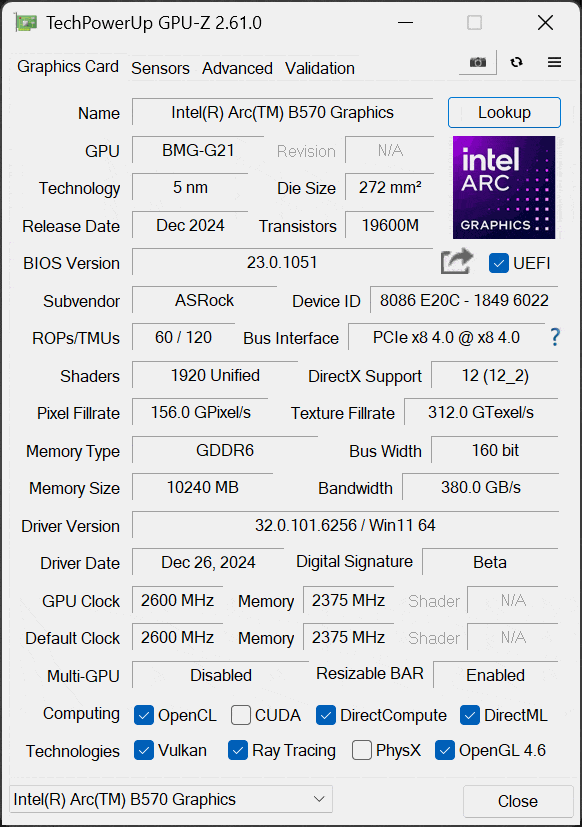
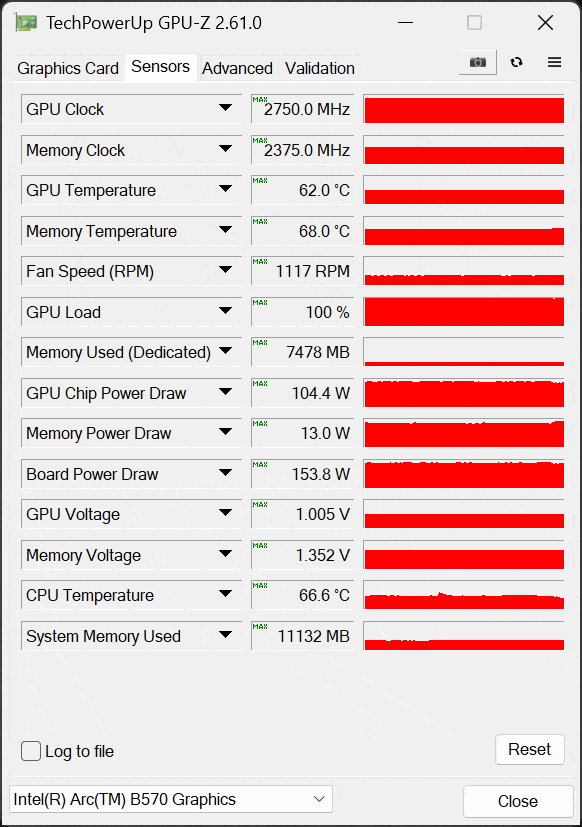
We can see above, that while playing a game, the GPU temperature rose only to 62c, and the memory temperature at 68c with a GPU Voltage of 1.005V. The ASRock Challenger Arc B570 10GB OC runs very cool and quiet, the cooler on board is more than sufficient to keep this GPU cool for long hours. It sipped about 154W of power, at max, for the board power, and 104W for GPU chip power. The default TDP of a reference Intel Arc B570 is 150W, therefore the ASRock Challenger Arc B570 10GB OC is running at the reference spec for max TDP.
Intel Arc A750
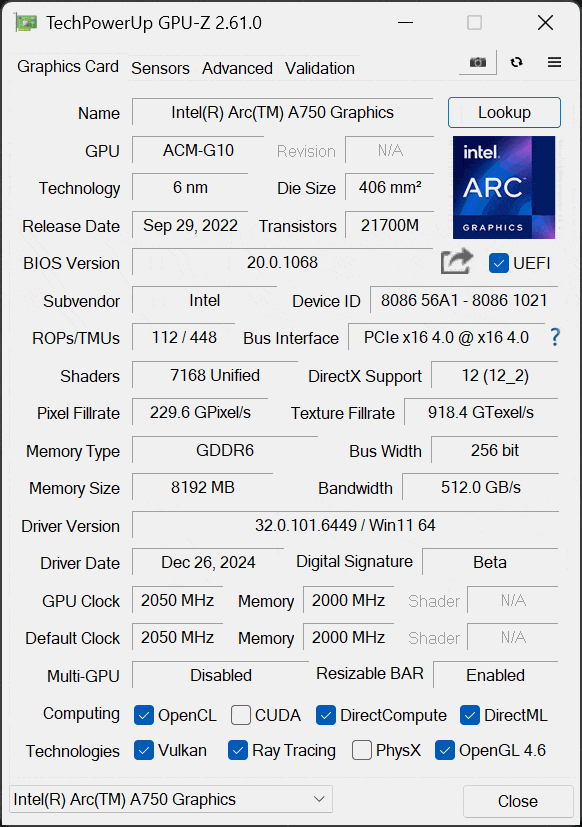
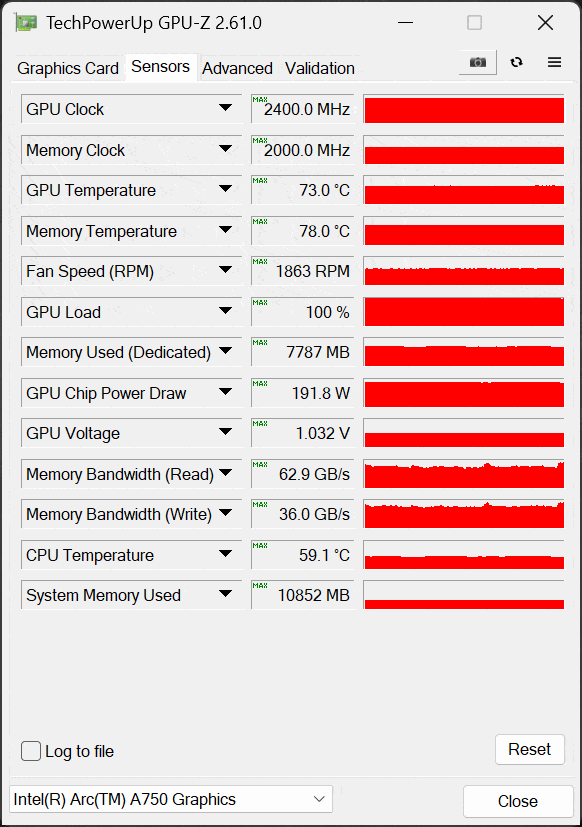
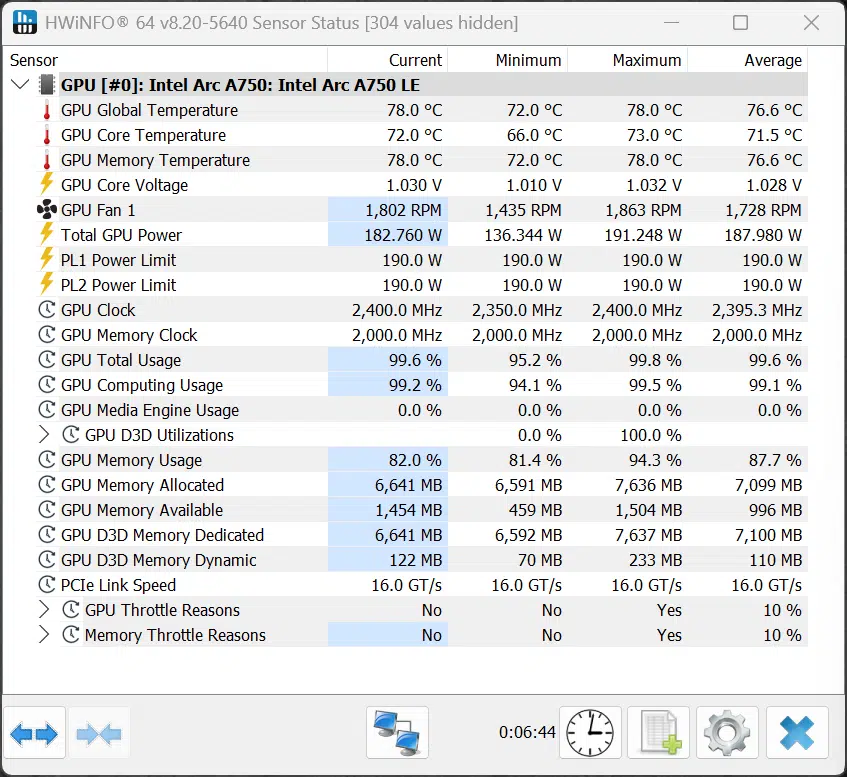
For comparison, the Intel Arc A750, which is a Limited Edition Intel card, was running at 191W for Total GPU Power with a PL1 and PL2 of 190W. That is not Total Board Power, just GPU power, the TDP of the Arc A750 is 225W. Therefore, the ASRock Challenger Arc B570 10GB OC runs at a much lower Wattage and is much more efficient. The Intel Arc A750 also ran as hot as 78c GPU Global Temperature, and 73c Core Temperature with 78c memory temperature. Therefore, the ASRock Challenger Arc B570 10GB OC runs much cooler than a reference Intel Arc A750 video card.
Clock Frequency
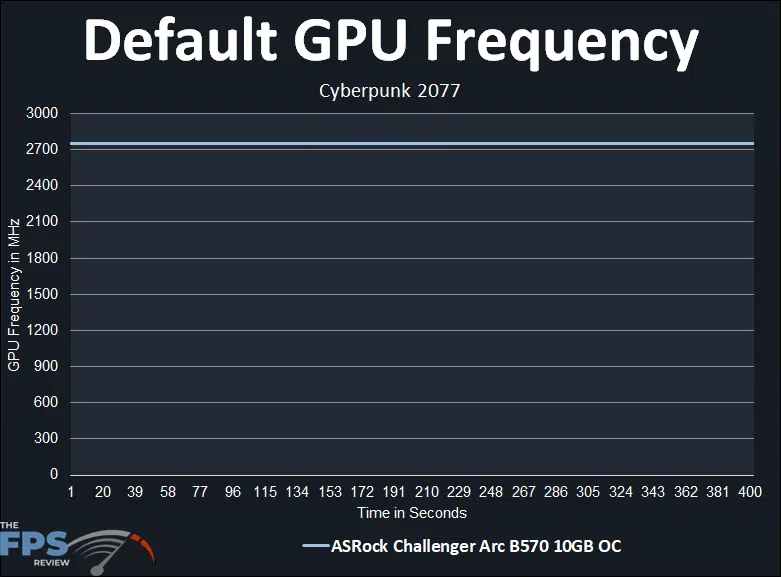
The ASRock Challenger Arc B570 10GB OC held steady at 2750MHz for the entire run, with no dips, and a nice solid 2750MHz of consistent frequency while gaming. The ASRock Challenger Arc B570 10GB OC has a boost clock of 2600MHz, which is already above the Intel reference clock speed of 2500MHz. Thanks to the improvements to the ASRock Challenger Arc B570 10GB OC in cooling and power, and the factory overclock, it shoots way past that to 2750MHz, an increase of 6% over the factory overclock from ASRock or 10% over the boost clock of the reference Intel Arc B570 GPU.
Discussion (4 replies)
Join Discussion →Interesting article. I especially liked the cpu comparison. Im not sure just how this GPU fits in.
So what's the point of getting one if you have to pair it with a 9800X3d or even a 7800x3d?
I hope intel fixes this.
Not sure if the other GPUs would suffer similarly. I don't recall from previous testing if they do - or at least, I bet that testing hasn't been re-run with a 9800x3D to see if they get an uplift.
Not advocating that anyone does that... but if you are looking at spending around $200 on a GPU - really, you're options are... generations old stuff that ... may or may not run better on faster CPUs... or Intel, which will run better on a faster CPU for sure, and for many titles run faster than similar priced GPUs, but at worst perform more or less the same as every other $200 option that's out there right now for some titles..
Techspot has a review comparing the ARC 580 with other nvidia and AMD cards using both a 5600 and 9800X3d, only the ARC card suffered severe performance loss.
[URL unfurl="true"]https://www.techspot.com/review/2940-intel-arc-b580-rereview/[/URL]