
Gaming Power, Temp, and Clock Speed
On this page, we are going to explore the power, temperature testing, and CPU frequency that we experienced on the AMD Ryzen 9 9950X3D in gaming. That’s right, this is a gaming-focused power, temp, and CPU clock speed testing that you will see below. The power, temp, and clock speed graphs below are not stress tests, it is not pushing the CPU as hard as possible. The graphs below indeed show the power, temp and clock speed while simply playing a game, in this case Cyberpunk 2077 at 1080p Ultra with a manual run-through.
Gaming CPU Clock Speed
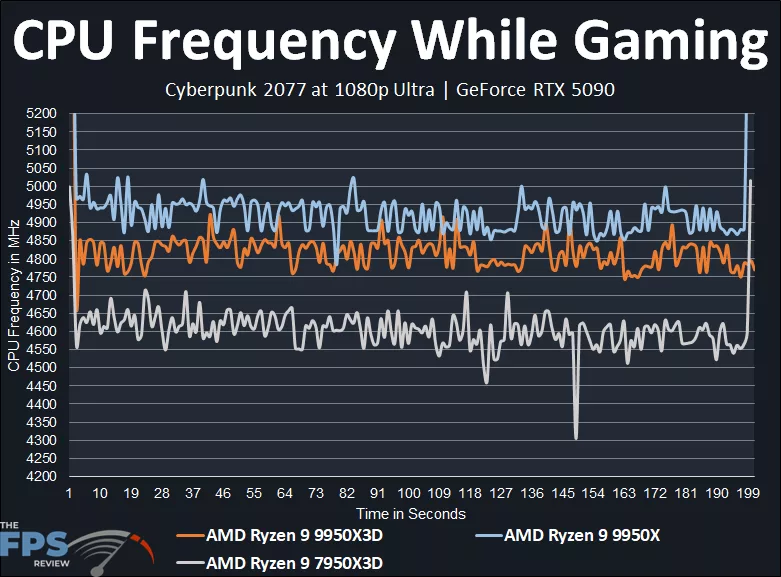
In the graph above, we are graphing the CPU clock frequency while gaming in Cyberpunk 2077 at 1080p Ultra in a manual run-through. The AMD Ryzen 9 9950X3D has a CPU frequency of 4.3GHz with a turbo clock frequency of up to 5.7GHz, the AMD Ryzen 9 7950X3D has a CPU frequency of 4.2GHz with a turbo clock frequency of up to 5.7GHz, and the AMD Ryzen 9 9950X has a CPU frequency of 4.3GHz with a turbo clock frequency of up to 5.7GHz.
In our gaming session, which does not push all the cores, mind you, you can see how the three CPUs compare on clock frequency. What we can see here is that the AMD Ryzen 9 9950X3D is running at a much higher frequency while gaming compared to the previous generation AMD Ryzen 9 7950X3D. There has been a pretty big improvement in clock speed compared to the previous generation Zen 4 X3D CPU.
Where the AMD Ryzen 9 7950X3D was running between 4.550GHz-4.650GHz, the new AMD Ryzen 9 9950X3D is now running in the 4.750GHz-4.850GHz range while gaming. That is about a 200MHz increase in clock speed with the new AMD Ryzen 9 9950X3D compared to the previous generation Ryzen 9 7950X3D while gaming, showing a positive improvement in performance.
We also can see that the AMD Ryzen 9 9950X3D runs at a lower clock speed compared to the non-X3D AMD Ryzen 9 9950X. The AMD Ryzen 9 9950X runs between 4.850GHz-4.950GHz while gaming, meaning it’s about 100MHz faster while gaming, or to put it another way, the AMD Ryzen 9 9950X3D is about 100MHz slower than the Ryzen 9 9950X while gaming. The X3D cache makes up for that frequency difference and provides faster performance, so if the AMD Ryzen 9 9950X3D did not have that cache, it would technically be slower in-game, but the whole point of it is that X3D cache.
Gaming CPU Power
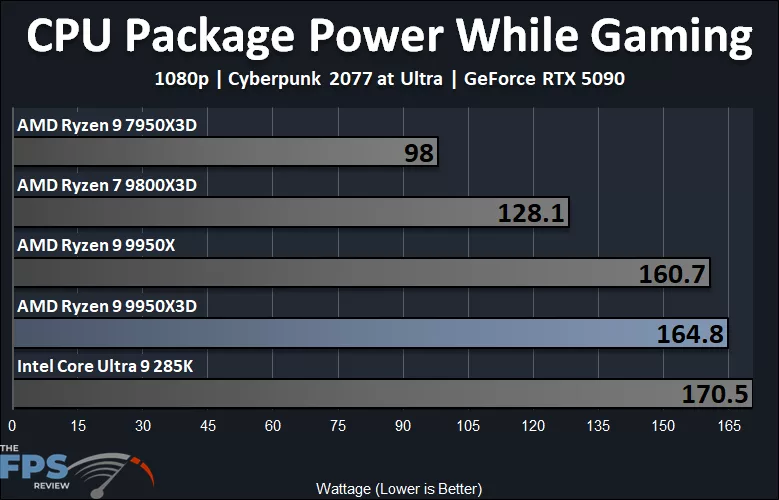
In the graph above, we are comparing the CPU package power while gaming. The AMD Ryzen 9 9950X3D has a TDP of 170W and a PPT of 230W, the Ryzen 9 7950X3D has a TDP of 120W and a PPT of 162W, the Ryzen 9 9950X has a TDP of 170W and a PPT of 230W, the Ryzen 7 9800X3D has a TDP of 120W and a PPT of 162W.
In our power testing while gaming, the AMD Ryzen 9 9950X3D does consume the second most power, with the Intel Core Ultra 9 285K consuming the most power while gaming, yet the lowest performance while gaming. The AMD Ryzen 9 9950X3D does consume 68% more power than the AMD Ryzen 9 7950X3D while gaming, which is quite a bit more, but we did see the AMD Ryzen 9 9950X3D also running 200MHz higher while gaming, so the frequency was higher. The AMD Ryzen 9 9950X3D consumes 29% more power than the AMD Ryzen 7 9800X3D, which typically was the faster CPU, for less power draw while gaming. Finally, the AMD Ryzen 9 9950X3D consumes 3% more power than the Ryzen 9 9950X non-X3D part.
Gaming CPU Temperature
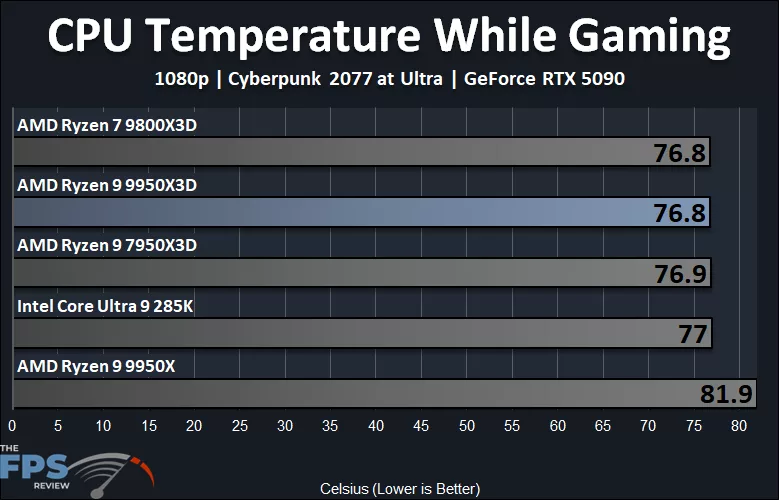
In the graph above, we are taking a look at the CPU temperatures while gaming in Cyberpunk 2077 at 1080p Ultra in a manual run-through. The AMD Ryzen 9 9950X actually ran the hottest while gaming at nearly 82C, which was interesting. However, the AMD Ryzen 9 9950X3D ran rather cool compared to the other CPUs; it was on par with the AMD Ryzen 7 9800X3D and AMD Ryzen 9 7950X3D. The Intel Core Ultra 9 285K didn’t do too badly here either, but certainly, the AMD Ryzen 9 9950X3D is a cooler-running CPU than the Ryzen 9 9950X while gaming.
Discussion (19 replies)
Join Discussion →Thanks for the review. Just the take i was looking for!
Good review, thanks!
Looks exactly like I suspected.
The multi CCD penalty in gaming is still real, so it consistently performs lower than the 9800x3d in games, but on average the penalty seems less than in the past, maybe because of slightly higher clocks.
It would be interesting to see how it performs in games with one of the CCD's disabled.
I wonder how much better a 9950x3d with one CCD disabled would perform compared to the 9800x3d...
Based on the clock speeds (5.7Ghz vs. 5.2Ghz) the upper bound should be 9.6% at stock clocks, but in reality it will likely be lower, as RAM bandwidth/latency will likely hold it back.
Lets not forget that overclocking is now possible with x3D CPU's. I'm going to presume that the CCD's in the 9950x3d are higher bins to hit the 5.7Ghz clocks, but the question to me is this:
If you are a gaming extremist and overclocker, and want the best gaming performance bar none....
Is it better to buy a 9950x3d for $699 (compared to the $479 9800x3d) and disable one CCD (to get rid of the CCD penalty)?
Or, if you are going to overclock both anyway, are you likely to be limited at about the same clocks/performance.
In other words, can you get higher by overclocking a one CCD 9950x3d than by overclocking a 9800x3d.
I've already seen many 9800x3d overclocks it 5.7Ghz, so we know it can tie the stock 9950x3d, but the question is, is that 9950x3d right at its limit, or will that higher bin allow it to go even higher?
...and if it does go even higher, (6+Ghz?) will it even matter, or will AMD's fabric/memory controller design hold it back anyway?
This would be a really cool test, especially if a few different memory configurations are thrown in for good measure. Which would be faster for games on an AMD system when really pushing the clocks like this? DDR5-6400 in a 1:1 MCLK to UCLK configuration, or DDR5-8000 in a 2:1 MCLK to UCLK configuration.
The DDR5-8000 will get slightly less top level memory bandwidth due to a slightly lower UCLK, but on the flip side, with the RAM running at 4000Mhz (8000MT/s) penalties from things like refreshes are going to be much smaller, as those don't use memory controller bandwidth, and instead operate at the speed of the RAM. Of course, timings and submitting will likely make a difference too.
I have yet to see a really good review that combines all of these complexities of overclocking X3d chips, multiple CCD's and RAM settings when pushed to the limit.
Most sites have been getting hit with back to back launches since CES.....
It's interesting. I've seen some reviewers where the 9950x3d is steadily trading blows with the 9800x3d. Yet the reviews here are showing it largely a step below for gaming. (Well more a 1/2 step really.) Not discounting it mind you.
What resolutions are being looked at in those reviews? Our numbers are at 1080p where CPU bound is more anything. 4k testing is probably going to be within margin of error...
Game Selection, Manual In-Game Run-Through vs Benchmark, Area used within game for manual run-through, length of run-through, Resolution, Game Settings, System Configuration, BIOS version used, BIPO settings used, Memory used and type and speed, Windows Updates applied, Game Bar Updated, Chipset Drivers used, GPU used, System resource minimization, VBS on or off, FPS capture method, Number of run-throughs performed, Fresh data or old data, Clean install of Windows or not, verification of results, etc... name your variable.
Well, the 9900x3d is 679€ and the 9950x3d is 789€ around here, not as bad as the GPU's, still not good though.
Picked up my 9950x3d at Microcenter this morning. Wheee... FOMO skipped! ;)
As of 1:15pm EST, my local Micro Center has 25 in stock. Newegg and Amazon have none. A friend of mine grabbed one from Newegg and said they sold out in 9 minutes. He also got one from Micro Center. He's gonna return the one he got from Newegg.
This morning the Dallas Microcenter had 380 9950x3d's. Currently.. maybe out I don't know.
I'm having a hard time deciding which one I want now. 9800x3d or 9950x3d. Considering I'll have a separate workstation, and my AM5 system will pretty much only be used for games, I'm leaning towards the 9800x3d, but the draw is strong.
I have to admit, your results seem a bit different than most others I am seeing now.
Did you guys confirm that you had proper core parking working during the game tests?
Our results make sense compared to the other CPUs used in our comparison, specifically the 9800X3D and 7950X3D, and the advantages over the 9950X that we saw. The results make sense when you compare our own data to itself. The 9800X3D has the overall advantage, and that makes sense, if core-parking wasn't working, then the results would be far far worse for the 9950X3D, and it isn't. BTW, the 9950X3D was the first CPU we installed with a fresh install of Windows and drivers, and updates, so there is literally nothing getting in the way of the PPM drivers, and other chipset driver optimizations.
Cross-comparing versus other review sites can be misleading due to the myriad of variables I described above, that I will copy below. Game selection and where you benchmark in the game makes a big difference, including if it's a game benchmark or manual run-through. we use manual run-throughs that emphasize CPU-dependency; I cannot speak for other reviews.
Please specify which games you think are questionable.
Compared to Gamers Nexus while graphical settings are different you went with Ultra and they went with Medium. Theirs is showing the 9950x3d = to the 9800x3d. Where yours is reflecting a nearly 5fps difference. That could easily be a margin of error.
F1 24, Gamers nexus running 1080p/High as opposed to Ultra again puts them at equal AS DOES yours. So that lines up.
Hardware unboxed CP 2077 shows a 3fps lead for the 9800x3d over the 9950x3d. Not bad.
(I'm not sighting these to prove or disprove, you asked I'm just doing a bit of research because I'm a nerd.)
Hardware unboxed results for The last of us Part 1 had a 2fps lead over the 9800xed, same effectively as yours.
Hardware unboxed Starfield results are effectively = with a 1 FPS lead for the stock clock 9950x3d. 1080p Ultra.
So your tests are largely the same or margin of error differences in results. It seems other review sites are leaning slightly toward the 9950x3d being the better for gaming depending largely on the game itself. :)
Sorry, didn't mean to sound like I was making accusations or anything. I don't have enough information to say one way or another.
Just that most review sets out there I have seen have the two trading blows, and maybe even having the 9950x ahead by one or two percent on average. Most conclusions out there are along the lines of "wow, isn't it amazing. AMD has solved the split CCD performance penalty issue". Your review leads to a different conclusion, so I was just curious what might be different.
Overall game selection in the test suite can certainly be a possible explanation.
Yours seems to be a little bit of an outlier, and outliers are always interesting :) You can learn from them. Understanding the "why" the general conclusion is different can lead to a better understanding of the two CPU's comparative performance.