
Overclocking ASUS TUF Gaming GeForce RTX 5070 OC Edition
To overclock the ASUS TUF Gaming GeForce RTX 5070 OC Edition, we used ASUS GPU Tweak III (v1.8.8.0), which was downloaded from the support section of the video card’s webpage. GPU Tweak is a very familiar software and is quite straightforward to use.
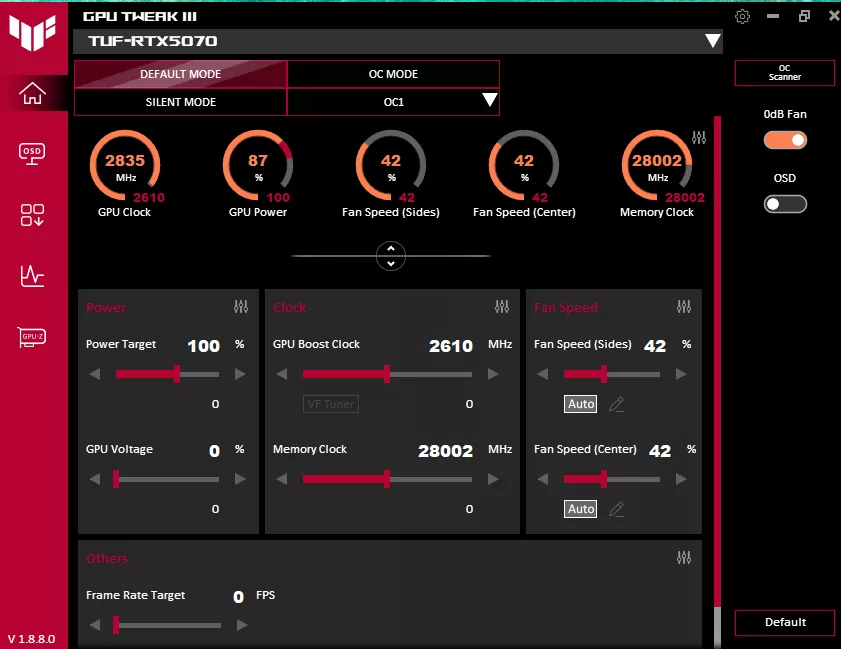
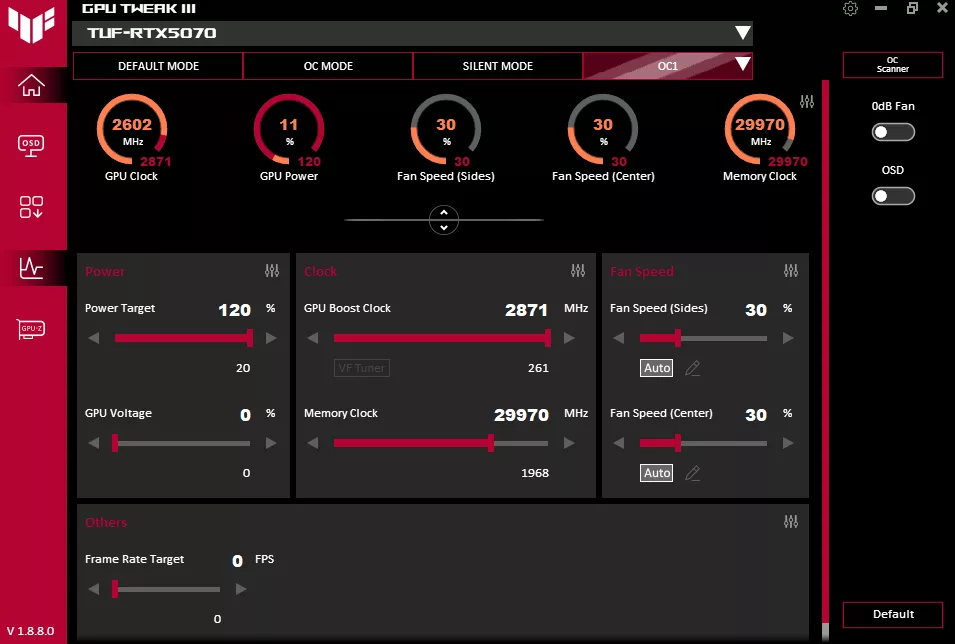
For the ASUS TUF Gaming GeForce RTX 5070 OC Edition, we had the ability to adjust all settings. This includes: GPU Boost clock, memory clock, GPU core voltage, and power target. Fan cycles are also adjustable if needed. We used our Cyberpunk 2077 manual run-through for testing purposes and logged sensor data from GPUZ.
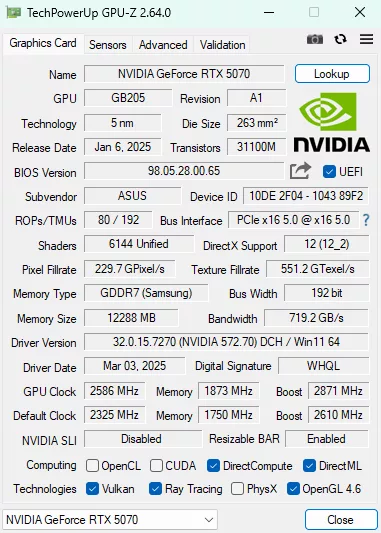
Overclocking involved taking the GPU Boost clock all the way out to the right in GPU Tweak, and there was nothing left. The maximum setting was +261MHz. Memory was increased to +1968MHz. The power target was taken all the way out to the maximum as well, providing up to a +20% for the extra power limit. At 20%, that improves the maximum power from 250W up to 300W, giving you more headroom for overclocking, which is a very large range for the GeForce RTX 5070 GPU that ASUS has provided.
Trials showed us a couple of things. First, anything beyond our final memory setting resulted in an unstable card. While there was room on the slider, there was no more room for the card to go higher. The same held true for the Boost clock; this seems to be a power limitation.
We note that at our final settings, the ASUS TUF Gaming GeForce RTX 5070 OC Edition was perfectly stable, and the temperatures were remarkably low while the fans were inaudible. Final settings: Boost Clock: +261MHz/2871MHz Memory: +1968MHz/29970MHz (30Gbps).
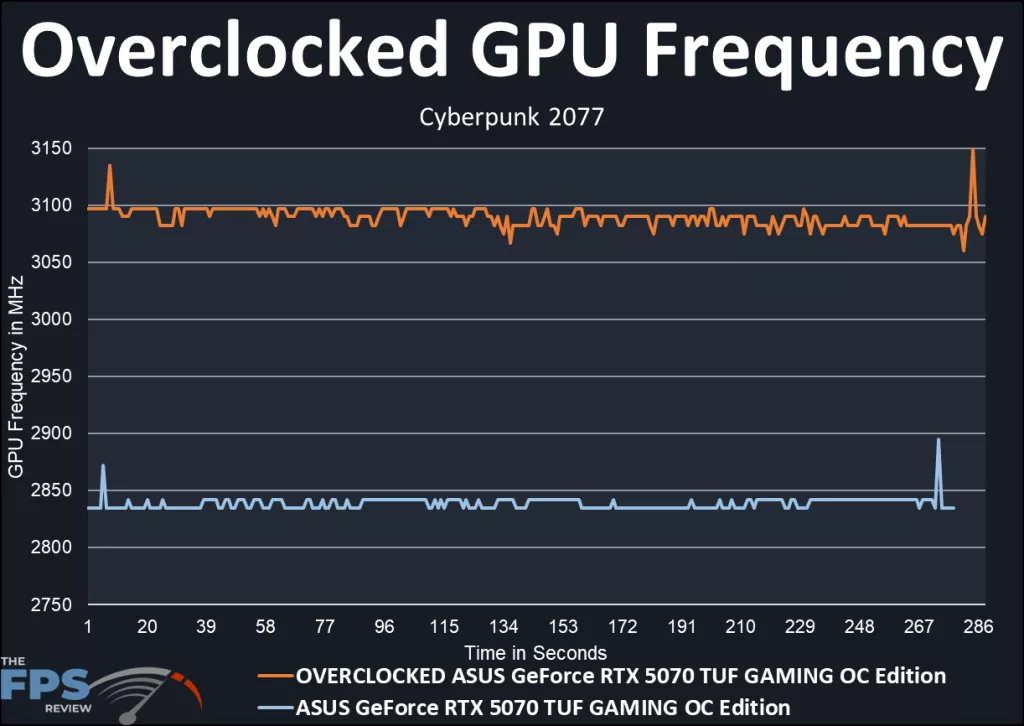
The graph above shows our results in real-time gaming. The blue line represents the default card out-of-the-box with its factory overclock of 2610Mhz. One can see the Boost clock is well above that at an average of 2,839MHz or 8% over the reference Boost. The orange line is our achieved overclock.
The average Boost overclocked is 3090MHz. This value is 8% over the real-time Boost. That’s pretty darn good right there. All in all, we were able to achieve a Boost clock 23% over the NVIDIA reference Boost clock and 8% over the real-time factory overclock out-of-the-box. We will have to see how that correlates with real-time gaming results, but all in all, this card is a pretty good overclocker. The bonus is the cooling is superb, and the fans remained silent. We did not have to adjust the fan cycle from default.
Discussion (9 replies)
Join Discussion →Man I have a ruff time wondering why people would by this over a 9070 or even a 9070xt.
I agree. Now that the 9070XT is out, the choice is obvious, especially if you dont care about ray tracing. But....thats the deal and it is the pinnacle of graphics in the right games. What we dont talk much about though is turning on DLSS4 and jacking up FrameGen to 4x. That is the game changer for the 5070. Yeah....but....its.....fake....frames....I dont care. It takes a game the card cant handle and lets you play it. Ive done it in a bunch of ray traced games and the technology is pretty amazing. Isnt that what we are all about? Improving technology? I mean, overclocking is just brute force DLSS and we all think that is fine and dandy. Circling back...in plain raster, 9070XT at 1440 is the schizzle, hands down.
I have nothing against MFG in games. My problem is while it might be an non issue in a lot of games... and look/work just fine. The latency it introduces to controls for people that don't realize that will hurt them. Sure they will learn... but then enters buyers remorse.
Alternatively... I've seen some interesting tech in use where people are using their ADM card for raster then an NVidia card for MFG on top of it... it's kind of bonkers.... very hit or miss... but would be cool if that could work. high frame rate base game with MFG tacked on could be a great experience all around.
The problem is, it too is expensive, and not at MSRP, with rumors that pricing on the 9070/XT will actually not be MSRP, but higher, in the next couple of months it's all a wash. The prices fluctuating on both ends, is a problem for everyone. It's very uncertain times. So in a perfect world, at MSRP, I might agree with you, but if the 9070/XT is also very inflated on pricing, then, well, /shrug
I dont think thats a fair assumption.
You cant base your purchase on rumors.
I dont care if the two cards cost the same. The new AMD cards are very good and the nvidia cards at the low end arent. About all nvidia has is the improvement in DLSS and everybody has big hate for that, instead of congratulations for pretty amazing technology.
Unfortuntely, all the cards are out of stock right now, so we don't know what the available price actually is for the 9070/XT either. If you look at PC Part Picker, any 9070s showing in stock are above $700, up to $850, and that's just for the 9070 model, ouch.
It is not really an assumption, it's a given right now that AMD's GPUs are not going to be MSRP pricing. They are in fact, marked to go up in pricing; that is pretty much confirmed.
It truly is uncertain on both sides, not great for the consumer sadly. I've said it before, GPU MSRP is a construct, and that is truly the sad state of affairs.
As for features, I would argue NVIDIA has the upper-hand in the DLSS Upscaling department, DLSS 4's Transformer model is amazing for Upscaling quality and beats AMD's FSR 4 implementation in quality, plus DLSS is simply integrated in more games than FSR 4 currently. Frame Generation's usefulness aside, NVIDIA does hold a win in DLSS Upscaling and FG image quality currently.
While AMD has improved in RT performance, our testing does show NVIDIA holds the win in RT performance still as well.
A big advantage red team, though, is the 16GB VRAM buffer on the 9070. The 5070's 12GB is not acceptable.
I agree with everything and if you're doing online video calls off of your gaming box... the broadcast suite offered by Nvidia is also very nice. Though animated backgrounds and AI eye attention being turned on kills 6 gig of vram (work laptop) it does work.
I grabbed the TUF 5070 OV to replace my EVGA 3070FTW and do not regret it.. I probably will 10 months from now but maybe not.
Price was solid around $600 and as much as I should of sprung for the TI model im still happy.
Overall it smashes my old 3070 I used for 3 years and that 3070 gave me countless hours of 1440p gaming. But it would struggle with RT On with higher settings. The 3070 was sliding by with some Vaseline for 4K on my cheap tv.. mostly slow clickers and lighter titles. But it still played Hogwarts and sorts well with low or no RT.
This 5070 is the first time I've ever had a current card and it proved true. As much as I thought about finding a 4070TI or even the 5070TI I thin I will be okay for a bit, much better then I was with the 3070.
I havent even thought about using the Tweak app to OC yet. I am pretty happy with all my favorite and newer games. I'll be playing mostly 1440p unless I find a fun action game or something like GoW Ragnorak with a controller.
Like I said I could regret it a few months down the road but I am tired of seeing items go out of stock and rising prices. Figured grab it now and make the best of it and so far so good.
I like the basic design and this GPU runs a lot cooler and quieter then the 3070. My 3070 would only get loud when pressed but it did get warm around 80c. Those same games and scenarios the 5070 laughs staying fairly cool around 60c, I did see it climb to about 70c after an hour or two of Ragnorak or something.
I am also not used to being able to use native settings as my 3070 was always relying on the DLSS.
Idk about the AMD competition I do know the one model offered more speed and power for possibly cheaper but I've used nvidia for 20+ years and always been happy.
Also my first non EVGA GPU since BFGTech was around. ASUS is my go to for motherboards w the ROGs and this card just looked and felt right.
Need to pour one out for both of those names.