
AMD FSR Ray Regeneration Performance
AMD FSR Ray Regeneration is only supported in Call of Duty: Black Ops 7 at this time. In this game, Ray Regeneration is only functional in the multiplayer mode. This game does have a built-in benchmark in the multiplayer mode, and thus, we are using it for our benchmarking today.
Ray Regeneration is AMD’s method for Machine Learning Ray Tracing denoising. Instead of using the game’s built-in denoiser for Ray Tracing, an ML-model is used on the GPU that aims to improve Ray Tracing image quality. The goal of Ray Regeneration, or any AI-powered denoiser, is to improve image quality, and not necessarily improve performance. Using NVIDIA’s Ray Reconstruction, we did find that it often had a positive benefit of providing a slight performance improvement using it anyway. While it isn’t meant to be there to improve performance, it often did in our testing. We are therefore interested in finding out if AMD’s Ray Regeneration will improve performance or if it will harm performance.
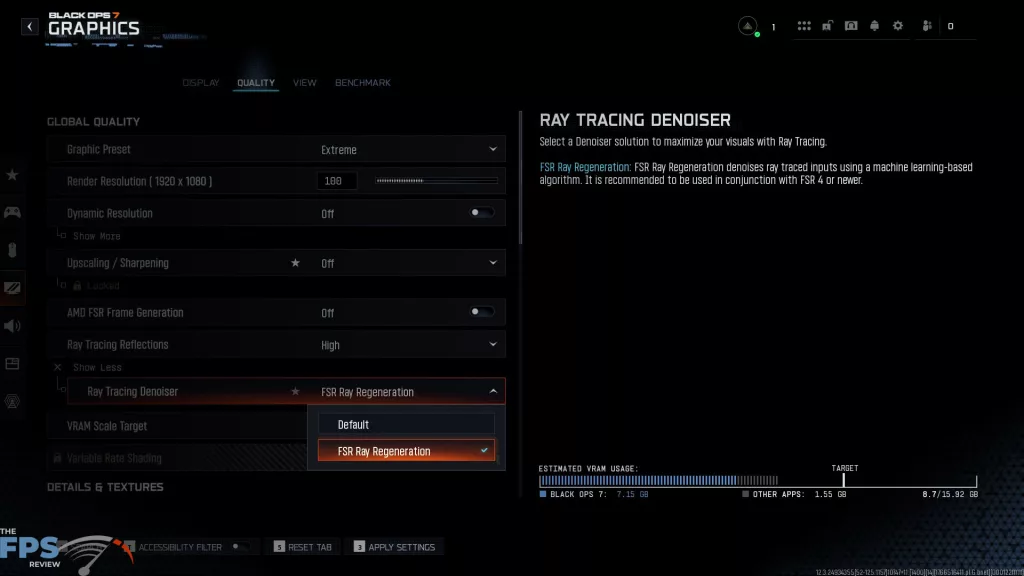
The goal of this testing below is to strictly look at the performance impact that turning on AMD FSR ML-Ray Regeneration has on game performance. Under the Quality settings, there is a drop-down menu for “Ray Tracing Reflections”; turning this to “High” will reveal the denoiser options below it when you click “Show More.” Under that is the “Default Denoiser” or “FSR Ray Regeneration”. For our testing, we simply toggled between the Default Denoiser and FSR Ray Regeneration to see the performance impact on each video card. We do have Variable Rate Shading disabled for apples-to-apples comparisons, but otherwise, we are using the Extreme preset.
AMD Radeon RX 9070 XT
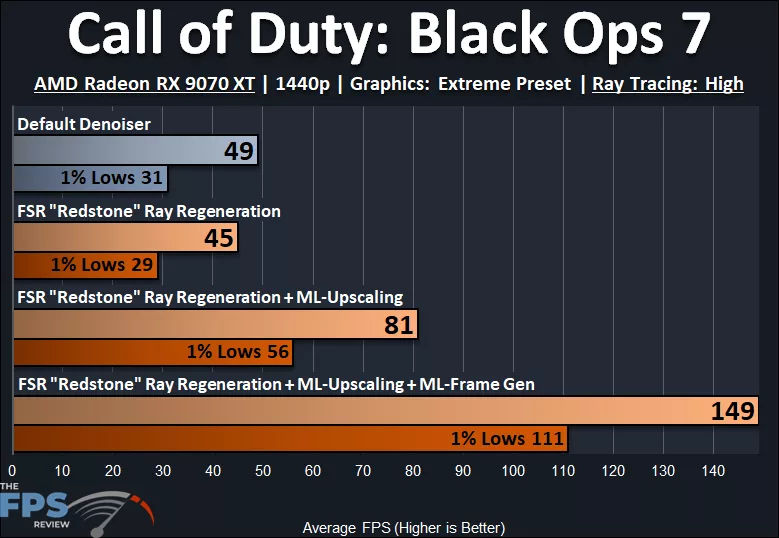
Trying to run Ray Tracing in this game at 4K on a Radeon RX 9070 XT was not a pleasant experience, so we dropped the resolution down to 1440p on the Radeon RX 9070 XT. The blue bar represents native resolution 1440p and the Default Denoiser, and you can see that with High Ray Tracing it is producing 49FPS AVG and 1% Lows at 31FPS, so the game is not playable with High RT. In the next bar down, we are simply enabling the new AMD FSR ML-Ray Regeneration, and we can see that it drops to 45FPS AVG and 29FPS for 1% Lows. That is a performance drop of 8% on the AVG and 6% on the 1% Lows. The game is not playable.
In the next bar down, we are enabling AMD FSR Redstone/FSR 4 ML-Upscaling with Ray Regeneration. This greatly improves performance, the AVG increases 80% to playable levels, and the 1% Lows increase 93%, but are still under 60FPS, which is not great. On the bottom bar we are enabling ML-Frame Generation, and ML-Frame Gen has improved smoothing by 84%, and 1% Lows have improved by 98%.
It is important to keep in mind that this is a built-in benchmark and does not represent actual in-game gameplay. When game input is taken into account, in actual gameplay, the 1% Lows and performance overall with Frame Generation, particularly, may be different. This is a ‘best-case’ scenario of Ray Regeneration performance with ML-Upscaling and ML-Frame Gen.
AMD Radeon RX 9070
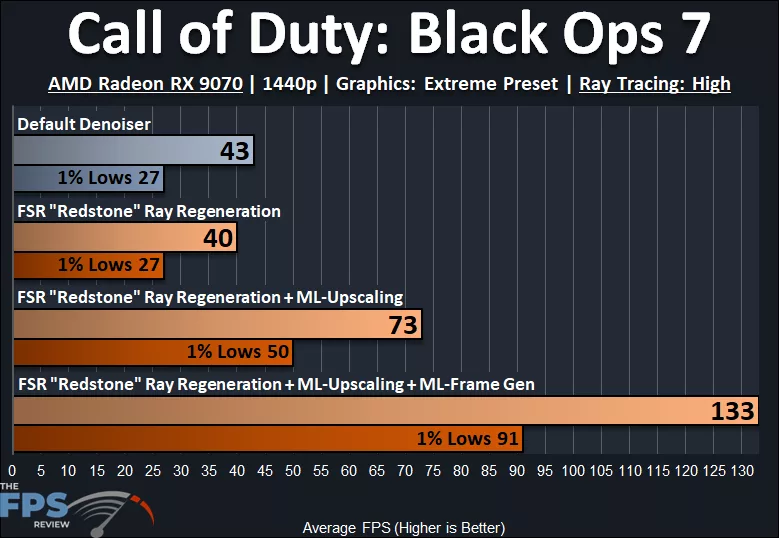
With the AMD Radeon RX 9070, we kept the resolution at 1440p on the Extreme preset and native resolution. With the Default Denoiser, performance is 43FPS AVG and 27FPS 1% Lows, and not playable. When we enable the FSR Redstone ML-Ray Regeneration, we see a performance drop of 7% on the AVG, and the 1% Lows stay the same in this scenario.
When we enable ML-Upscaling, we see a performance increase of 83%, taking the AVG to 73FPS, and the 1% Lows increase by 85%, but at 50FPS it isn’t near playable. When we further enable ML-Frame Gen, the smoothness increase is 82%, and the 1% Lows improve by 82%.
AMD Radeon RX 9060 XT
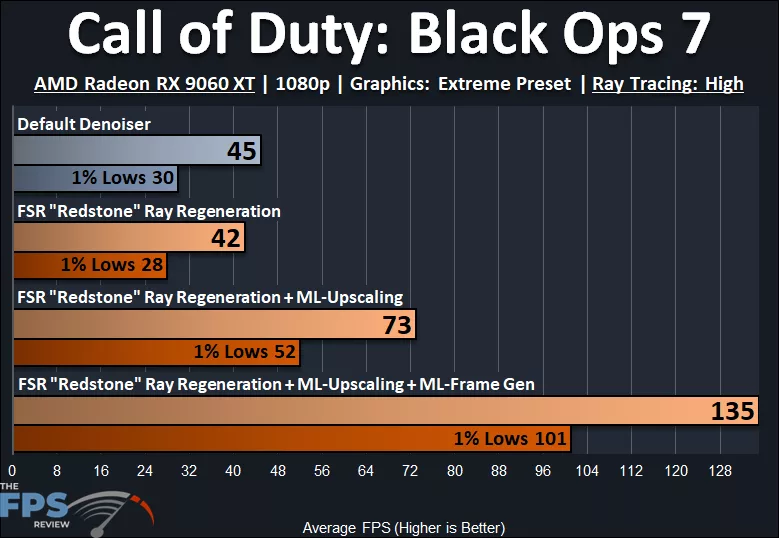
With the AMD Radeon RX 9060 XT, we dropped the game down to 1080p on Extreme settings. At native resolution with the Default Denoiser, the Radeon RX 9060 XT produces 45FPS AVG and 30FPS 1% Lows, and the game is not playable with RT. When we enable the FSR Redstone ML-Ray Regeneration performance drops by 7% on AVG and 7% on 1% Lows. When we enable ML-Upscaling, performance increases by 74%, and the 1% Lows increase by 86%. When we enable ML-Frame Gen, the smoothness increases by 85%, and the 1% Lows increase by 94%.