

Google debuted Project Genie last week, and not long after, multiple video game publishers saw stock prices drop. Based on Genie 3, the generative AI solution allows users to give text descriptions or upload images to generate photorealistic environments, which can be explored in real-time. Project Genie’s release could very well end up being the snowflake to trigger an avalanche within the gaming industry as the next level of Artificial General Intelligence (AGI).
“World models use their deep understanding of physical environments to simulate them. Genie 3 represents a major leap in capabilities – allowing agents to predict how a world evolves, and how their actions affect it.”
-Google
In a somewhat unexpected twist, videogame publishers CD PROJEKT, NINTENDO, ROBLOX, TAKE-TWO, and Unity all saw their stock prices drop right after the release of Project Genie. As reported by VGC (via Nasdaq), Unity’s shares saw the largest drop of roughly 35%.
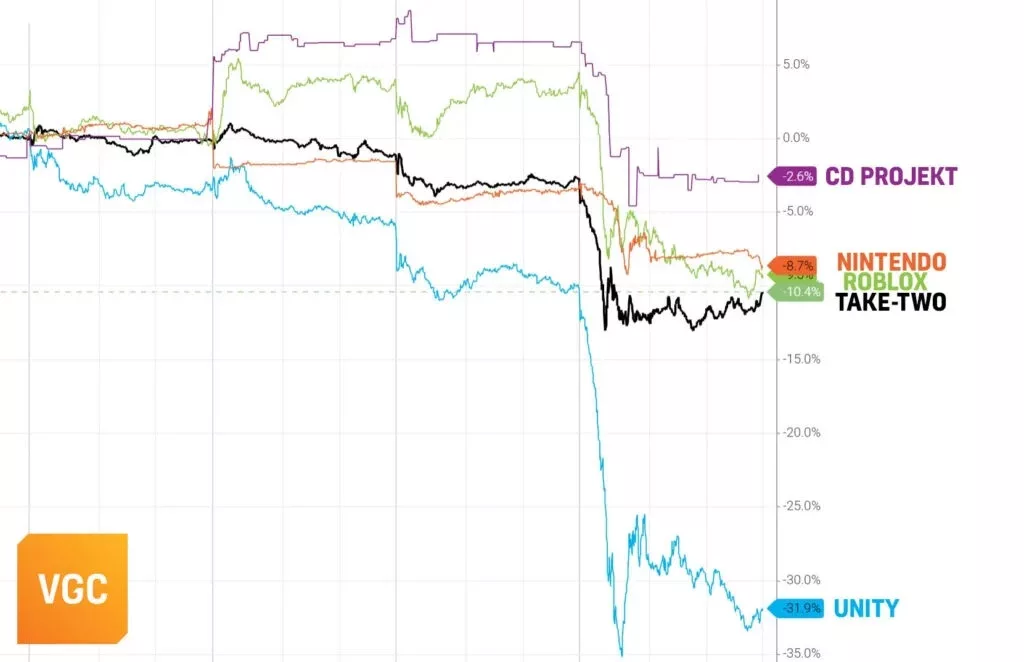
Should video game publishers and their stakeholders be worried, well probably not, but they ought to at least be paying attention. Google Lab’s solution is still in its infancy, but it is among a growing list of online services that offer users the ability to create content using minimal skills. While Project Genie is being noticed for its ability to create explorable world environments and incorporate player avatars/characters, it still has very real limitations. It should also be noted that Disney recently embarked on a slightly similar venture with its billion-dollar investment into OpenAI by allowing Sora to be used for creating short videos with its licensed Marvel, Star Wars, and Pixar IPs.
Meanwhile, Unity’s CEO Matthew Bromberg is taking these turn of events in stride and, rather than shrinking away in fear or lashing out in anger against them, has stated a silver lining exists here while also pointing out the pros and cons of current AGI limitations. The lengthy 300+ word post is a good read and clarifies that the Unity Engine already integrates AI-driven content creation via its human creators for world models.
Folks. Can I explain something about world models? Seems like today might be a good day for that.
— Matthew Bromberg (@MBromberg) January 30, 2026
Advances in large-scale “world models” — whether developed by partners like Google or others — materially expand the frontier of interactive content creation. These models can…
“As a result, world models expand content supply and reduce development friction, while Unity remains the system of record for runtime, distribution, and long-term operations. This dynamic broadens Unity’s addressable market and reinforces its central role in the interactive ecosystem.”
– Matthew Bromberg, Unity CEO