
The chip enthusiast community has been waiting on this one since last year, and AMD finally pulled the trigger today. The Ryzen 9 9950X3D2 Dual Edition is officially real, officially named, and officially coming April 22, 2026. It is the first desktop processor to place AMD’s 3D V-Cache stacking on both core complex dies simultaneously, and the cache numbers alone are enough to make any PC builder sit up a little straighter.
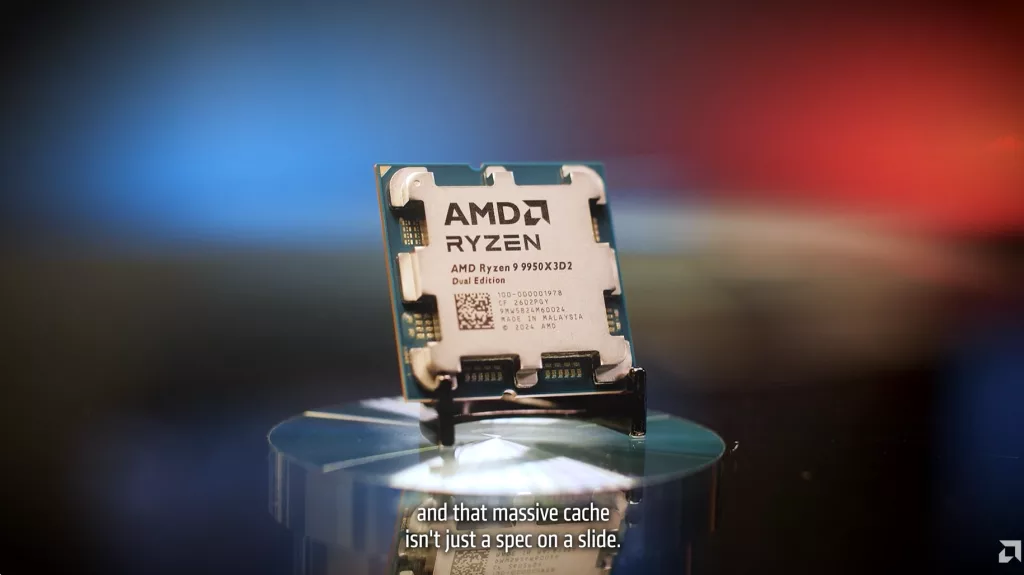
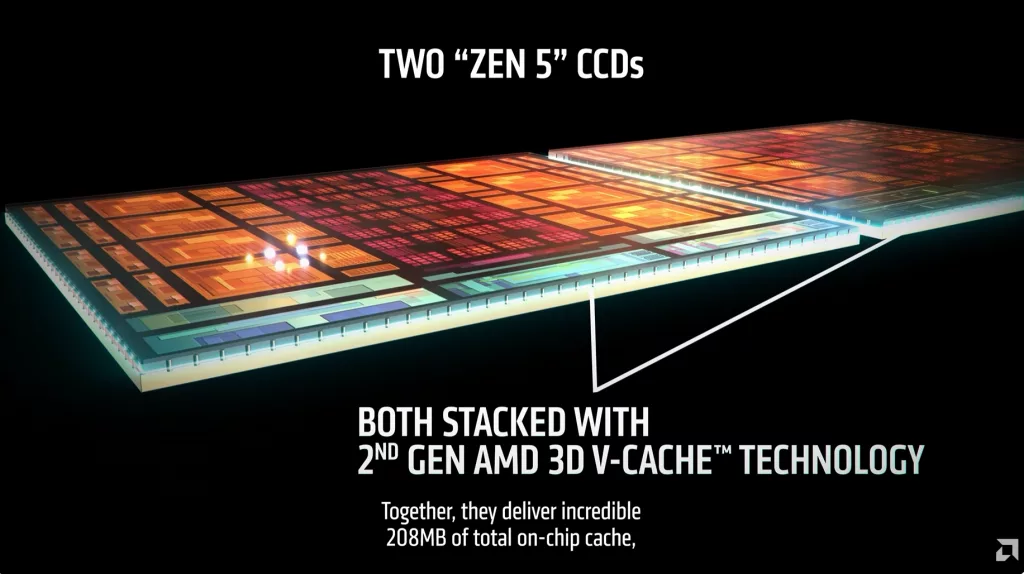
The 9950X3D2 Dual Edition is a 16-core, 32-thread Zen 5 processor built for the AM5 socket, which puts it in familiar territory for anyone who already owns a 600 or 800 series board. What separates it from the existing Ryzen 9 9950X3D is the second cache stack. Where previous high-end X3D parts applied 3D V-Cache to only one CCD, leaving the other chiplet to fend for itself in terms of cache bandwidth, the 9950X3D2 Dual Edition stacks 104MB of 2nd Gen 3D V-Cache onto each CCD. Total on-chip L3 cache lands at 192 MB per the spec sheet, with AMD quoting 208 MB as the full figure including all cache levels. Either way, it is the most cache ever crammed into a Ryzen desktop processor, and it is not particularly close.
| Specification | AMD Ryzen 9 9950X3D2 | AMD Ryzen 9 9950X3D | AMD Ryzen 7 9850X3D | AMD Ryzen 7 9800X3D |
|---|---|---|---|---|
| CPU Family | AMD Ryzen 9000 Series (Granite Ridge) | AMD Ryzen 9000 Series (Granite Ridge) | AMD Ryzen 9000 Series (Granite Ridge) | AMD Ryzen 9000 Series (Granite Ridge) |
| Model Number | Ryzen 9 9950X3D2 | Ryzen 9 9950X3D | Ryzen 7 9850X3D | Ryzen 7 9800X3D |
| Release Date | 03/26/2026 | 03/12/2025 | 01/29/2026 | 11/07/2024 |
| MSRP | $ 699 | $ 499 | $ 479 | |
| Total Cores | 16 | 16 | 8 | 8 |
| Total Threads | 32 | 32 | 16 | 16 |
| Base Clock | 4.3 GHz | 4.3 GHz | 4.7 GHz | 4.7 GHz |
| Boost Clock | 5.6 GHz | 5.7 GHz | 5.6 GHz | 5.2 GHz |
| L1 Cache | 1280KB (80KB per core) | 1280KB (80KB per core) | 640KB (80KB per core) | 640KB (80KB per core) |
| L2 Cache | 16MB (1MB per core) | 16MB (1MB per core) | 8MB (1MB per core) | 8MB (1MB per core) |
| L3 Cache | 192 MB | 128 MB | 96 MB | 96 MB |
| Total Cache | 208MB | 145.MB | 104.6MB | 104.6MB |
| TDP | 200 W | 170 W | 120 W | 120 W |
| Max Junction Temp | 95 °C | 95 °C | 95 °C | 89 °C |
Clock speeds come in at a 4.3 GHz base with up to 5.6 GHz boost. That boost figure is 100 MHz lower than the standard 9950X3D, which traded some clock headroom for the thermal demands of the additional cache stack. TDP is rated at 200W, making it the highest-draw AM5 processor to date, and AMD is explicitly recommending a liquid cooler. The chip is manufactured on TSMC’s 4nm FinFET node for the compute dies and 6nm for the I/O die, and it supports DDR5 memory up to DDR5-5600 in dual-channel configurations (this is official speed, not what you’ll be able to get with EXPO), with ECC support (motherboard dependent). PCIe 5.0 lanes, overclocking support via Precision Boost Overdrive, Curve Optimizer, and AMD EXPO are all present.
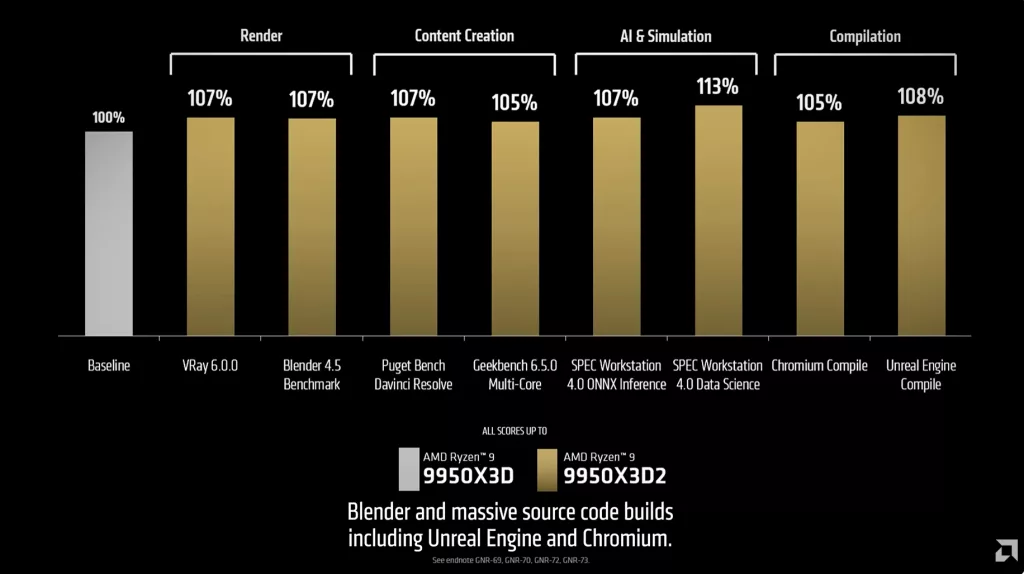
AMD is positioning this as a chip for creators and developers rather than pure gaming, though gaming performance should also benefit from eliminating the latency penalty that comes when a game thread running on the non-cached CCD of a standard 9950X3D has to reach across to the other chiplet’s cache. The company’s own benchmarks show gains of 5 to 13 percent over the 9950X3D in workstation-class tasks including V-Ray, Blender, DaVinci Resolve, Unreal Engine, and large-scale source code builds like Chromium. As AMD Senior VP Jack Huynh put it in the announcement video, “208MB of cache means more game data, more assets, and more working data sitting right next to the CPU cores.”
Pricing has not been announced. The Ryzen 9 9950X3D is currently pricing out around $675, so we’d expect the 9950X3D2 Dual Edition to land a bit higher than that.
This chip was a long time coming. We started reporting on rumors of this chip in the summer of last year, rumors continued to swirl through CES and popped up yet again a few days ago.
The Ryzen 9 9950X3D2 Dual Edition launches April 22, 2026. Let us know your thoughts in the forums, and stay tuned for pricing and full availability details as they emerge.