

At this point its no secret that AMD is readying refresh parts for its AM5 lineup, and now the only real question is when they will be revealed. A few weeks back, AMD accidentally listed one of the upcoming processors in release notes on a driver page, so to some degree, at least one part has had some official acknowledgement. In contrast, leaks for both have more or less detailed their general specifications. These are, of course, the 16-core / 32-thread AMD Ryzen 9 9950X3D2, rumored to feature dual caches for its CCDs with a slightly lower boost clock, and the 8-core / 16-thread AMD Ryzen 7 9850X3D, essentially a higher-clocked version of its popular Ryzen 7 9800X3D.
| Processor | Cores/Threads | Base Clock | Boost Clock | L3 Cache | TDP |
| Ryzen 9 9950X3D2 | 16/32 | 4.3 GHz | 5.6 GHz | 192 MB | 200W |
| Ryzen 9 9950X3D | 16/32 | 4.3 GHz | 5.7 GHz | 128 MB | 170W |
| Ryzen 7 9850X3D | 8/16 | 4.7 GHz | 5.6 GHz | 96 MB | 120W |
| Ryzen 7 9800X3D | 8/16 | 4.7 GHz | 5.2 GHz | 96 MB | 120W |
Benchmarks surfaced for the AMD Ryzen 9 9950X3D2 were posted online a couple of days ago, and while such things can be faked, there have been no updates since, indicating they are not legitimate. These Passmark and Geekbench scores (via VideoCardz) appear to confirm the specifications for the new flagship gaming processor, while also showing some early synthetic testing results. However, the real data is yet to be seen, as gaming benchmarks will likely reveal how much of an improvement having dual 3D caches can provide. One of the tests was reportedly done using a Galax B850M motherboard with 96 GB 4800 MT/s DDR5 (2x 48 GB) memory.
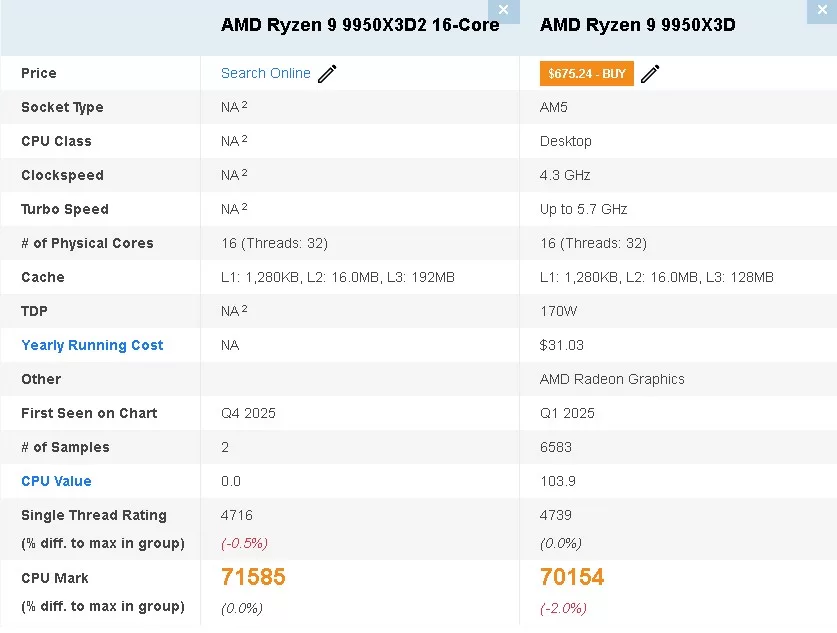
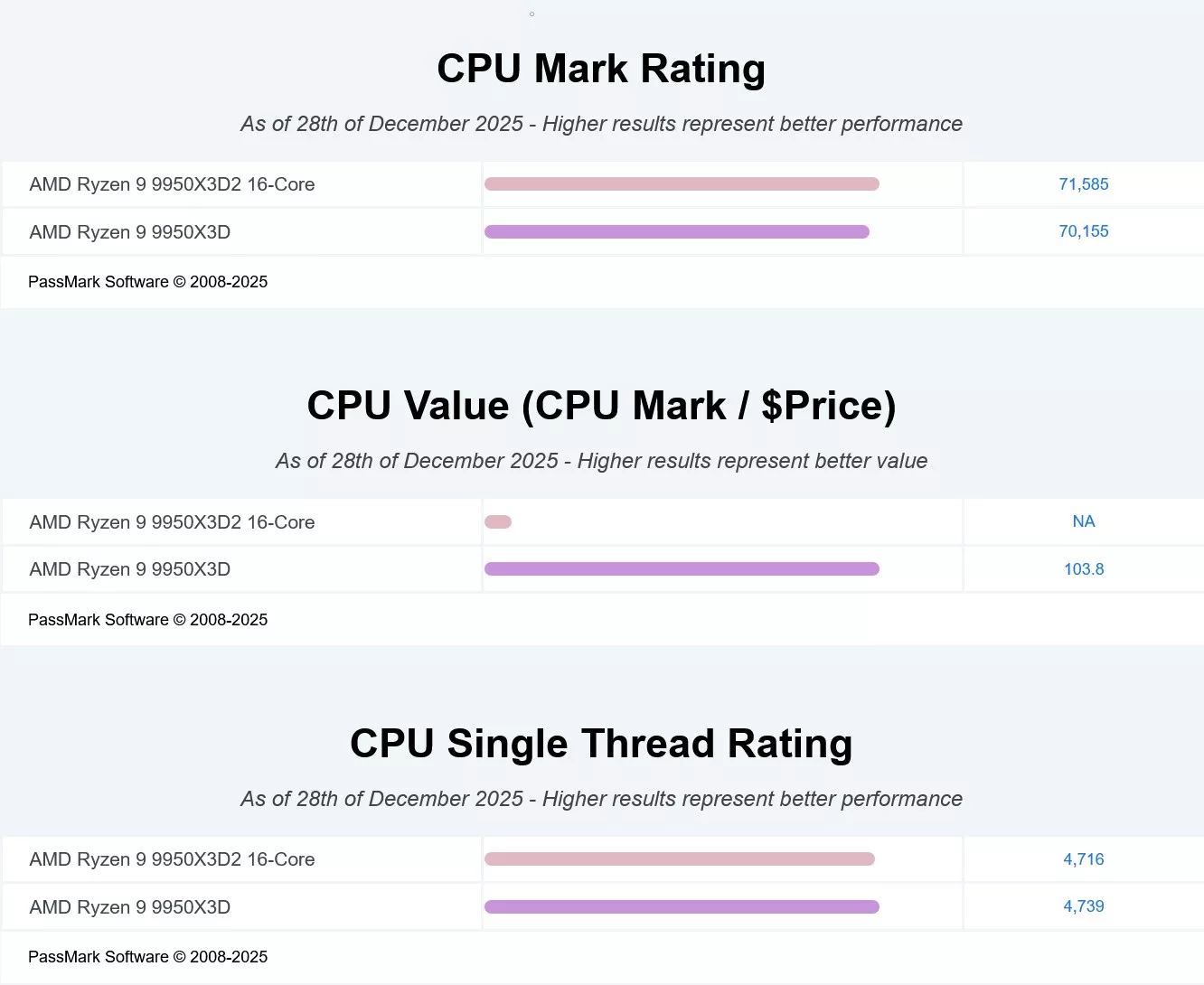
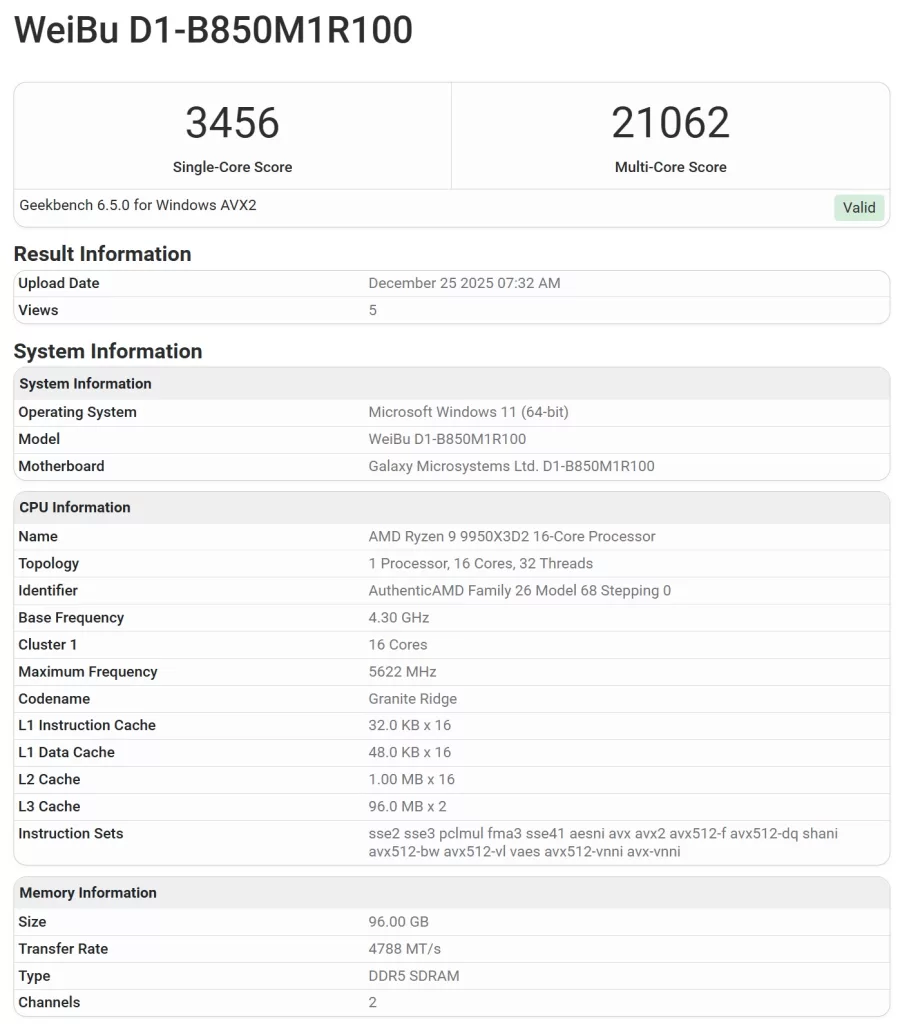
Something else to consider for those looking to compare the results of this processor with its predecessor is that we don’t yet have like-for-like system setups benchmarked in either database to really go by. There are some 9950X3D benches that are higher using 870E motherboards, and then others that are lower. Between its dual 3D cache and 100 MHz lower boost clock of 5.6 GHz, there will assuredly be a mix/match of results when more test results are posted.
Meanwhile, AMD CEO Dr. Lisa Suwill be presenting a keynote at CES 2026. While it is supposed to be focused on AI, it is hoped that AMD will officially debut these processors during this year’s event.

Discussion (13 replies)
Join Discussion →This'll be a fun one.
My bet is that... most of the folks that clamored for such a SKU will find that AMD made the correct choice by not prioritizing it. But I'm looking forward to seeing which workloads benefit do benefit.
Unless they improve the cross ccd performance I suspect gains if any will be minimal for gaming workloads.
The potential gain I see would be if the game misfires and runs off the CCD without cache, then this would fix any game misfiring off the wrong CCD at least. It's why people love the 9800X3D; they are guaranteed to always get the X3D benefits, no chance of hitting the wrong CCD.
The problem is, that this won't fix the cross-CCD issues that @Grimlakin mentioned.
Like yeah, if the threads assigned to different CCDs don't need to talk to each other too much, it'll help (or not hurt). But if they do?
Better to not have the second CCD in use in the first place.
AMD I think is still behind Intel in making sure that stuff goes to the best place to run it.
The gaming drivers feel solid. When I fire up a game all load moves to the x3d ccd. All other cores are parked. Basically my 16 core processor becomes 8 when I game. I would prefer the gaming load be on one ccd and non gaming on tne other... but that doesn't appear to be the case.
AMD just needs more cores per CCD
That's Zen 6, strongly rumored to be moving to 12 'large' cores per CCD from the current eight. Would also be nice to have a second CCD with Zen6c cores in a dual-CCD part, with another 16-20 cores.
That is an interesting idea. 12 large cores for 24 threads with x3d v cache. And 24 compact cores for 24 threads for light work computation. If they can identify what threads needs what processors and keep.thwt division up under heavy load that would be awesome. I just worry that the scheduler would need custom code from the processes to know.
Case in point oracle code needs special oracle firmware for large rac implementations otherwise your processor 0 gets bogged in scheduling and slows the entire rac.
It's REAL!
[URL unfurl="true"]https://www.sytronix.co.uk/workstations[/URL]
Looks like AMD may limit these to system integrators or OEMs for AI workstations :(
At least two MT tests where the increased cache may come in handy (9950X3D2 has DDR5-4800 vs. 6000) : https://browser.geekbench.com/v6/cpu/compare/15838300?baseline=15979655
They have some balls running it on an Asrock mobo :D
Yeah, I was wondering about that too. I guess it was sort of their way of external QA testing. Next test, ASUS!
Yeah, between this and last year's near-unobtanium 9955X3D mobile, that new Intel package in the ASUS NUC, which I think so far is OEM only, along with the rumor about NV bringing back the 3060, while also rumored to wind down some 50 series, manufacturers are not being straightforward about what's happening with fab orders.
At the moment, I am really beginning to think that fab order quantities are very limited and high-end CPUs will be the next thing nobody can get. Everyone is aware of the RAM situation, but not so sure how many are paying attention to this, and 2026 is looking to be a very strange year when it comes to CPUs.
This is pure speculation, but more than just a couple of coincidences happening to make me suspicious.
[URL unfurl="true"]https://www.phoronix.com/news/AMD-Ryzen-9-9950X3D2[/URL]