
Gaming Performance (A-D)
For all of our game testing, we are testing at 1440p resolution. We will test with a combination of Native Resolution and Upscaling. When using Upscaling, we are either using DLSS for NVIDIA or FSR for AMD. We have FSR 4/4.1 enabled where supported in games. The video cards being compared both run at the reference GPU speeds; we are comparing the XFX Swift Radeon RX 9070 GRE Triple Fan Gaming Edition and the NVIDIA GeForce RTX 5070 Founders Edition. We have sorted the graphs from fastest to slowest. All games are using manual run-throughs for benchmarking. Keep in mind that some games have Ray Tracing built into the game/engine, and always on, while others do not. We will have a dedicated page for games that have optional Ray Tracing settings to enable.
Alan Wake 2
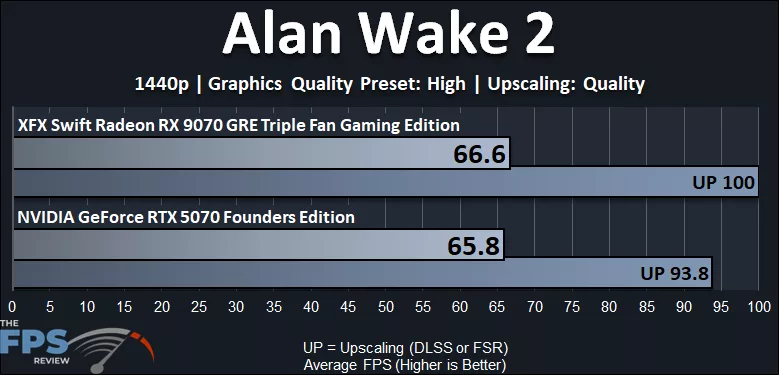
In Alan Wake 2, the Radeon RX 9070 GRE allows a playable gameplay experience at native resolution 1440p above 60FPS, and with FSR up to 100FPS. The Radeon RX 9070 GRE is 1% faster than the GeForce RTX 5070 at native resolution, and practically both video cards are equal in performance in this game, with the same experience.
Battlefield 6
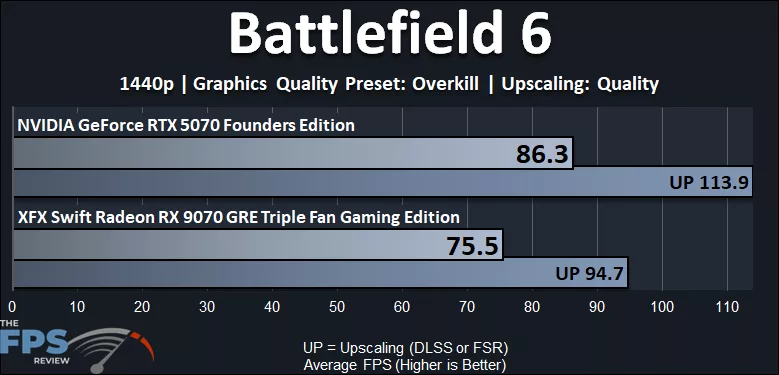
In Battlefield 6, the tide shifts in favor of the GeForce RTX 5070, outperforming the Radeon RX 9070 GRE. However, the Radeon RX 9070 GRE does still deliver a playable experience at 1440p native resolution at 75FPS average, and with Upscaling at 94FPS. The GeForce RTX 5070 is technically faster by 14%.
Black Myth Wukong
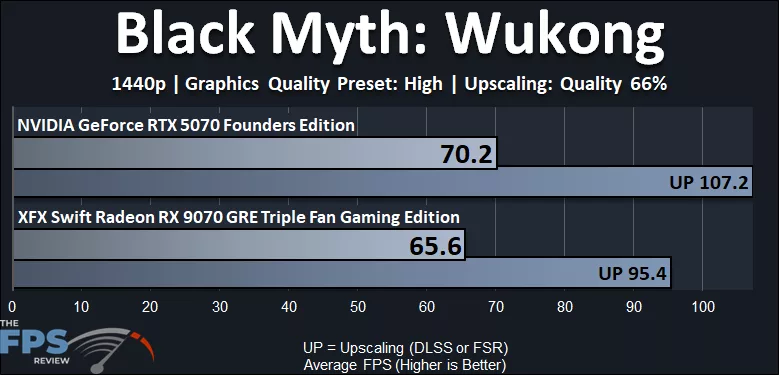
In Black Myth Wukong, we had to drop the game to “High” quality graphics at 1440p native resolution in order to find a playable experience on both video cards. At “High” the Radeon RX 9070 GRE does offer a playable experience right above 60FPS at native resolution 1440p, and with Upscaling, that is a smooth 95FPS. The GeForce RTX 5070 is faster, but only slightly, about 7% on average.
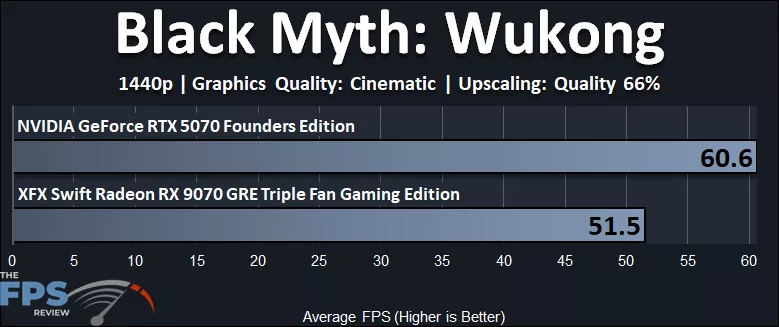
We also wanted to show you what performance in this game looks like at 1440p on “Cinematic” game quality, but with Upscaling (DLSS/FSR) enabled as well. The GeForce RTX 5070 can maintain a playable experience at 60FPS in Cinematic with DLSS Upscaling enabled, while the Radeon RX 9070 GRE cannot. The GeForce RTX 5070 is 18% faster in this scenario.
Clair Obscur: Expedition 33
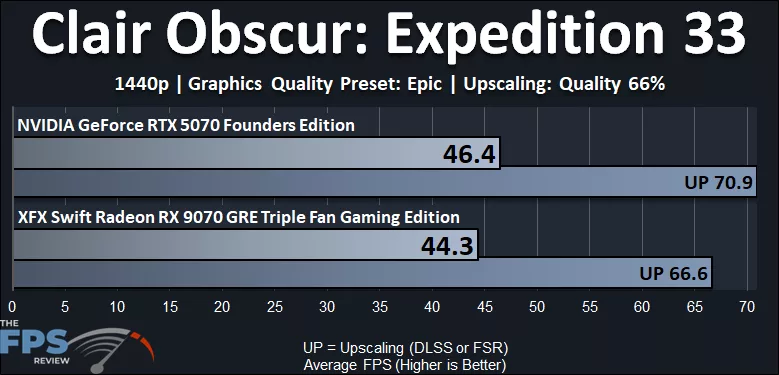
In Clair Obscur: Expedition 33, both video cards are closer in performance at the “Epic” game setting. In this game, “Epic” is not playable on either video card at native resolution. It does require that DLSS or FSR Upscaling be utilized to get a playable framerate above 60FPS, of which the Radeon RX 9070 GRE is then playable. The GeForce RTX 5070 is 5% faster at native resolution and 6% faster with Upscaling enabled compared to the Radeon RX 9070 GRE.
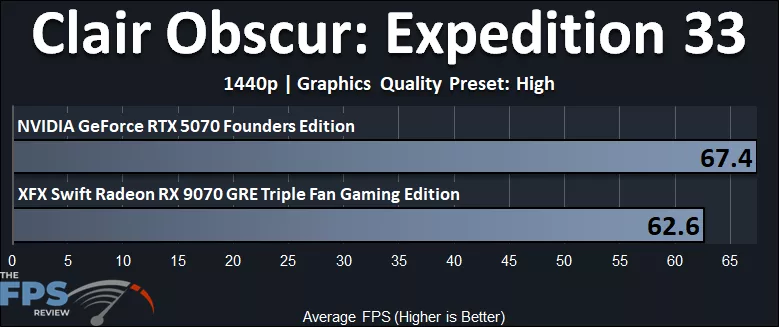
We also wanted to show you what turning down the game settings to “High” looks like at Native Resolution, no Upscaling at all. Here, both video cards are playable at native resolution, and the GeForce RTX 5070 is 8% faster than the Radeon RX 9070 GRE.
Crimson Desert
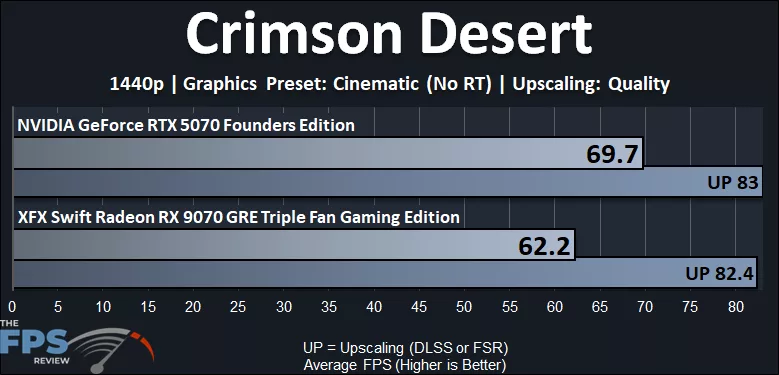
Note that for Crimson Desert, we have run all new refreshed results that are using the new 1.11.00 patch version. In Crimson Desert, we are running the game at the highest “Cinematic” quality, but we have disabled the Ray Tracing options for this rasterization test. Both video cards are playable at 1440p native resolution, just edging out 60FPS, and with Upscaling, both are at the same 80+FPS range. The GeForce RTX 5070 is 12% faster than the Radeon RX 9070 GRE at native resolution.
Cyberpunk 2077
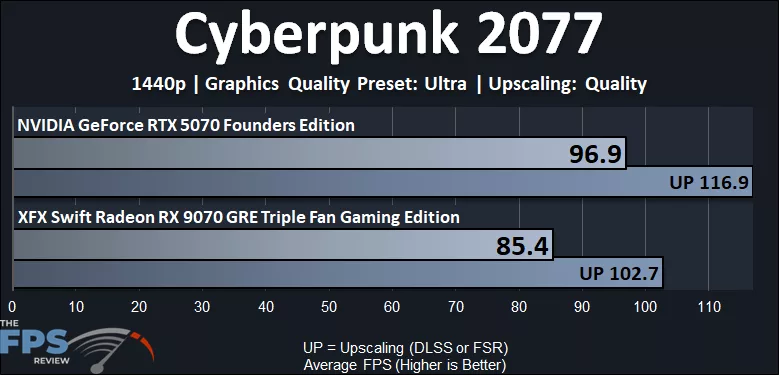
In Cyberpunk 2077, both video cards are playable at 1440p native resolution with high framerates, and Upscaling only helps further. The GeForce RTX 5070 is the clear performance master in this game; however, with a larger advantage of 13% to the average framerate.
Doom: The Dark Ages
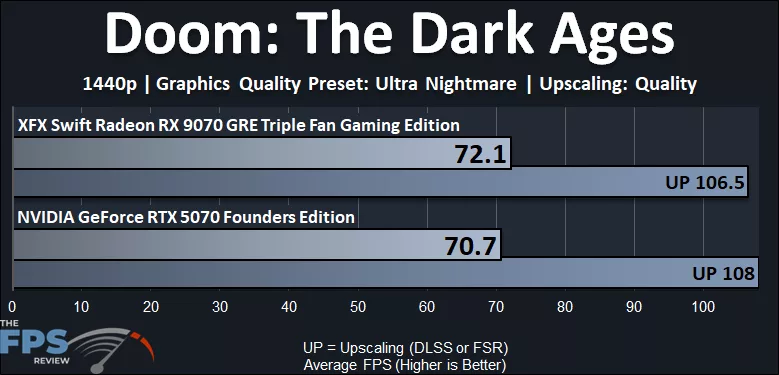
The favor swings back to the Radeon RX 9070 GRE in Doom: The Dark Ages, with it performing 2% faster than the GeForce RTX 5070. The gameplay experience between the video cards is the same in this game; however, with both offering a playable experience at native resolution, and upscaling only helps further.
Discussion (2 replies)
Join Discussion →Seems a solid card right until you get into reflections and such. Still, lets hope the driver/interface suite gets better too!
apparently the 9070 gre runs into vram limitations at 1440p
[embedded media]