
Ray Tracing Game Performance
On this page, we are going to look at games where we can optionally enable Ray Tracing-specific features, and turn them ON to see how Ray Tracing performance lines up. Keep in mind, some of the games on the previous pages had baked-in Ray Tracing, such as Unreal 5’s Lumen, or custom engines. Now, however, we are going to enable the Ray Tracing options in games that have them in our testing suite.
For all of our game testing, we are testing at 1440p resolution. We will test with a combination of Native Resolution and Upscaling. When using Upscaling, we are either using DLSS for NVIDIA or FSR for AMD. We have FSR 4/4.1 enabled where supported in games. The video cards being compared both run at the reference GPU speeds; we are comparing the XFX Swift Radeon RX 9070 GRE Triple Fan Gaming Edition and the NVIDIA GeForce RTX 5070 Founders Edition. We have sorted the graphs from fastest to slowest. All games are using manual run-throughs for benchmarking.
Alan Wake 2
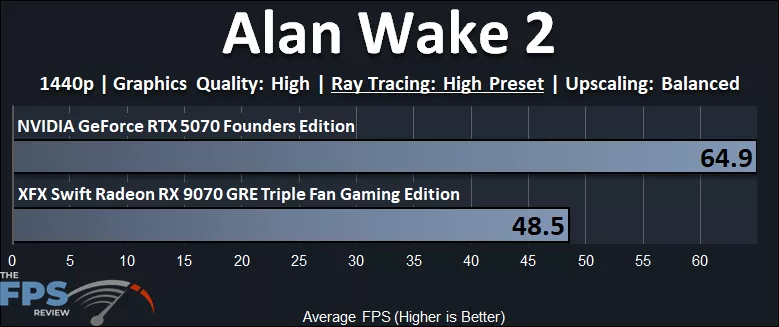
Turning on the “High” Ray Tracing Preset in Alan Wake 2 at 1440p with Quality Upscaling puts a great demand on the GPUs. The AMD Radeon RX 9070 GRE struggles and barely provides a playable experience in this particular game. The GeForce RTX 5070 handles it a lot better and is playable above 60FPS. The GeForce RTX 5070 is 34% faster than the Radeon RX 9070 GRE with High Ray Tracing.
Black Myth: Wukong
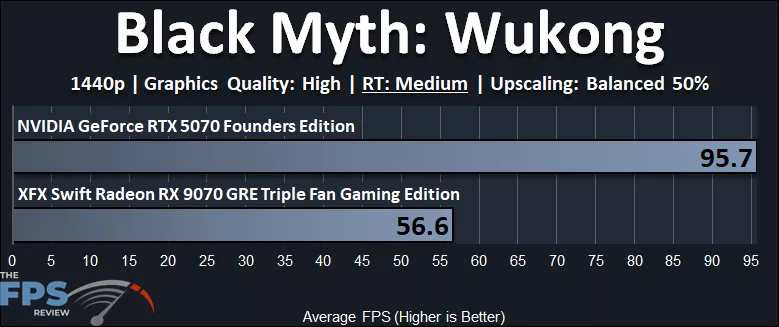
For Black Myth: Wukong, we are running the game at the “High” quality setting, and we have turned on only “Medium” Ray Tracing, as anything greater was too demanding. In addition, we did have to enable a more aggressive Upscaling quality mode, using “Balanced” Upscaling. The Radeon RX 9070 GRE struggled, and even with FSR at “Balanced,” couldn’t reach 60FPS. The GeForce RTX 5070, on the other hand, at the same settings, was a whopping 69% faster. We could either run a “Quality” DLSS with it, or we could enable some higher graphics settings on the GeForce RTX 5070; we had more headroom.
Crimson Desert
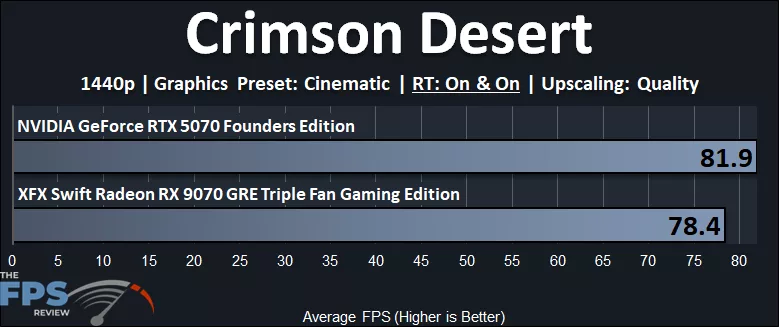
In Crimson Desert, we have enabled both Ray Tracing options shown in patch 1.11.00, but Ray Reconstruction and Ray Regeneration are NOT enabled as both tanked performance. We also have DLSS and FSR Upscaling enabled. Both video cards deliver a playable experience, and the GeForce RTX 5070 is 4% faster than the Radeon RX 9070 GRE.
Cyberpunk 2077
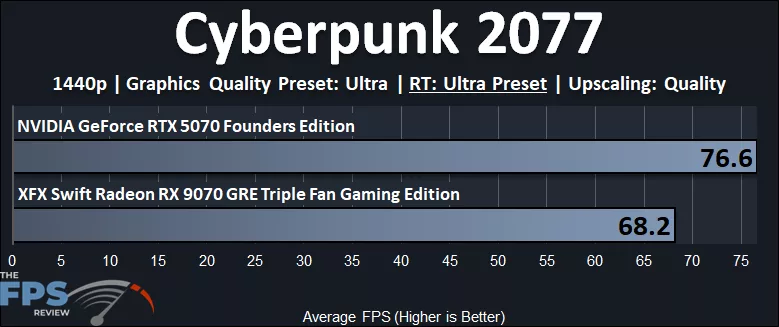
In Cyberpunk 2077, we can run the “Ultra” Ray Tracing option with DLSS or FSR Quality Upscaling enabled and get a playable experience, even on the Radeon RX 9070 GRE. The GeForce RTX 5070 does allow a faster, smoother, and better experience, though with 12% more performance.
Dying Light: The Beast
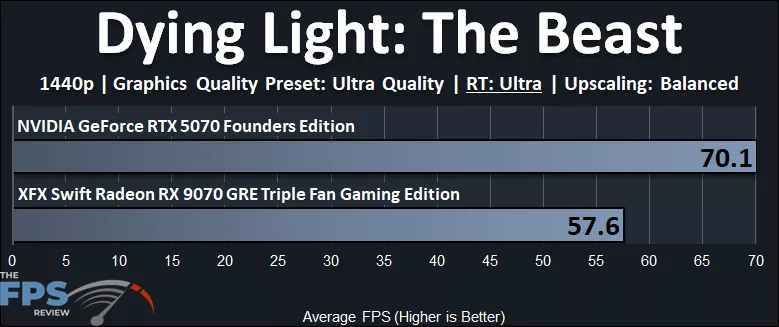
Turning on the “Ultra” Ray Tracing in Dying Light: The Beast was very demanding on graphics performance, even though we did have DLSS/FSR Quality Upscaling enabled. The Radeon RX 9070 GRE struggled the most and wasn’t playable at 1440p. The GeForce RTX 5070 performed much more smoothly and was 22% faster.
Resident Evil Requiem
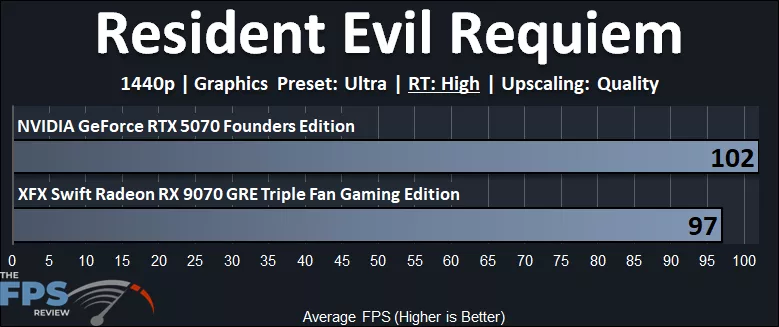
In Resident Evil Requiem, we had no trouble with “High” Ray Tracing on either video card at 1440p with Quality Upscaling. The GeForce RTX 5070 is only 5% faster than the Radeon RX 9070 GRE. This game is well optimized with Ray Tracing.
Discussion (2 replies)
Join Discussion →Seems a solid card right until you get into reflections and such. Still, lets hope the driver/interface suite gets better too!
apparently the 9070 gre runs into vram limitations at 1440p
[embedded media]